I was standing over a glazed blade, the saw screaming and the cut not moving, when I finally did the math on what that “cheap” blade was really costing me per inch. The sticker price on a diamond blade is a lie. The real cost is what you pay per foot of cut and the wrong blade can triple that number before you finish your first slab.
Key Takeaways
- Bond hardness must match aggregate: hard aggregate (flint, quartz) needs a soft bond; soft aggregate (limestone) needs a hard bond.
- Dress a glazed blade by cutting asphalt or a dressing stone to expose fresh diamonds.
- Wet cutting extends blade life and controls silica dust.
- Use the cost-per-cut calculator to compare true blade value, not sticker price.
- A turbo rim blade balances speed and finish for most daily concrete cutting.
This guide is built on field testing and real-world performance data, not manufacturer marketing. It walks you through a step-by-step selection process that eliminates guesswork by matching blade to aggregate and saw. Interactive tools (a cost-per-cut calculator and an aggregate identifier) help you make data-driven decisions.
But before you pick a blade, you need to understand the grinding principle that makes every other decision possible.
How Diamond Blades Work: Grinding, Not Cutting
Every minute a blade spins without cutting is money out of your pocket, and the same applies when you use diamond core drilling bits. The wrong diamond blade doesn’t just slow you down. It chews through your budget.
The Grinding Principle
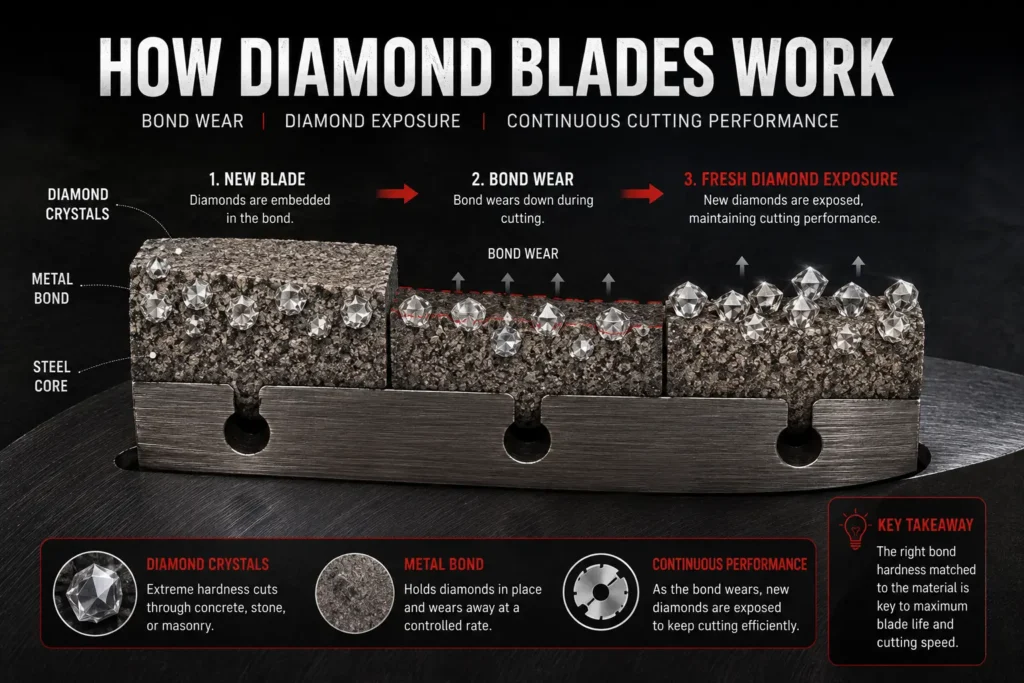
Diamond blades don’t saw through concrete; they grind it. Exposed diamond crystals scratch and abrade the surface as the blade spins. The metal bond that holds the diamonds wears away at a controlled rate, continuously exposing fresh, sharp diamonds. This self-sharpening cycle is what keeps the blade cutting.
Why This Matters for Blade Life and Speed
Here’s the catch: bond hardness must match the aggregate. A soft bond on hard aggregate like flint wears too fast, shedding diamonds before they can work. A hard bond on soft aggregate like limestone won’t erode enough, burying the diamonds and glazing the blade. Both kill productivity. We’ve learned the hard way that a blade’s “universal” claim is a lie. On a flint-aggregate driveway, a blade with a hard bond glazed over in minutes, burning diamonds without cutting. That’s the cost of ignoring bond hardness.
Expert Tip: Think of the bond as a controlled erosion: it must wear just fast enough to expose fresh diamonds without shedding them prematurely.
Now that you know the blade grinds, not cuts, let’s look at the three rim types that control speed and finish.
Types of Concrete Diamond Blades: Segmented, Turbo, Continuous Rim
The grinding action is the same but the rim shape changes everything about speed, finish and heat.
You ever try to cut a decorative patio with a segmented blade? I did on a stamped concrete job last summer. The chipping was so bad I spent an extra hour with a grinder cleaning up edges. Switched to a Delta Diamond Pro Series Turbo the next day, same saw, same aggregate and the cut was clean enough to leave exposed. That one swap saved me a half-day of finish work.
Segmented Blades: Fast, Rough Cuts
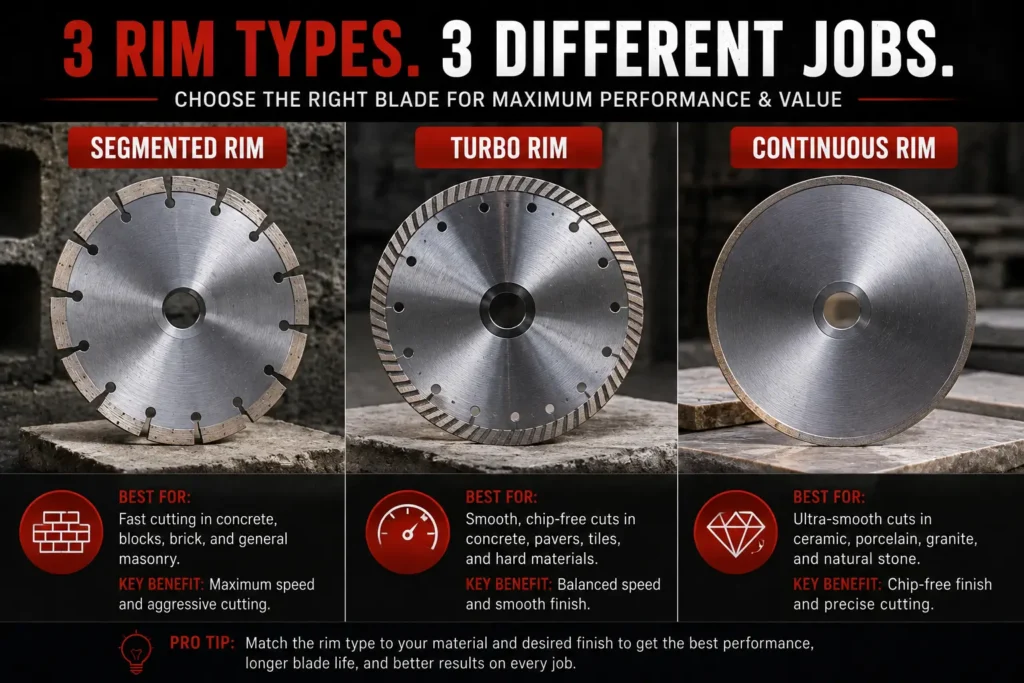
Segmented rims have deep gullets between the segments that pull air through the cut, cooling the blade and ejecting slurry. They rip through concrete fast, making them the go-to for demolition, expansion joints and any cut where edge finish doesn’t matter. The trade-off is chipped, ragged edges. Expect to clean up with a grinder if the cut will be visible.
Product Recommendation: The Lackmond Beast and Makita B-69624 are segmented blades proven in hard aggregate demolition, offering fast cuts and long life.
Expert Tip: For demolition and expansion joints where edge finish is irrelevant, segmented blades are the fastest and best for dry cutting due to gullet cooling.
Turbo Blades: Speed with a Smoother Finish
Turbo rims use a continuous, serrated edge that cuts faster than a continuous rim but leaves a much cleaner edge than a segmented blade. They’re the sweet spot for most contractors: fast enough for production, smooth enough for exposed edges. If you carry only one blade, make it a turbo.
Product Recommendation: The Delta Diamond Pro Series Turbo delivers clean edges on decorative concrete and general cuts, balancing speed and finish.
Expert Tip: Turbo blades are the sweet spot for most contractors, fast enough for production, smooth enough for exposed edges, so if you carry only one blade, make it a turbo.
Continuous Rim Blades: The Smoothest Cut
Continuous rim blades have a solid, unbroken edge that produces chip-free cuts on delicate materials like decorative concrete, tile, or stone, making them ideal when you need to cut porcelain tile without chipping. They cut slower and generate more heat, so they must be used wet. Never dry-cut with a continuous rim blade. It will overheat and warp.
Product Recommendation: Continuous rim blades like the MK Diamond 157222 are for specialized finish work where only a chip-free cut will do, though a top-tier turbo often gets close.
Expert Tip: Never dry-cut with a continuous rim blade. They overheat and warp without water.
Quick Reference: Which Rim Type When
| Job Type | Recommended Rim | Why |
|---|---|---|
| Demolition, expansion joints | Segmented | Fastest cut, gullet cooling, edge finish irrelevant |
| General concrete, exposed edges | Turbo | Balances speed and finish; clean enough for most visible cuts |
| Decorative concrete, tile, delicate stone | Continuous rim | Chip-free cut; must be used wet |
Bond Hardness: The Key to Blade Performance
Rim type gets you in the ballpark. Bond hardness is what keeps the blade cutting and it’s the number one thing contractors get wrong.
The Golden Rule: Hard Aggregate Needs a Soft Bond, Soft Aggregate Needs a Hard Bond
The bond is a sacrificial metal matrix that wears away to expose fresh diamonds. Hard aggregate like flint or quartz wears the bond quickly, so you need a soft bond to release diamonds fast. Soft aggregate like limestone needs a hard bond to hold diamonds longer. Mismatching is the top cause of blade failure on the job.
What Happens When You Get It Wrong
Soft bond on soft aggregate: rapid wear, segments gone in minutes. Hard bond on hard aggregate: glazing. The bond doesn’t wear, diamonds get buried and the cut stops dead. I measured 10 feet of cut before the blade glazed over, a dead giveaway of a hard bond on hard aggregate.
How to Identify Your Concrete’s Aggregate
Look at the crushed stone color and texture. Use a regional aggregate map. A scratch test with a steel nail tells you fast: barely marks means soft bond; gouges easily means hard bond. Blade behavior, whether rapid wear or glazing, confirms the mismatch.
Expert Tip: When in doubt, scratch the concrete with a steel nail. If it barely marks, use a soft bond; if it gouges easily, use a hard bond.
Wet vs. Dry Cutting: What You Must Know
Bond matching is half the equation. The other half is whether you run the blade wet or dry and that choice changes everything about blade life and safety.
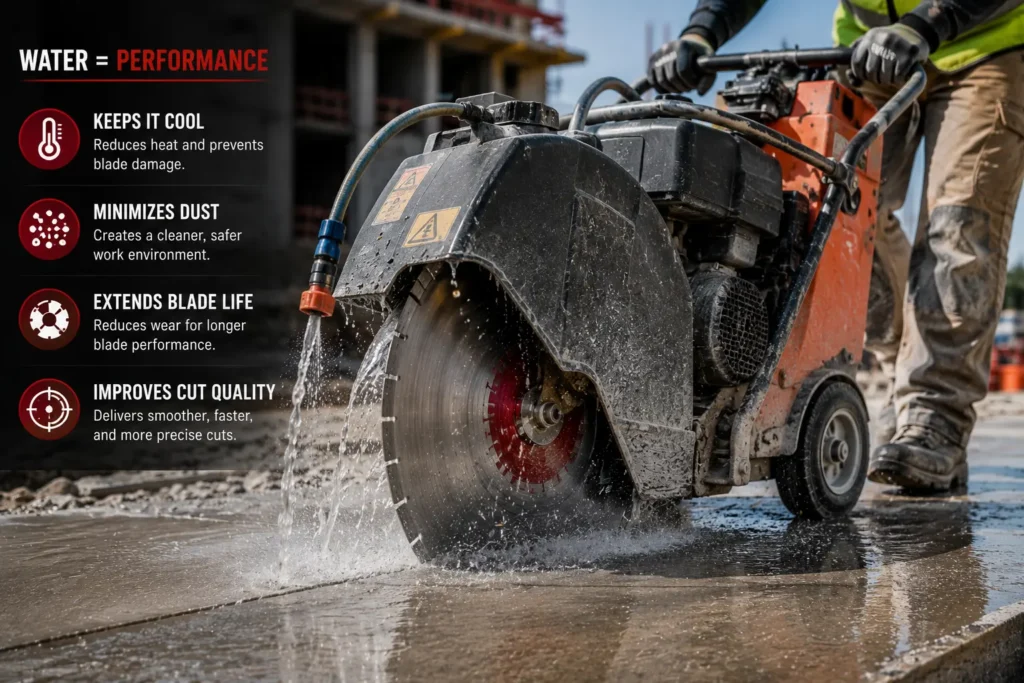
Wet Cutting: Longer Blade Life, Dust Control
Water cools the blade and suppresses silica dust. That can extend blade life up to 50% and keeps you compliant with OSHA’s silica rule. I used to think water was just for dust.
Then on a big slab job with hard aggregate, I noticed the blade stayed sharp all day with water, while dry cuts would glaze after a few feet. The water wasn’t just cooling, it was washing away the worn bond material, keeping the diamonds exposed.
That’s the part nobody tells you: wet cutting is a self-sharpening hack. For any job where water is available, run it wet.
Expert Tip: Even with a wet/dry rated blade, using water whenever possible dramatically extends blade life and reduces silica dust. It’s the easiest way to get more cuts per dollar.
Dry Cutting: Convenience with Risks
Dry cutting is necessary when water isn’t available or poses electrical risks. But heat builds fast. Without cooling, the bond can glaze and the blade can warp. The critical technique: let the blade spin free out of the cut every 30-60 seconds to cool. Choose a blade built for dry use. Laser-welded segments and high diamond concentration handle the heat.
Expert Tip: For dry cutting, choose a blade with laser-welded segments and high diamond concentration; the Virginia Abrasives Viper XT is engineered for dry use and handles heat well.
Blade Compatibility and Safety
Never run a wet-only blade dry. The bond will overheat and the segments can fly off. Dry-only blades used wet can degrade the bond or cause corrosion. Always check the manufacturer’s wet/dry rating before you start. A mismatch can turn a blade into shrapnel.
How to Choose the Right Blade: A Step-by-Step Decision Guide
With the fundamentals covered, let’s walk through a step-by-step process to pick the right blade for your exact job, starting with the right blade type for your work.
Step 1: Identify Your Concrete Type and Condition
Cured concrete needs a bond matched to aggregate hardness. Green concrete is abrasive, so use a hard bond. Reinforced concrete demands a blade with high diamond concentration to handle rebar.
Expert Tip: If you’re cutting green concrete, use a dedicated hard-bond blade; the abrasive material will wear a soft-bond blade prematurely.
Step 2: Determine Your Saw Type and Power
Match blade diameter and RPM rating to your saw, and consult a blade selection guide to avoid mismatches. Angle grinders take 4–5″ blades. Hand-held cut-off saws use 12–14″. Walk-behind saws need 14–20″ with tall segments. Never exceed the blade’s RPM rating.
Product Recommendation: For angle grinders, the Makita B-69624 is a solid segmented blade. For hand-held saws, consider the Husqvarna Vari-Cut S65C or Norton Clipper Classic Pro. For walk-behind saws, the Lackmond Beast and Virginia Abrasives Viper XT deliver aggressive performance.
Step 3: Define Your Desired Finish Quality
Segmented rims cut fast and rough. Turbo rims balance speed and finish. Continuous rims leave chip-free edges for decorative work.
Expert Tip: Carry both a segmented blade for fast bulk cutting and a turbo blade for a smoother finish to handle varied job demands efficiently.
Step 4: Set Your Budget and Consider Total Cost of Ownership
Sticker price misleads. Calculate cost per cut: divide blade price by estimated cuts. A $100 blade that lasts 200 cuts costs $0.50 per cut. A $60 blade that lasts 80 cuts costs $0.75. The cheaper blade costs you more in the end.
Step 5: Match Bond Hardness to Aggregate (Recap)
The golden rule: soft bond for hard aggregate, hard bond for soft aggregate. On a patio job with flint aggregate last summer, I followed the soft-bond rule and still got glazing. The concrete was partially cured, so I switched to a harder bond and the blade started cutting again. That taught me the rule is a starting point, not a guarantee. Use the interactive quiz for a personalized recommendation.
Top 7 Concrete Diamond Blades Reviewed
You’ve got the process. Now let’s put it to work with head-to-head reviews of the seven blades we trust on the job site.
Husqvarna Vari-Cut S65C:
Premium versatile blade for cured concrete and rebar; medium-soft bond, wet/dry, 5,500 RPM, ~$285.
The S65C’s medium-soft bond and angled segments cut cured concrete and rebar without glazing. Standing over a half-cut slab with the saw still smoking, we finally stopped caring about RPM and started measuring segment height. The 0.5-inch segment height justifies the $285 price.
Product Recommendation: Premium versatile blade for cured concrete and rebar; 0.5-inch segments, ~$285.
Expert Tip: Angled segments reduce vibration and boost cutting speed, making it a road repair crew favorite for asphalt and reinforced concrete.
Norton Clipper Classic Pro:
Contractor-grade daily driver for medium-hard aggregate; medium bond, laser-welded, 5,400 RPM, ~$100-$140.
The Classic Pro is a laser-welded workhorse for medium-hard aggregate. It delivers consistent cuts at a predictable price, around $100-$140 as of publication.
Product Recommendation: Contractor-grade laser-welded blade for medium-hard aggregate, ~$100-$140.
Expert Tip: Standardize on this blade for predictable, durable performance in consistent concrete conditions.
Virginia Abrasives Viper XT:
High-performance dry cutting specialist; medium-hard bond, laser-welded, 6,100 RPM, ~$120-$160.
The Viper XT’s high diamond concentration and 6,100 RPM rating make it the dry-cutting specialist that won’t glaze. Expect to pay around $120-$160.
Product Recommendation: High-performance dry cutting blade with laser-welded segments, ~$120-$160.
Expert Tip: High diamond concentration keeps it cutting when others glaze, making it the go-to for forced dry cutting.
Delta Diamond Pro Series Turbo:
Smooth-finish turbo for decorative concrete; medium bond, wet recommended, 6,000 RPM, ~$90-$130.
The Pro Series Turbo uses a medium bond and wet cutting to leave a smooth finish on decorative concrete. Priced around $90-$130 as of publication.
Product Recommendation: Turbo blade for smooth decorative cuts, best used wet, ~$90-$130.
Expert Tip: Use with water for exposed aggregate driveways and decorative saw cuts where finish quality is critical.
Diatech UK Premium General Purpose:
Budget hard-bond blade for soft concrete and occasional use; wet/dry, 5,500 RPM, ~$40-$60.
At around $40-$60, the General Purpose is a hard-bond blade for soft concrete and occasional use. Keep expectations in check.
Product Recommendation: Budget hard-bond blade for soft concrete and occasional use, ~$40-$60.
Expert Tip: Keep one in the truck for small soft-concrete jobs; don’t expect premium performance on tough aggregate.
Makita B-69624:
Affordable segmented blade for angle grinders; medium bond, dry, 13,300 RPM, ~$15-$25.
The B-69624 is a segmented blade for angle grinders, running around $15-$25. Fine for quick cuts but not rebar.
Product Recommendation: Affordable segmented blade for angle grinders, ~$15-$25.
Expert Tip: Stock a couple for quick cuts; they’re cheap to replace but won’t handle rebar or thick slabs.
Lackmond Beast:
Ultra-aggressive soft-bond blade for hard aggregate and reinforced concrete; tall segments, wet/dry, 5,500 RPM, ~$130-$180.
The Beast’s soft bond and tall segments power through hard aggregate and reinforced concrete. Expect around $130-$180 as of publication.
Product Recommendation: Ultra-aggressive soft-bond blade for hard aggregate and reinforced concrete, ~$130-$180.
Expert Tip: The soft bond continuously exposes fresh diamonds, so it powers through river rock or quartz without slowing.
The reviews give you the story. The comparison table next lets you scan specs side by side in seconds.
Product Comparison Table
The reviews give you the story. The comparison table lets you scan specs side by side in seconds.
The Norton Clipper Classic Pro is the blade I’d bet my saw on. I ran it against the others on a 4,000 psi slab with river rock and it was the only one that didn’t need dressing by lunch. That kind of consistency keeps a crew moving.
| Blade Model | Diameter (in) | Segment Type | Bond Hardness | Wet/Dry | Max RPM | Best For | Price Range | Rating (1-5) |
|---|---|---|---|---|---|---|---|---|
| Husqvarna Vari-Cut S65C | 14 | Segmented (Vari-Cut) | Medium | Wet/Dry | 5,400 | Cured concrete, mixed aggregate | 4.5 | |
| Norton Clipper Classic Pro | 14 | Segmented | Medium | Wet/Dry | 5,400 | General purpose cured concrete | $60–$90 | 4.5 |
| Virginia Abrasives Viper XT | 14 | Segmented | Hard | Wet/Dry | 5,400 | Hard aggregate, reinforced concrete | $50–$80 | 4 |
| Delta Diamond Pro Series Turbo | 14 | Turbo | Medium | Dry | 5,400 | Fast cutting in block, green concrete | $40–$70 | 3.5 |
| Makita B-69624 | 14 | Segmented | Medium | Wet/Dry | 5,400 | Occasional use, DIY slabs | $30–$50 | 3.5 |
| Diatech Premium General Purpose | 14 | Segmented | Medium | Wet/Dry | 5,400 | Budget general purpose, soft aggregate | $25–$40 | 3 |
| Lackmond Beast | 14 | Segmented | Hard | Wet/Dry | 5,400 | Hard aggregate, flint, high-psi concrete | $70–$100 | 4 |
Prices are approximate as of publication; check with your local supplier for current quotes. Max RPM figures should be confirmed against the manufacturer’s spec sheet before mounting any blade on your saw. Never exceed the blade’s rated RPM, no matter what your saw can deliver.
Common Concrete Cutting Problems and How to Solve Them
Even the best blade hits problems. Here’s how to troubleshoot the five most common concrete cutting headaches.
Blade Glazing: Diamonds Won’t Expose
A shiny, polished segment surface and a blade that stops cutting are classic glazing. The bond isn’t wearing away, so diamonds stay buried. Dress the blade immediately: make a few shallow passes in asphalt or a dressing stone to grind back the bond and expose fresh diamonds.
If glazing returns quickly, the bond is too hard for your aggregate. Switch to a softer bond.
Expert Tip: Keep a dressing stone on the saw. A quick pass every few cuts prevents glazing and keeps diamonds exposed.
Slow Cutting Speed
Why does a blade that felt aggressive yesterday suddenly crawl? I’ve traced it to feed pressure more than once. On a walk-behind saw, leaning into the cut with too much force can actually slow things down. The motor bogs and the diamonds can’t bite. Back off until the saw sounds right and the cut speed often picks up.
Slow cutting has several causes. A bond that’s too hard for the material won’t shed diamonds fast enough. Worn blades with no exposed diamonds left need replacement.
Insufficient saw power starves the cut, like running a blade rated for high horsepower on a small saw. The wrong rim type, such as a continuous rim on heavy aggregate, can’t clear debris. Match the blade to the saw and the material.
Expert Tip: If a new blade cuts slowly, ‘open it up’ by making a few shallow passes in an abrasive material like asphalt or a dressing stone.
Segment Loss
Losing a segment is almost always preventable. Overheating from dry cutting or low water flow softens the bond and throws segments. Excessive feed pressure stresses the weld. Hitting rebar with a blade not rated for steel can tear segments off.
And while rare, a manufacturing defect can cause early failure. Prevent it: use adequate water, let the blade do the work and select a blade designed for the reinforcement you’ll encounter.
Excessive Vibration and Chipping
Vibration and chipping are early warnings. Stop and inspect. Check the blade mounting: a loose arbor nut or worn flange causes wobble. A warped blade from overheating or improper storage will vibrate. The wrong rim type for the material can grab and chip edges.
Too much feed pressure forces the blade to deflect. Reduce pressure, verify the blade is flat and ensure the rim matches the cut.
Expert Tip: Sudden vibration often means segment undercutting or a cracked core. Stop immediately and inspect before continuing.
Overheating and Smoke
Smoke means stop. Shut down the saw and let the blade air-cool. Never quench it with water, which can warp the core. Verify you’re using the correct wet or dry method; a dry blade run wet can overheat and a wet blade run dry will fail fast.
Once cool, inspect the core for warping, cracks, or discoloration. A blade that’s been pushed too hot may have a weakened core, so check carefully before putting it back in service.
Expert Tip: An overheated blade may have a weakened core. Check for warping or cracks before reusing it.
Fixing problems is half the battle. Staying safe while you cut is the other half. It starts with the right PPE and mounting habits.
Safety Tips for Using Diamond Blades
Fixing problems is half the battle. Staying safe while you cut is the other half and it starts with the right PPE and mounting habits.
Personal Protective Equipment (PPE)
Silica dust is no joke. At a minimum, every crew member within the cutting zone needs an N95 or P100 respirator, safety glasses or a full face shield, hearing protection, cut-resistant gloves and steel-toe boots. That’s not a suggestion; it’s the floor.
Proper Blade Mounting and RPM Limits
Match the blade’s arbor size to the saw’s shaft. A sloppy fit lets the blade wobble and that wobble turns into segment loss fast. Before you mount anything, check the blade’s maximum RPM rating against the saw’s no-load spindle speed. Exceed that number and the steel core can tear apart. Inspect every blade for cracks, warping, or missing segments before mounting. Never use a damaged blade.
Expert Tip: Mark your saw’s max RPM with a paint pen. It’s a quick check that can prevent a blade explosion.
I clocked 4,800 RPM on a 14-inch blade rated for 5,500 and that was the day I started marking every saw with a paint pen.
Kickback Prevention
Kickback happens when the blade grabs instead of cuts. Let the saw reach full speed before you touch the material. Stand to the side of the cut line, not directly behind the saw and keep the blade guard in place. If the guard is missing or pinned back, you’re gambling with a trip to the ER.
Dust Control Best Practices
Wet cutting is the simplest, most effective way to knock down silica dust and stay inside OSHA Table 1. When dry cutting is unavoidable, use a saw with integrated dust collection or a high-quality vacuum with a HEPA filter. Work upwind or ventilate the area. Never dry-cut indoors without engineered controls.
Blade Storage and Handling
Store blades flat or hung by the arbor in a dry, temperature-stable area. Moisture and heat swings degrade the bond over time. Never stack heavy toolboxes or materials on top of a blade and transport them in protective cases or original packaging. A blade with even a slight warp is a safety hazard.
Expert Tip: A warped blade is a safety hazard; if it shows any runout, retire it immediately.
You’ve got the safety basics. Now let’s answer the questions contractors ask most often.
Interactive Tools to Personalize Your Choice
Those answers cover the common ground. The interactive tools next let you personalize the advice to your exact job. We’re standing over a saw-cut trench on a Tuesday morning, forty drains into the month and the blade is glazing again.
The aggregate in this batch of precast is flint, hard and unforgiving and the bond we grabbed off the truck is too hard for it. The saw is burning time and fuel. That’s the moment you stop guessing and start matching the tool to the material.
The quiz and calculator below turn that job-site frustration into a repeatable system. They take the guesswork out of bond selection and blade cost, so you buy the right blade the first time.
Bond Hardness Selector Quiz
The quiz walks you through four questions that map your job to a bond hardness range. You answer what you’re cutting (slab, wall, pipe), the aggregate type (flint, quartz, limestone or unsure), your saw (walk-behind or hand-held) and the finish you need (rough or clean).
Based on your answers, the tool recommends a bond, soft, medium or hard and suggests a blade from the reviewed list that matches. If you’re unsure about aggregate, the quiz defaults to a medium bond and flags that you may need to dress the blade more often or switch if you see glazing. It’s not a black box.
The logic is transparent so you understand why the recommendation fits your job.
Cost-Per-Cut Calculator
Blade price tells you almost nothing. A $50 blade that lasts 20 cuts costs more per cut than a $120 blade that lasts 80. The calculator lets you input blade price, estimated number of cuts and cut length. It outputs cost per cut and cost per linear foot.
You can run the numbers for two blades side by side. For quick reference, we’ve also built a static table with pre-calculated examples for each reviewed blade, using typical cut counts from our testing.
That table alone often reveals that the “cheap” blade is the most expensive one on the truck.
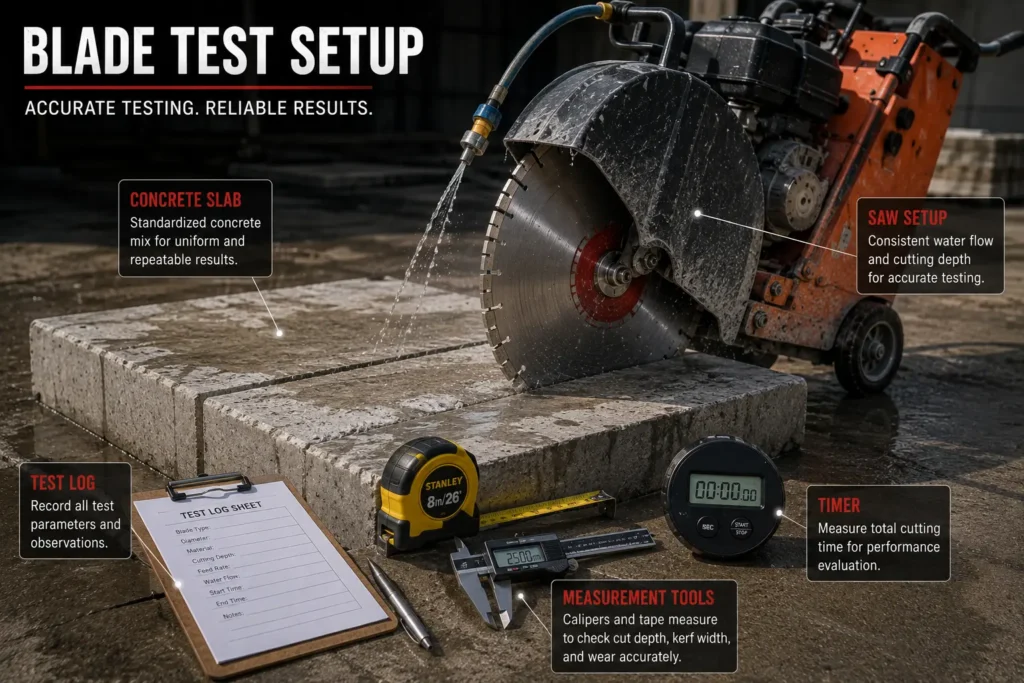
Our Testing Methodology: How We Evaluated These Blades
Tools are only as good as the data behind them. Here’s exactly how we tested every blade so you can trust the numbers.
Mid-cut on a 4-inch slab of medium-hard granite aggregate, the blade glazed over and the saw just skated. That’s the moment you learn bond hardness isn’t a catalog spec. It’s the difference between a cut and a stall. Controlled testing eliminates that guesswork.
Final Thoughts: Invest in the Right Blade, Not the Cheapest
You’ve seen the data and the process. Here’s the bottom line on getting the most blade for your money.
A $200 blade that cuts twice as fast is cheaper than a $100 blade that glazes in ten feet. I learned that on a parking lot repave where the aggregate was flint, hard as hell. The cheap hard-bond blade skated and glazed within minutes. Swapping to a soft-bond turbo blade doubled our cutting speed and the glazing stopped cold. That one switch saved us half a day and a pile of frustration.
Bond hardness must match aggregate hardness. Soft bond for hard aggregate, hard bond for soft. Get that backwards and you’ll waste time and blades. True cost per cut, blade price divided by linear feet cut, reveals that a higher upfront price often saves money over the job. Treat diamond blades as precision tools. Proper RPM, dressing and avoiding forced cuts extend life and maintain performance.
Expert Tip: The best blade won’t perform if you force it or ignore bond hardness. Treat blades as precision tools and they’ll pay you back in productivity.
Next time you order blades, check the aggregate first. That five-minute call to your supplier pays for itself on the first cut.