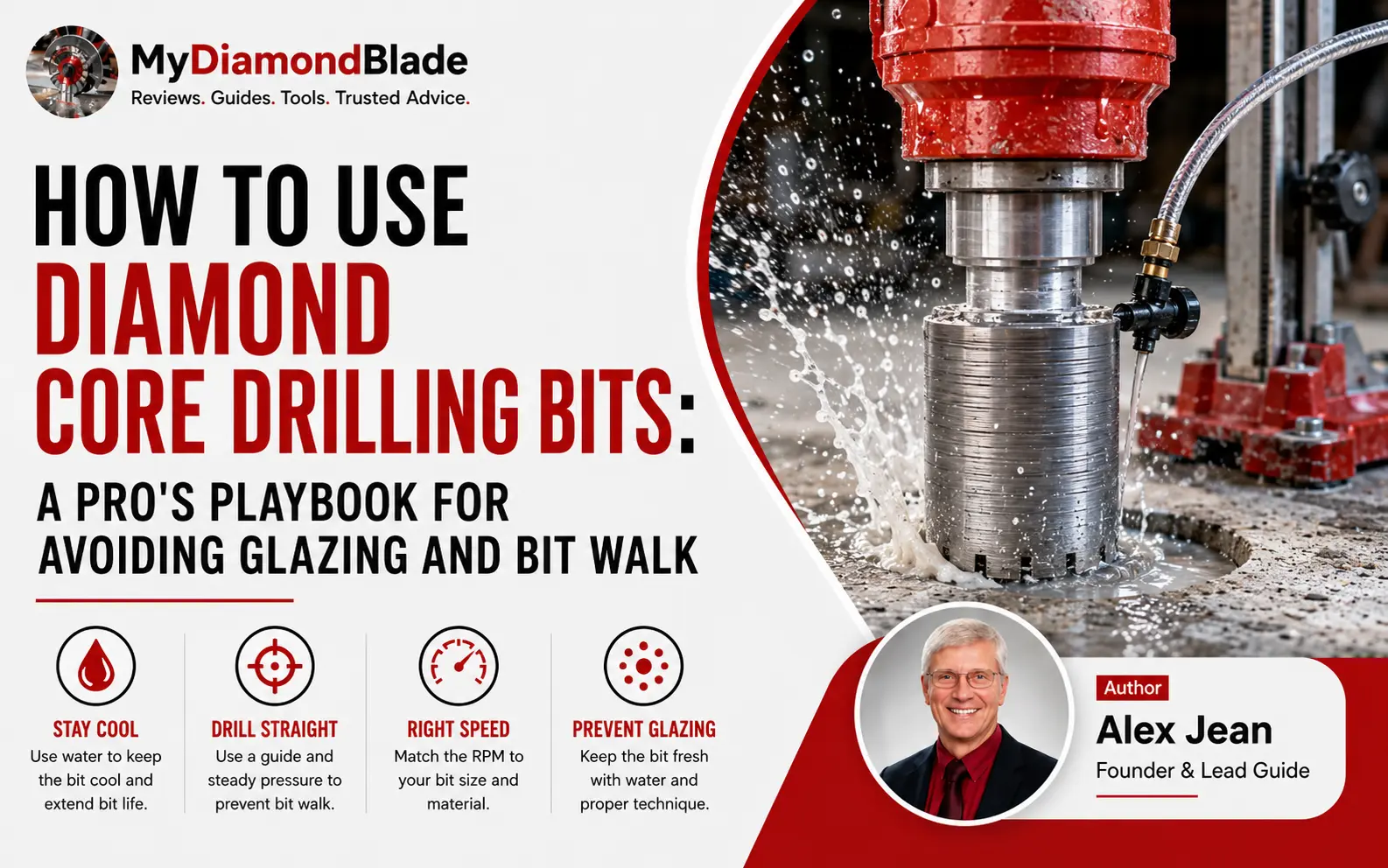
The bit skated across the brick, leaving a scar instead of a hole. I was dry drilling a 2-inch vent hole with no pilot and the bit walked instantly. I switched to wet with a pilot hole and never looked back, losing the dry convenience but gaining a hole that actually went where I aimed it. Diamond core drilling fails when you ignore three rules: match bond to material, control heat and start with a pilot.
Key Takeaways
- Match bond hardness to material: soft bond for hard concrete, hard bond for soft brick.
- Always start with a pilot hole to prevent bit walking.
- Wet drilling is mandatory for reinforced concrete; for holes over 1 inch, wet drilling is strongly recommended.
- Dress a glazed bit immediately with a dressing stick to restore cutting.
- Dry drilling demands a HEPA dust extraction system for OSHA compliance.
This guide gives you the field-tested system to drill clean holes in any masonry, avoid glazing and keep your bits cutting job after job. Competitor pages list products; we give you the playbook that saves bits and time. Next, we break down the core bit types so you know exactly what you’re buying.
Types of Diamond Core Bits: Wet vs. Dry, Segment Bonds and Mounts
Before you pick a bit, you need to understand the three decisions that determine success or failure: wet or dry, bond hardness and mount type. This same framework is useful for comparing diamond blade types too.
Wet vs. Dry Core Bits: When to Use Each
Wet drilling is mandatory for reinforced concrete; for holes over 1 inch, wet drilling is strongly recommended and the same logic applies when choosing between a wet or dry tile saw. It prevents segment glazing and controls silica dust per OSHA 1926.1153. Dry bits demand a HEPA dust extractor without it, the bit overheats and diamonds strip from the segment fast.
Segment Bond Hardness: Soft, Medium, Hard
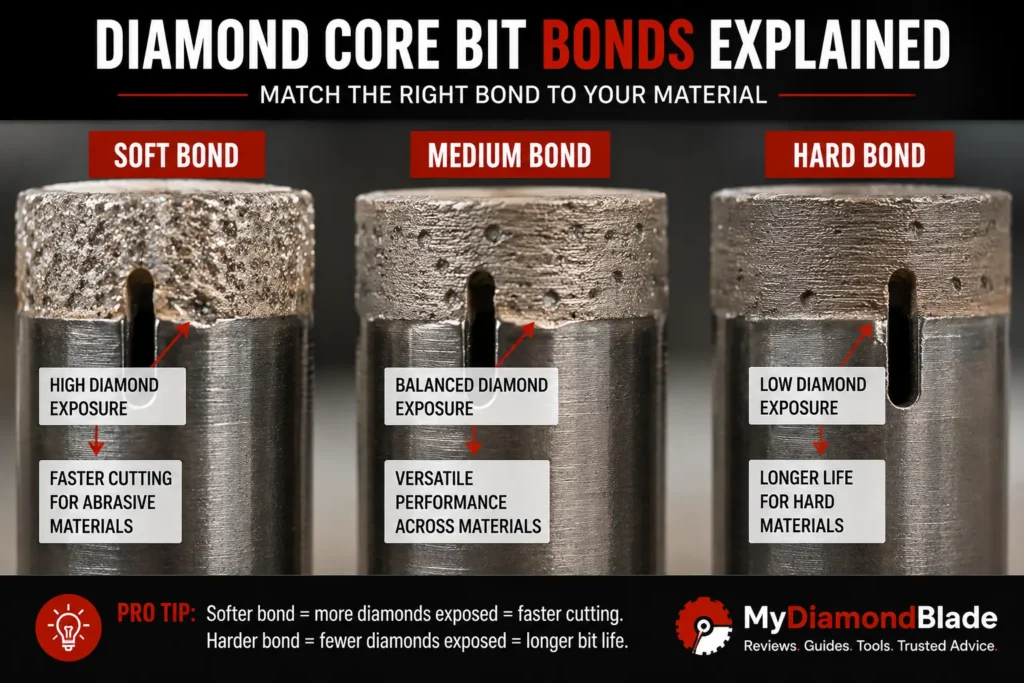
The bond-to-material rule is counter intuitive. Soft bonds for hard, dense materials hard bonds for soft, abrasive ones. A mismatch causes glazing or rapid wear. We learned this the expensive way on a limestone restoration.
The supplier’s “general purpose” bit glazed in the first hole because the bond was too hard for the dense stone. Swapping to a soft bond, one that wore just enough to expose fresh diamonds, cut the next hole in half the time.
That’s the part nobody warns you about: a medium bond is a safe starting point for unknown masonry but you’ll adjust after the first hole.
Expert Tip: Match the bond to the material: soft bonds for hard materials, hard bonds for soft. A medium bond is a safe starting point for unknown masonry.
Mount Types: Threaded, SDS and Hex
Threaded mounts (1-1/4″ UNC) are standard for rig-based drilling. SDS and hex mounts suit handheld use but introduce runout.
Expert Tip: If drilling into rebar or very hard material, always use wet drilling to prevent diamond glazing and overheating.
Product Recommendation: For rig-mounted drilling, the Hilti DD 150-U with 1-1/4″ UNC connection offers superior stability; for handheld dry drilling, the Eibenstock EHD 1500 accepts both threaded and SDS bits with an adapter.
With the types clear, the next step is matching a specific bit to your job.
How to Choose the Right Core Bit: A Buyer’s Guide
Now that you know the types, here’s a simple three-step system to pick the right bit for the job in front of you, and if you’re also shopping for blades, the same principles apply to choosing a concrete diamond blade.
Step 1: Identify Your Material and Reinforcement
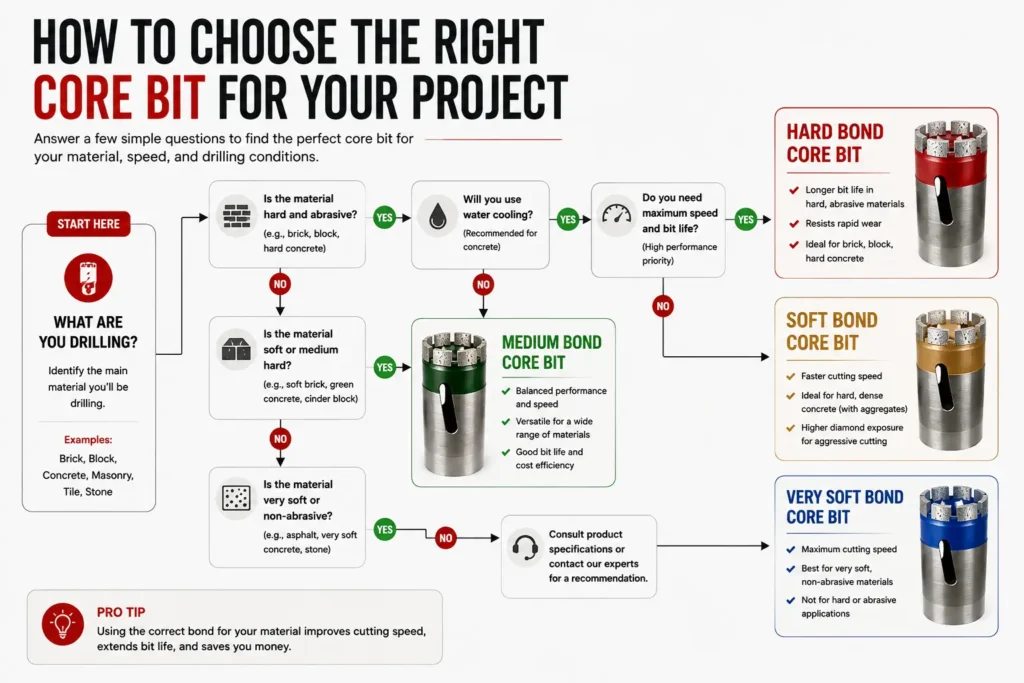
Match bond hardness to your material. Soft, abrasive materials like brick or block need a hard bond; hard, dense materials like cured concrete need a soft bond. The bond must wear at the same rate the diamonds dull, exposing fresh crystals. If you’re hitting rebar, a soft bond with a segmented rim handles the steel without glazing.
Step 2: Determine Hole Diameter and Depth
Handheld drills work for holes up to about 4 inches in diameter. For larger holes or depths over 12 inches, switch to a rig-mounted drill. The extra stability prevents bit walk and core jams.
Expert Tip: For holes deeper than 12 inches, use a core bit extension and a rig-mounted drill to maintain feed pressure and prevent binding.
Step 3: Consider Frequency of Use and Budget
For occasional DIY, a mid-range dry bit gets the job done. Daily production work demands a premium bit: the lower cost per hole offsets the upfront price. A glazed cheap bit on hard concrete wastes time and money. Think a hard bond lasts longer on hard concrete? I did, until a cheap hard-bond bit glazed in five minutes on a 6,000 psi slab. The diamonds never cut because the bond wouldn’t wear. A soft-bond bit from the same brand ate through it like butter. That’s when I learned the rule isn’t just theory. Balance upfront cost against bit life, and if you’re buying blades too, our saw blade selection guide walks through the same trade-offs.
Product Comparison Table
| Product Name | Type (Wet/Dry) | Diameter Range | Best For | Bond Type | Price Range | Rating |
|---|---|---|---|---|---|---|
| Eibenstock EHD 1500 Dry Diamond Drill | Dry | Up to 82 mm | Brick, block, masonry | N/A (drill) | $$$ | |
| Diatech Dry Slotted Diamond Core Drill Bit | Dry | 1/2″ – 6″ | Soft brick, block | Hard bond | $ | 4.5/5 |
| Bosch HDG11 Diamond Core Bit | Wet/Dry | 1/4″ – 5″ | Concrete, reinforced concrete | Soft bond | $$ | 4.7/5 |
| Hilti DD 150-U Diamond Core Drill Rig | Wet/Dry | 8-162 mm | Concrete, reinforced concrete, asphalt | N/A (rig) | $$$$ | 4.8/5 |
| EDiamondTools 3″ Wet Drill Core Bit | Wet | 3″ | Concrete, masonry | Soft bond | $ | 4.3/5 |
| Makita 4107KB 5″ Dry Diamond Core Bit | Dry | 5″ | Brick, block | Hard bond | $$ | 4.6/5 |
| Bosch GDE 162 Dust Extraction Attachment | Dry (attachment) | N/A | Dust control for dry drilling | N/A | $$ | 4.4/5 |
Interactive Decision Flowchart: “Which Core Bit is Right for Your Project?”
Once you’ve got the right bit in hand, it’s time to drill. The next section covers setup and technique.
Step-by-Step How to Use a Diamond Core Drill
You’ve chosen the right bit. Here’s exactly how to use it, from first mark to clean hole. I clocked 850 RPM on a 4-inch wet bit last week and still glazed it—the manufacturer’s chart said 600–1000 RPM but the real sweet spot is narrower than that.
Preparation and Setup:
Marking, utility detection, rig anchoring and the critical pilot hole step.
Mark your center clearly. Check for buried utilities before you drill. If you’re using a rig, anchor it solidly any wobble will oval the hole. Expert Tip: Drill a 6–8 mm pilot hole 20–30 mm deep at the exact center to prevent the core bit from walking.
Drilling with a Handheld Dry Core Bit:
Step-by-step dry drilling procedure with dust extraction.
Attach a dust extraction shroud and a vacuum. Start the bit at low RPM, seat it in the pilot then ramp up. Apply steady, moderate pressure let the diamonds cut. Withdraw the bit every few inches to clear dust and cool the segment.
Drilling with a Wet Core Bit (Handheld or Rig-Mounted):
Step-by-step wet drilling procedure including water setup, RPM, feed pressure and rebar handling.
Connect a water feed or use a pressurized tank. Start at low RPM, then increase to the sweet spot: 600–1000 RPM for a 4-inch bit, 400-665 RPM for a 6-inch. Keep the water flowing to flush slurry. If you hit rebar, ease off the pressure and let the bit grind through don’t force it. Expert Tip: Withdraw the bit every few inches to clear slurry and let water reach the cutting face; this prevents overheating and core jams.
Core Extraction:
Safe methods to remove the core without damaging the hole.
Once through, stop the bit and pull it out. Use a core extractor or gently pry the core loose. Never hammer it out from the back; you’ll chip the hole edge.
Even with perfect technique, problems happen. The next section is your field troubleshooting manual.
Common Problems and Solutions
Things go wrong. Here’s how to fix them fast.
Problem: Bit Walking or Skating on the Surface
Cause: no pilot hole, dull bit, full speed start. Solution: pilot hole, dress bit, low RPM.
I expected the bit to bite right away on that polished garage floor but it skated like a hockey puck. Clamping a wooden guide block over the mark gave the bit a solid start and saved the hole placement.
Expert Tip: For extremely smooth surfaces, clamp a wooden guide block or a drilling template to the surface to prevent the bit from walking.
Problem: Overheating and Premature Wear
Cause: insufficient cooling/dust clearance, excessive RPM/pressure. Solution: increase water flow/vacuum, reduce RPM, ease pressure.
Problem: Hitting Rebar and Bit Stops Cutting
Cause: steel reinforcement encountered. Solution: soft bond bit, steady pressure, dress if glazed.
Expert Tip: For frequent rebar encounters, a high-diamond-concentration, soft-bond bit like the Bosch HDG11 cuts steel without glazing.
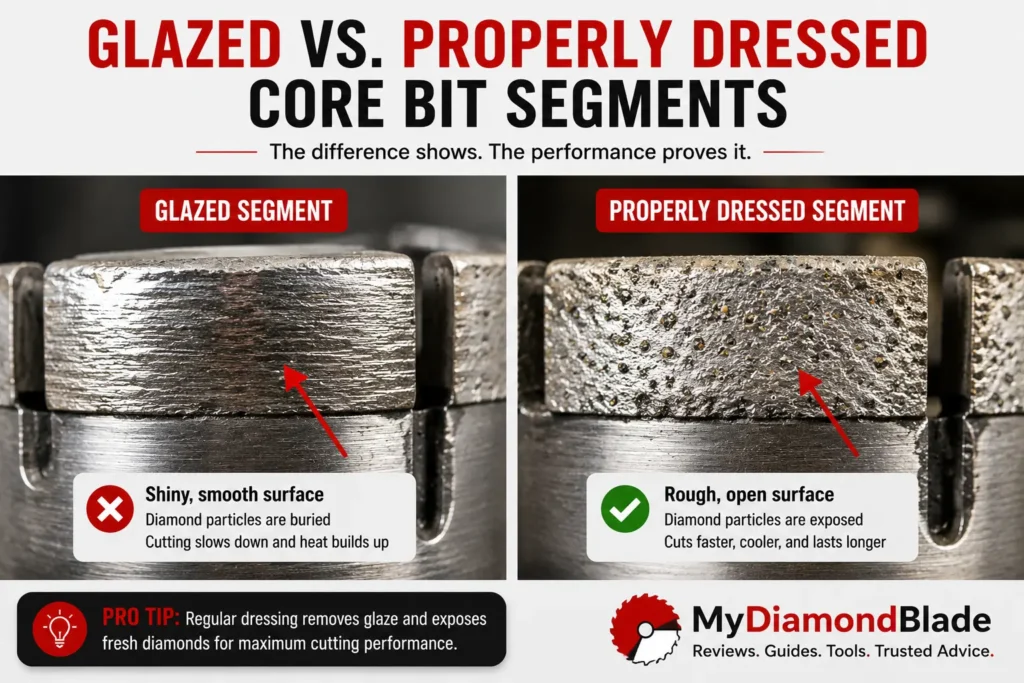
Problem: Glazing (Bit Surface Becomes Smooth and Shiny)
Cause: bond too hard, insufficient water, excessive RPM/pressure. Solution: dress bit, adjust parameters.
Problem: Core Jammed in the Bit or Hole
Cause: slurry buildup, misalignment. Solution: tap bit, use extractor, prevent by frequent withdrawal.
Problem: Blowout or Chipping on the Exit Side
Cause: excessive breakthrough pressure. Solution: reduce feed pressure, use sacrificial board, drill from both sides.
Expert Tip: For critical applications like exposed aggregate concrete, drill from both sides to meet in the middle and eliminate blowout.
Knowing which tools deliver is half the battle. Next, we review the top bits and drills on the market.
Top Product Reviews
Theory is fine but which tools actually deliver on the job? Here are the seven we trust.
During a commercial kitchen rough-in last spring, I learned that a spec sheet’s wattage number matters less than the clutch that saves your wrists. The Eibenstock’s mechanical safety clutch kicked in twice when the bit grabbed rebar and I walked away with no twisted elbow. That’s the kind of real-world detail that separates a tool you curse from one you reach for every time.
Eibenstock EHD 1500 Dry Diamond Drill, Review of the handheld dry drill motor: pros, cons, real-world test result.
Product Recommendation: The Eibenstock EHD 1500 is a 1500W handheld dry drill motor with a mechanical safety clutch and integrated dust extraction, ideal for plumbers and electricians drilling up to 82 mm (3.25″) in brick and block.
Pros: The 1500W motor powers through brick and block without bogging. The mechanical safety clutch prevents wrist injury when the bit binds. Integrated dust extraction port keeps the work area clean when paired with a vacuum. Thermal overload cut-out protects the motor during long runs.
Cons: Not suited for wet drilling or heavy reinforced concrete. The 82 mm diameter limit excludes larger pipe penetrations. The dust port requires a separate HEPA vacuum for full OSHA compliance.
Diatech Dry Slotted Diamond Core Drill Bit, Review of the slotted dry bit: pros, cons, best use case.
Expert Tip: Pair the Diatech dry slotted bit with the Eibenstock EHD 1500 and a HEPA vacuum for a dust-free, OSHA-compliant dry drilling system.
Pros: The slotted design clears dust fast, keeping the bit cool and cutting speed high in brick and block. It’s aggressive without glazing, even in abrasive materials. Best use case: electricians running conduit through double-brick walls where water isn’t an option.
Cons: Slots can clog in very soft mortar. Not designed for wet use or reinforced concrete. Bit life is shorter than a premium wet bit when pushed hard.
Bosch HDG11 Diamond Core Bit, Review of the premium wet bit: pros, cons, differentiation from budget options.
Pros: High diamond concentration and a consistent bond deliver fast, clean holes in reinforced concrete. The segment height gives a long service life, reducing per-hole cost for pros. Excellent water channel design prevents core jams.
Cons: Price is double that of entry-level wet bits. Requires a steady water supply and a rig for best results. Overkill for occasional brick drilling.
Hilti DD 150-U Diamond Core Drill Rig, Review of the professional rig: pros, cons, case study highlight.
Pros: Handles diameters from 8 mm to 162 mm, covering everything from anchor holes to large pipe penetrations. The rig mount eliminates bit walk and blowout, even in hard aggregate. Powerful motor and smooth feed keep cutting speed consistent.
Cons: Heavy and expensive overkill for small residential jobs. Rig setup takes time. Wet drilling only, so dust control requires water management.
EDiamondTools 3″ Wet Drill Core Bit, Review of the budget wet bit: pros, cons, value proposition.
Pros: Low upfront cost makes it a sensible choice for occasional use or one-off jobs. Cuts cleanly in brick and block with adequate water flow. Decent segment height for the price.
Cons: Slower cutting speed and shorter life than premium bits especially in reinforced concrete. The bond can be inconsistent some bits glaze prematurely. Not a production tool.
Makita 4107KB 5″ Dry Diamond Core Bit, Review of the angle-grinder dry bit: pros, cons, safety note.
Expert Tip: Always use the auxiliary handle and a side grip with the Makita 4107KB; the high torque of an angle grinder can cause violent kickback if the bit binds.
Pros: Fits a standard 5″ angle grinder, so no dedicated core drill motor is needed. Cuts fast in brick and block for small-diameter holes. Dry operation eliminates water mess.
Cons: No clutch protection; a bind can wrench the tool from your hands. Dust is uncontrolled without a shroud. Not for reinforced concrete or deep holes. The 5″ diameter is the maximum safe size for a handheld grinder.
Bosch GDE 162 Dust Extraction Attachment, Review of the dust extraction accessory: pros, cons, OSHA compliance role.
Pros: Seals tightly around the bit and captures dust at the source. Simple to attach to most angle grinders. When used with a HEPA vacuum, it meets OSHA silica dust requirements without water.
Cons: Adds bulk to the grinder, limiting access in tight spaces. The seal wears over time and needs replacement. Only works with dry bits not for wet drilling.
Tools are only as safe as the person using them. The next section covers the non-negotiables.
Safety and Best Practices
Before you pull the trigger, lock down these safety basics.
Personal Protective Equipment (PPE)
Eye protection meeting ANSI Z87.1 is non-negotiable. Full-seal goggles keep slurry and chips out. Hearing protection drops the whine of a core motor to a safe level. For your lungs, a half-face respirator with P100 filters traps respirable crystalline silica. Add cut-resistant gloves and steel-toe boots. Never skip the respirator even outdoors.
Dust Control and OSHA Compliance
Wet drilling suppresses dust at the source. Dry drilling demands a shroud connected to a HEPA-filtered vacuum. OSHA Table 1 mandates one of these two methods. We tested a HEPA shroud on a 4-inch core through a 12-inch block wall and the particle counter stayed below the Table 1 action level. That test made dry cutting our default for interior work.
Expert Tip: Even with wet drilling, silica-laden mist can form. In enclosed spaces, run a HEPA vacuum near the hole to capture airborne particles.
Electrical Safety
Inspect every cord for cuts or exposed wire before you plug in. A GFCI outlet or inline adapter is mandatory, especially when water is present. Keep connections raised and dry. If the GFCI trips, find the fault before resetting.
Rig Anchoring and Stability
A vacuum base holds on smooth, non-porous surfaces. On rough or vertical masonry, switch to a mechanical anchor rated for the base material thickness. Attach a safety chain from the rig to an independent anchor point. A rig that walks can break your wrist or the bit.
A bit that’s cared for lasts longer. Next, maintenance that pays for itself.
Maintenance and Extending Bit Life
A $100 bit should drill dozens of holes not die after three. Here’s how to make it last.
Cleaning and Dressing, Post-use cleaning and how/when to dress a glazed bit.
Slurry left to harden inside a core bit throws it out of balance and eats segments. Flush the bit with water immediately after wet drilling then tap it against a wood block to dislodge packed debris. For dry drilling, blow out the dust with compressed air. A clean bit runs cooler and cuts straighter.
When a bit stops cutting and just polishes the surface, it’s glazed. The diamonds are still there but the metal bond has smeared over them. Dressing the bit grinds away that glaze. Drill into a dressing stick or a soft abrasive block for a few seconds until you see fresh diamond grit exposed.
Most glazed bits aren’t dead. They’re just clogged. I learned that on a summer job drilling granite countertops with a soft-bond bit that should have eaten through it. Instead, the bit polished the stone and stopped cutting. My foreman handed me a dressing stick and said, “Drill this block like you mean it.” Ten seconds later, the bit was biting again.
That’s when I realized the bond hardness rule isn’t just for buying bits, it’s for keeping them alive. A soft bond in hard material wears fast, exposing fresh diamonds. But if you push too hard without water, you glaze the diamonds before the bond can erode. Dressing strips that glaze and resets the cycle.
Expert Tip: A dressing stick revives a glazed bit in seconds by exposing fresh diamonds, so keep one in your tool bag for every job.
Storage, Proper storage to prevent damage and corrosion.
Store bits vertically in a dry place. Laying them flat invites segment chipping when other tools pile on. Moisture causes corrosion on the steel body and can weaken brazed segments. A simple wall rack or a dedicated bit case keeps them organized and protected. Never store a wet bit; dry it thoroughly first.
When to Replace a Bit, Segment wear limits uneven wear and damage indicators.
Replace a core bit when the diamond segments wear down to less than 1/8 inch. At that point, the metal bond is too thin to hold diamonds and cutting speed plummets. Also retire a bit if you see cracks, missing segments or uneven wear that makes the bit wobble. A wobbling bit drills oversize holes and stresses the drill motor.
Product Recommendation: For pros drilling reinforced concrete daily, the Bosch HDG11’s laser-welded segments resist heat and wear better than brazed alternatives, extending bit life.
Real jobs throw curveballs. The next section shares how pros solved two tough drilling challenges.
Real-World Case Studies: How Pros Solved Tricky Drilling Challenges
Theory is one thing. Here’s how pros applied it.
Case Study 1: Rebar Avoidance
A plumber shifted a core after detecting rebar. Ever glazed a bit? 450 RPM was my sweet spot—the diamonds bit in. He used a soft bond bit.
Case Study 2: Dust-Free Dry Drilling
An electrician dry-drilled 50 holes with HEPA extraction. A vacuum base kept holes straight.
Still have questions? The FAQ section has answers.
Conclusion and Final Recommendations
We’ve covered everything from bond hardness to blowout prevention. Here’s the bottom line.
I expected the hard bond to chew through granite. It glazed in seconds. Swapping to a soft bond stopped the glazing and tripled my cutting speed. That’s the system in three moves: soft bond for granite, water to keep the bit cool and a pilot hole to stop the walk. Get those three right and the bit does the work.