
The first time I cut concrete with a circular saw, I learned the hard way that a wood blade doesn’t just cut poorly: it’s a dust bomb waiting to go off. I was young, impatient and figured “a blade’s a blade.” Ten seconds in, the saw kicked back, the blade glazed over and a cloud of fine dust filled the garage. I couldn’t see my hands, let alone the cut line.
That dust isn’t just messy; it’s respirable crystalline silica, a serious lung hazard that hangs in the air long after the saw stops. And the wrong blade doesn’t just ruin the cut: it can destroy your saw and turn a weekend project into a safety emergency.
Key Takeaways
- A diamond blade is non-negotiable; wood or metal blades destroy themselves instantly and create a safety hazard.
- Wet cutting with a continuous water stream reduces respirable silica dust by 85% compared to dry cutting and keeps the blade cool.
- Multiple shallow passes (about ¼ inch each) prevent binding, overheating and motor strain. Never force a full-depth cut in one go.
- Match the blade type to the job: segmented for rough control joints, continuous rim for chip-free paver edges, turbo for all-around speed.
- A glazed blade isn’t dead: dress it on a cinder block to expose fresh diamonds and restore cutting performance.
A circular saw can handle concrete cleanly and safely but only if you treat it like a concrete saw not a wood saw; for larger demolition, compare gas vs electric cut-off saws. A circular saw can handle concrete cleanly and safely but only if you treat it like a concrete saw not a wood saw. This guide gives you the contractor’s playbook: blade selection that matches the job, dust safety backed by NIOSH data and field-tested cutting techniques that keep your saw alive and your lungs clear.
Understanding Diamond Blade Types
The foundation of every clean, safe concrete cut is the blade and understanding diamond blade types helps you pick the right one.
Expert Tip: Never mount a wood or metal blade to cut concrete: only a diamond blade designed for masonry can handle the abrasive material safely.
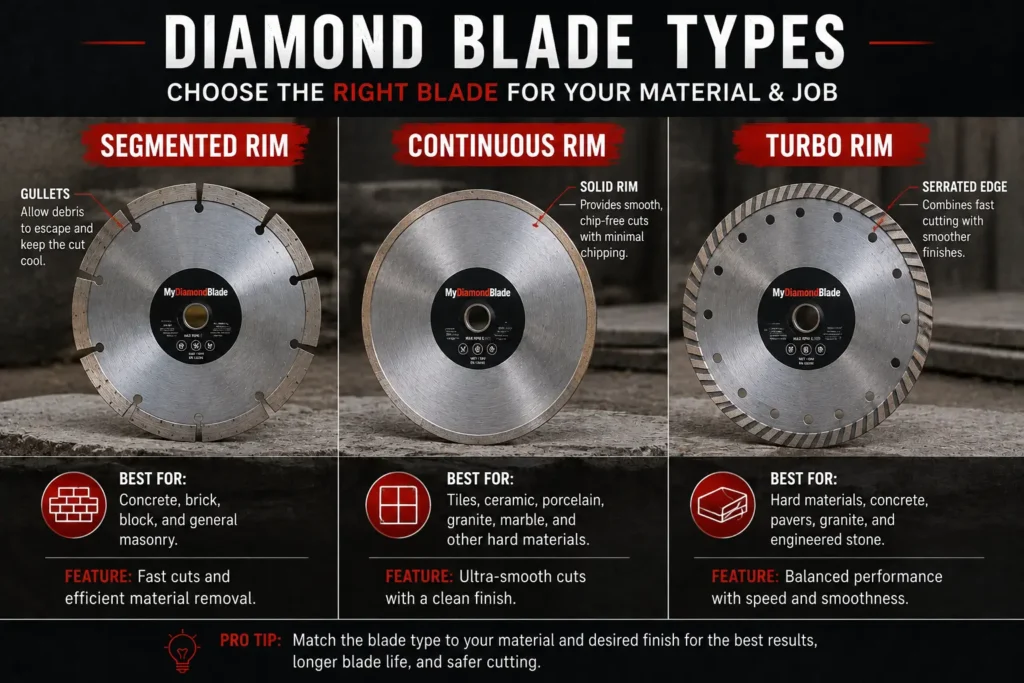
Segmented Blades: The Workhorse for Rough Cuts
Segmented blades have a rim divided into distinct sections with deep gullets between them, which is key to how diamond blades work. Those gullets pull air through the cut, dissipating heat and ejecting debris fast. That makes them the go‑to for rough demolition, cutting control joints in slabs and any job where speed matters more than a clean edge. The trade‑off is a rougher finish and more chipping along the cut line.
Segmented blades are fast but they’ll leave you with a mess you didn’t plan for. We cut a 4‑inch slab for a plumbing trench with a segmented blade. It ripped through in minutes but the edges were chipped and ragged. We spent another half hour with a grinder cleaning up the spalling. That’s the reality: you get speed but you’ll often need a secondary tool to clean up the edge.
Expert Tip: When cutting control joints in existing slabs, a segmented blade with a wider kerf (around 0.125 inches or more) prevents binding as the concrete expands and contracts.
Continuous Rim Blades: For Smooth, Chip‑Free Finishes
A continuous rim blade has a solid, uninterrupted edge. Without gullets, it cuts slowly and generates more heat, but it produces the smoothest, chip‑free finish you can get from a circular saw. That’s why it’s the blade for pavers, tile and backer board, any material where a clean edge is non‑negotiable.
The catch: continuous rim blades glaze over quickly without water. The metal bond melts and smears across the diamonds, stopping the cut. Wet cutting is mandatory to keep the rim cool and the diamonds exposed.
Product Recommendation: A 7‑1/4‑inch continuous rim diamond blade delivers smooth, chip‑free cuts in pavers and tile. Look for one rated for wet use.
Turbo Blades: Speed and Versatility Combined
Turbo blades split the difference. Their rim has a serrated, wavy edge, not segmented, not solid that balances cutting speed with a reasonably smooth finish. They handle hard concrete, brick and stone well and many are rated for both wet and dry use.
You won’t get the mirror edge of a continuous rim but you’ll cut faster and with less chipping than a segmented blade. For general‑purpose concrete work where you want one blade that does most things decently, a turbo blade is the smart middle ground.
Quick Comparison: Which Blade When?
| Blade Type | Best For | Pros | Cons | Cooling |
|---|---|---|---|---|
| Segmented | Rough demolition, control joints, fast slab cuts | Fast cutting, excellent heat dissipation | Rough, chipped edges | Air‑cooled (gullets) |
| Continuous Rim | Pavers, tile, backer board | Smoothest, chip‑free finish | Slow, glazes without water | Wet only |
| Turbo | Hard concrete, brick, stone, general‑purpose | Good speed, decent finish, wet/dry | Not as smooth as continuous rim | Wet or dry |
Safety and Silica Dust Control: Protecting Your Lungs and Body
Blade chosen, now let’s talk about the dust it’ll throw and how to keep your lungs intact.
The Hidden Danger: Crystalline Silica Dust
Ever tasted concrete dust after a dry cut and felt your throat burn? I did, once, cutting a patio slab with a segmented blade and no mask. The gritty film on my teeth and the cough that followed weren’t just annoying: they were a warning. That’s when I learned that wet cutting slashes airborne silica by 85%. Respirable crystalline silica is the fine dust that burrows deep into your lungs. It causes silicosis, lung cancer and COPD. It’s not just a nuisance. In NIOSH field studies, wet cutting reduced respirable silica dust by 85%. Out of 79 dry cutting trials, 10 exceeded OSHA’s permissible exposure limit of 50 μg/m³. Only 1 of 89 wet cuts did.

Essential PPE: What You Need to Wear
A P100 respirator is mandatory for any dry cutting. N95 masks don’t filter the fine silica particles. Pair it with foam-seal safety glasses that keep dust out of your eyes and earmuffs with an NRR of 25 or higher. Concrete saws are loud. Wear long sleeves and pants to keep dust off your skin.
Product Recommendation: P100 half-face respirator (3M 6200 series), foam-seal safety glasses and earmuffs with NRR 25+.
Wet Cutting vs. Dry Cutting: Which Method and When?
Wet cutting is the gold standard. A garden hose trickling water onto the blade suppresses dust dramatically but you must use a GFCI-protected outlet to avoid shock. The trade-off: it’s messier and can slow you down. Dry cutting is faster but only acceptable outdoors with a P100 respirator and no bystanders downwind. If you can wet cut, do it.
Expert Tip: For indoor cuts or extended work, have a helper direct a gentle stream of water at the blade to suppress dust.
Setting Up a Safe Work Area
Cut outdoors whenever possible. Indoors, seal the area with plastic sheeting and create negative pressure with a fan blowing out a window. Clean up with a HEPA vacuum or wet methods. Never dry sweep. After the job, blow compressed air away from the saw’s motor vents to clear dust without forcing it inside.
Expert Tip: After cutting, use compressed air to blow dust away from motor vents, never into them, to prevent motor damage.
Safety gear dialed in. Now make sure the blade actually fits your saw and spins at the right speed.
I need the section to edit. Please provide the Markdown section.
Step-by-Step Cutting Techniques for Common DIY Projects
With the right blade mounted and the saw set up, it’s time to put that combination to work on real projects. Here’s how to handle the four most common DIY concrete cuts, pavers, control joints, backer board and slab scoring, plus the universal straight-cut habits that make every job cleaner.
How to Cut Concrete Pavers Cleanly
Place the paver on a sacrificial board (a scrap of plywood or rigid foam) to support the cut and prevent underside chipping. Mark your line, then clamp a straight-edge guide to the paver.
Use a continuous rim blade for the cleanest edge. Make multiple shallow passes about 1/4 inch deep each, letting the blade do the work. The sacrificial board absorbs the breakthrough and keeps the bottom edge crisp.
Expert Tip: Place pavers on a sacrificial board to support the cut and prevent underside chipping.

Creating Control Joints in Existing Slabs
Control joints guide inevitable cracking along a straight line. Cut them to a depth of one-quarter the slab thickness; for a 4-inch slab that’s 1 inch. Use a segmented blade with a wider kerf to give the slab room to move.
Clamp a straight-edge guide to the concrete for a perfectly straight line and make the cut in a single pass if wet cutting or multiple shallow passes if dry. Clean out the joint with a wire brush or compressed air before filling with sealant.
Expert Tip: For control joints, use a segmented blade with a wider kerf to accommodate slab expansion and contraction.
Expert Tip: Clamp a straight-edge guide to the concrete to ensure perfectly straight cuts, especially for long control joints.
Trimming Concrete Board (Backer Board) for Tile
Concrete board is brittle support the entire piece on a flat surface to prevent snapping and chipping. A continuous rim or turbo blade gives the cleanest edge. You can score and snap thinner board but for precise cuts or notches, use the saw.
Dry cutting backer board generates a lot of fine dust, so always wear a respirator and consider a dust shroud. Make a single shallow pass then a second to finish forcing the saw will chip the surface.
Scoring and Breaking Concrete Slabs
For thick slabs, you can’t cut all the way through with a 7-1/4-inch saw the maximum depth is about 2-1/2 inches for holes, diamond core drilling bits are the right tool. Instead, score a deep cut along your line then snap the slab with a sledgehammer or chisel.
Make multiple passes to reach full depth then strike the waste side firmly. The break will follow the score line if the cut is deep enough. Never force a full-depth cut in one pass; it’ll bind the blade and overheat the saw.
General Tips for Straight, Accurate Cuts
Start by marking your line and cutting a shallow guide groove without a straight edge just follow the mark for the first 1/8 inch. Then clamp a straight edge and make the remaining passes.
For dry cutting, stick to 1/4-inch-deep passes this reduces silica dust and keeps the blade cool. I expected a single deep pass to be faster but the blade bogged down and glazed almost immediately. Switching to 1/4-inch passes changed everything the saw stopped fighting me, the dust cloud shrank and the cut stayed straight. That’s the number I dial in every time now.
Let the blade do the work steady, moderate pressure is all you need. Forcing the saw causes glazing and strains the motor.
Expert Tip: When dry cutting, make multiple shallow passes (1/4 inch deep) to reduce dust and prevent blade overheating.
Expert Tip: Let the blade do the work; apply steady, moderate pressure. Forcing the saw causes glazing and strains the motor.
Even with perfect technique, things go wrong. Next, we’ll tackle the most common concrete-cutting headaches and how to fix them.
Troubleshooting Common Concrete Cutting Problems
Blade Glazing: Why It Happens and How to Fix It
Glazing happens when the metal bond holding the diamonds melts over them, leaving a shiny rim that spins without cutting. During the patio extension last fall, my blade started skating across the slab, no bite, just a polished track. Year seven of cutting concrete and I still get caught when I push too hard dry. I grabbed a cinder block from the pile and made a few shallow passes the abrasive material wore away the glazed metal and exposed fresh diamonds. The blade cut like new. That’s dressing cutting into an abrasive material like a cinder block, asphalt or a dressing stick to restore the edge. Prevent glazing by using light pressure and wet cutting when possible.
Overheating: Preventing Motor Strain and Blade Damage
Overheating often comes from forcing the saw, prolonged dry cutting or a dull blade. Symptoms: a hot motor, a discolored blade or a burning smell. Stop immediately. Let the saw cool then switch to wet cutting or take shallower passes. The blade should do the work; you just guide it.
Chipping and Spalling: Getting Clean Edges
Chipping and spalling are usually caused by the wrong blade type, too much pressure or an unsupported workpiece. Switch to a continuous rim blade for clean edges, support the concrete fully and reduce feed pressure. A strip of tape along the cut line can also minimize surface chipping.
Binding and Kickback: Staying Safe and in Control
Binding signals a serious safety risk. It happens when the blade gets pinched in the kerf, often from uneven support or twisting the saw. The saw jerks or stalls. Stop and correct immediately ensure the workpiece is fully supported, use a straight edge and place wedges in deep cuts to keep the kerf open.
Slow Cutting: When to Replace or Dress Your Blade
Slow cutting usually means worn diamonds, a glazed blade or the wrong segment type for the concrete hardness. Dress the blade first: if that doesn’t restore speed, it’s time to replace. Verify you’re using a blade rated for the aggregate in your concrete.
Recommended Concrete Blades for Circular Saws (2026 Comparison)
Now that you can fix any problem mid-cut, here are the blades worth buying in 2026.
| Blade Model | Type | Diameter | Arbor | Best For | Price Range | Key Features |
|---|---|---|---|---|---|---|
| DEWALT DW4712 | Segmented | 7″ | 5/8″ | Fast demolition, rough cuts | $14–$20 | Ribbed heat-dissipation, 8,700 RPM max |
| Makita B-69659 | Segmented | 7-1/4″ | 5/8″ | General-purpose concrete and block | ~$20–$30 | Thin kerf, laser-cut expansion slots |
| Bosch DB743C | Continuous rim | 7″ | 5/8″ | Smooth finish cuts, tile | ~$30–$40 | Chip-free cutting, wet or dry |
| Freud D0741A | Segmented | 7-1/4″ | 5/8″ | Fast cutting in concrete and masonry | ~$20–$30 | High diamond concentration, laser-cut slots |
| Irwin Marples 4935560 | Segmented | 7-1/4″ | 5/8″ | Budget-friendly demolition | ~$15–$25 | Reinforced core, aggressive cut |
| MK Diamond 158434 | Continuous rim | 7″ | 5/8″ | Professional-grade smooth cuts | ~$40–$50 | Wet cutting recommended, long life |
| QEP 6-7005Q | Continuous rim | 7″ | 5/8″ | DIY tile and thin concrete | ~$20–$30 | Wet cutting, clean edge |
We grabbed the DEWALT DW4712 for a quick patio cut, expecting the ribbed design to keep it cool. It glazed in under ten feet. That’s the part nobody warns you about: even a well-reviewed blade can glaze if you push too hard on hard aggregate.
Numbers and specs are useful. Here’s how all this advice played out on a real patio job.
What’s the best diamond blade for cutting concrete with a circular saw?
It depends on the job. Match the blade to the finish you need and the speed you can tolerate.
- Segmented blades have deep gullets between the rim segments. They cut fast, clear debris well and run cool. Use them for rough cuts, demolition or outdoor slabs where a little edge chipping doesn’t matter. The DEWALT DW4712 is a solid segmented pick.
- Continuous rim blades have a smooth, unbroken edge. They produce the cleanest, chip-free cut. Choose one when you’re cutting exposed aggregate, decorative concrete or anything where the cut line will be visible. They cut slower and need more water to stay cool.
- Turbo blades split the difference. A serrated rim gives you a faster cut than a continuous rim with a smoother finish than a segmented blade. They’re a good general-purpose choice if you only want to own one blade.
Expert Tip: Never run a wood blade on concrete. It won’t cut, it’ll just make a lot of smoke and ruin the blade.
My blade stopped cutting. What’s wrong?
The blade is probably glazed. The metal bond that holds the diamonds has melted over them so no fresh cutting edges are exposed. The blade spins and polishes the concrete instead of biting into it.
Fix it by dressing the blade. Make a few shallow passes into an abrasive material like a cinder block, a chunk of asphalt or a dedicated dressing stick.
This wears away the glazed bond and exposes sharp diamonds again. If you’re mid-cut and don’t have a dressing stick, a scrap paver works in a pinch. I once glazed a brand-new turbo blade on a dense, high-psi patio slab.
Ten seconds into a cinder block brought it right back. Now I keep a half block in the truck.
How do I prevent chipping on the cut edge?
Chipping happens when the blade exits the cut unsupported. Two fixes:
- Score the cut line first. Run a shallow pass (about 1/4 inch deep) along the entire line. This creates a clean groove that guides the blade and supports the surface fibers on subsequent deeper passes.
- Tape the cut line. Lay painter’s tape or duct tape directly over the mark and cut through it. The tape holds the surface aggregate in place. It’s low-tech but it works.
For the cleanest possible edge on decorative work use a continuous rim blade keep the water flowing and make your final pass a whisper cut, just 1/8 inch deep.
Why does my saw keep binding?
Binding means the blade is pinched in the kerf. It’s dangerous and it kills blades. The most common cause: the concrete slab is settling or shifting as you cut, closing the kerf behind the blade. Other culprits: a dull blade, a crooked cut or too much downward pressure.
- Use a wedge. Tap a wooden shim or a plastic kerf wedge into the cut behind the saw to hold the kerf open.
- Check your depth. Don’t try to cut full depth in one pass. Multiple shallow passes reduce blade friction and let the kerf stay open.
- Straighten up. If the saw wanders, the blade binds. Clamp a straightedge as a guide and keep the shoe flat against it.
Key Takeaways
- Match the blade to the finish: segmented for speed, continuous rim for smoothness, turbo for a balance.
- A glazed blade isn’t dead, dress it on an abrasive material to expose fresh diamonds.
- Stop chipping by scoring first and taping the cut line.
- Prevent binding with a kerf wedge, shallow passes and a straightedge guide.