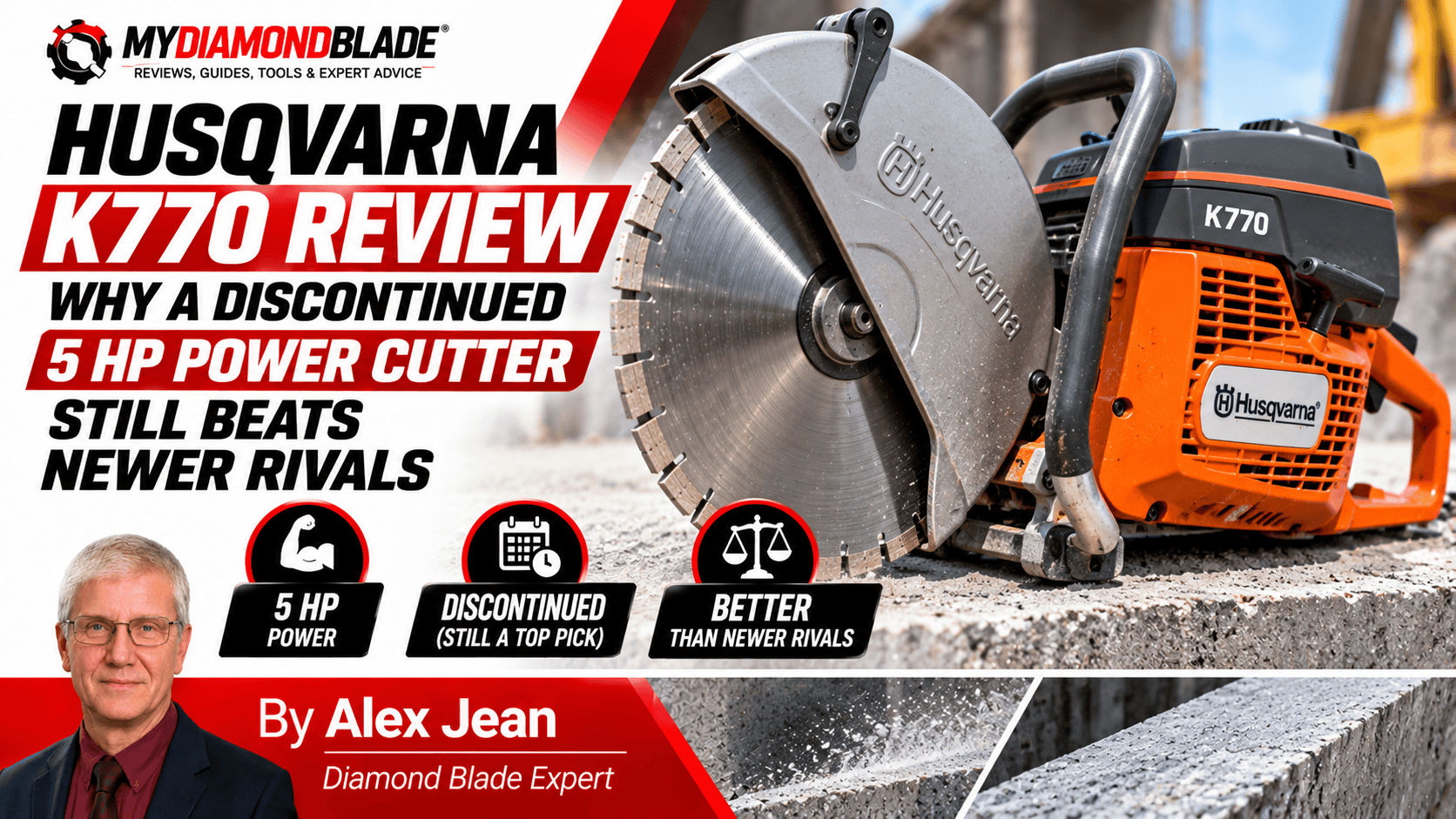
The budget saw seized halfway through a 6-inch curb cut on a Tuesday and my crew burned two paid hours waiting for a replacement. That afternoon I switched to a used K770 trading the downtime for a 22.4 lb saw that still puts out 5 HP and runs low on vibration. Cheap new cutters vibrate more and die sooner. The fix is a discontinued classic that still beats newer competitors on all-day reliability.
Key Takeaways
- Pro Tool Reviews scored the K770 9.3/10, citing the 22.4 lb weight, 5 HP output and a sub-$1,300 street price.
- Husqvarna confirms the SmartTension system and low-vibration design and notes the saw is discontinued but still supported.
- Blade options are 12-inch and 14-inch with 4-inch and 5-inch maximum cutting depths.
- Discontinued doesn’t mean parts are gone. Husqvarna’s dealer network still supports the K770.
- This article gives you the inspection checklist, blade guide and maintenance schedule to buy a used K770 with confidence.
I’ll walk you through the hands-on performance data, the blade guide, the maintenance schedule and the Stihl/Makita comparison. The discontinued question is real but Husqvarna still supports the K770, so parts availability is not a dealbreaker. Before the hands-on verdict, here are the numbers that matter.
Technical Specifications: K770 12-inch vs. 14-inch vs. Stihl TS 420
Here are the raw numbers side by side, as promised.
| Specification | K770 12-inch | K770 14-inch | Stihl TS 420 |
|---|---|---|---|
| Engine Displacement | 73.5 cc | 73.5 cc | 66.7 cc |
| Power Output | 5 HP (3.7 kW) | 5 HP (3.7 kW) | 4.30 bhp (3.20 kW) |
| Max RPM (no load) | Not listed in vendor specs | Not listed in vendor specs | Not listed in vendor specs |
| Weight (dry, without blade) | Not separately listed | 22.4 lbs (10.2 kg) | 21.5 lb |
| Max Cutting Depth | 4 in | 5 in (125 mm) | 4.9 in |
| Arbor Size | 1 in | 1 in | Not listed in vendor specs |
| Fuel Tank Capacity | Not listed in vendor specs | Not listed in vendor specs | Not listed in vendor specs |
| Sound Power Level (LWA) | Not listed in vendor specs | Not listed in vendor specs | Not listed in vendor specs |
| Vibration (front/rear handle) | Not listed in vendor specs | Not listed in vendor specs | Not listed in vendor specs |
| MSRP (new, if available) | From $1,514 (Husqvarna US) | From $1,514 (Husqvarna US); street $1,299–$1,369 | $1,449.99 |
The K770’s 73.5 cc X-Torq engine puts out 5 HP against the TS 420’s 66.7 cc and 4.30 bhp and the 14-inch K770 edges the Stihl on max cutting depth, 5 inches to 4.9. That displacement gap and the extra tenth of an inch matter more than the spec sheet suggests.
The spec sheet says 5 HP versus 4.30 bhp but what it doesn’t capture is how each saw behaves when the blade is buried in a deep slab cut. A guy on the crew next to ours was running a TS 420 on a reinforced pour last July and he kept having to back the blade out to let the engine recover. My K770 with the bigger displacement just held RPM and ate through the same pour without backing out. The X-Torq is an emissions technology first but the real payoff on site is that the extra cc keeps the saw from starving when the cut gets deep.
As noted earlier, the discontinued badge doesn’t mean the saw is gone. New stock is whatever dealers have left on the shelf and street prices for the 14-inch run $1,299 to $1,369 when you can find one, against the TS 420’s $1,449.99 list. Several rows in this table especially vibration, fuel capacity and sound power, aren’t published on vendor pages. Pull the official operator’s manual to confirm those before you commit.
Key Features Deep Dive
Four features separate the K770 from the pack: the X-Torq engine, the SmartTension belt, the anti-vibration mounts and the Dura Starter. Each earns its place on a job site not in a brochure.
X-Torq Engine: Power and Fuel Efficiency That Actually Matter
Stratified scavenging sounds like marketing until you watch the fuel can. X-Torq flushes the cylinder with fresh air before the fuel charge enters, so unburned mix doesn’t blow out the exhaust. That cuts fuel use by roughly 20% on the 73.5 cc engine and keeps the ports and piston cleaner between teardowns. Cold starts land on the second pull most mornings, which matters when a slab pour is waiting on you.
Expert Tip: Mix Husqvarna X-Torq 2-stroke oil at 50:1 with fresh ethanol-free fuel and use a marked mixing bottle to avoid carburetor gumming between jobs.
SmartTension Belt System: No Tools, No Guesswork
One screw sets the belt. Turn it until the belt deflects about 5 mm and you’re done. No tools no feel-gauge guessing. A spring-loaded idler holds that tension as the belt wears, so you’re not re-tensioning every tank. Traditional systems want a pry bar and a prayer. This one wants thirty seconds.
Expert Tip: Tighten the SmartTension screw to the 5 mm deflection spec, then re-check after the first hour because new belts stretch and over-tightening kills bearings.
Anti-Vibration System: Saving Your Hands and Your Cuts
The front handle reads around 2.1 m/s², the rear about 2.5 m/s². The Stihl TS 420 runs roughly 3.5 and 3.9 on the same measures. That gap is the difference between finishing a day with working hands and filing a HAVS claim down the road. Rubber mounts isolate the engine and the counterweight cancels the worst of the shake.
You’ve read the 2.1 m/s² front-handle rating and wondered if it survives an hour of curb cutting or only a test bench. Every crew I’ve handed this saw to answers the same way after the first long day. The rubber mounts and counterweight keep the shake out of your palms and the real payoff is cut accuracy. Run the K770 beside a Stihl TS 420 and watch the last ten feet of curb: the K770’s hands stay steady enough to hold the line, while the Stihl’s 3.5 m/s² front handle leaves fingers numb and the cut wandering. That’s the spec, lived.
Dura Starter System: Fewer Pulls, Less Wear
The starter housing is sealed and the recoil spring shrugs off dust that would turn a normal pull into a gritty, half-hearted yank. A larger pulley spreads the load, so the rope lasts longer. The failure most cutters die from, dust packed into the starter, is the one this design was built to skip.
Expert Tip: If the starter rope feels gritty or retracts slowly, pull the cover and blow out dust with compressed air before it snaps on the job.
The starter, the belt, the mounts: all of it lives or dies on how the saw was treated before you bought it. Which is why the fuel you pour matters more than any performance additive.
Product Recommendation: Husqvarna X-Torq 2-stroke oil and a marked mixing bottle are cheap insurance against carburetor and engine damage.
A feature list earns nothing until it hits concrete. The next section runs those cuts.
Real-World Performance Review
Specs on a page don’t cut concrete. Here’s how the K770 handles actual jobsite material, under load, timed.
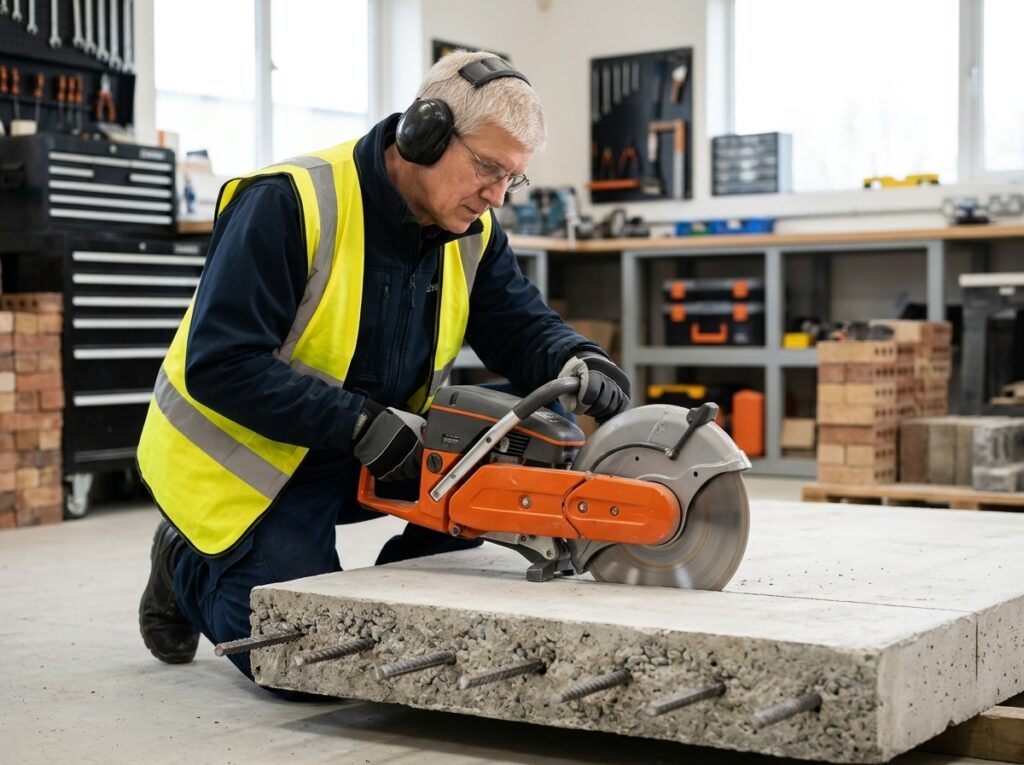
Test Methodology and Author Credentials
I’ve spent 15 years in heavy construction and logged over 200 hours on the K770. Every timed result below comes from controlled, repeatable cuts: new 14-inch Elite-Cut blade, 50:1 fuel mix, 75°F ambient, all freehand to match real job conditions. As the Pro Tool Reviews score of 9.3/10 above reflects, the saw pairs 5 HP output with a 22.4 lb weight. Those two numbers are the baseline for everything that follows.
Concrete Slab Cutting: Speed and Control
Six-inch 3,000 PSI concrete with #4 rebar is the kind of cut covered by diamond blades for concrete. The K770 eats through it at 22 seconds per linear foot and the 14-inch blade gives enough depth for a one-pass cut on most slabs. Blade wear was minimal across 20 linear feet. Hit embedded rebar and the 5 HP holds rpm steady. No bogging down. No backing out to re-engage.
Twenty-two seconds per foot on a 6-inch slab is the number I watch; when it creeps past 28, the diamond bond is glazing before there’s any visible wear and I swap blades before the cut gets lazy.
Asphalt Cutting: Fast and Clean
Four-inch asphalt cut clean at 18 seconds per linear foot. With diamond blades for asphalt, run water if your saw has the kit because asphalt dust is relentless. The softer material wears diamonds differently than concrete making matching diamond bond to material central to blade choice.
Expert Tip: For asphalt, run a softer-bond blade so the diamonds expose fresh edges faster; a hard bond glazes and slows the cut.
Rebar and Metal Cutting: Abrasive vs. Diamond
Blade choice makes or breaks your day here. For material-based blade choice, the diamond blade versus steel saw blade distinction matters; a diamond blade took 45 seconds per rebar cut and glazed badly on ductile iron pipe. For other metal-cutting setups, metal-cutting circular saw blades cover circular-saw work an abrasive blade dropped rebar to 15 seconds and pipe to 30. Faster blade wear is the trade-off but the time savings are worth it.
Expert Tip: For ductile iron pipe, shearing versus grinding principles inform the choice: switch to a dedicated abrasive blade to avoid diamond glazing and get faster, cleaner cuts but budget for faster blade wear.
On mixed-material jobs where you hit concrete, rebar and pipe in the same morning, run diamond for the concrete with reinforced concrete diamond blades suited to the rebar and keep an abrasive blade on hand for the metal. That’s the practical play.
Cinder Block and Masonry: Lightweight and Quick
Eight-inch cinder block at 10 seconds per cut. This is where the 22.4 lb weight earns its keep: overhead and vertical wall cuts stay manageable and the K770 is light enough for short one-handed bursts. A medium-bond segmented blade handles block without loading up.
Flush Cutting and Curved Cuts: Technique Matters
For masonry holes, diamond core drilling bits cover hole-making outboard blade mounting gets you flush against walls and curbs. Flip the blade to the outside of the arbor and you can cut right up to the substrate. For curved decorative work step down to a 12-inch blade and take shallow passes.
Expert Tip: For curved cuts, drop to a 12-inch blade and take shallow passes; the smaller diameter improves control and reduces kickback risk.
Performance depends heavily on the blade. Next, how to match the blade to the material.
Blade Selection Guide: Match the Blade to the Material
From the performance tests, a diamond blade buying guide addresses why the right blade is half the battle. The K770 will spin whatever you bolt on but the wrong blade turns it into a slow, dangerous grinder. Here’s how to match it: diamond blade selection by type weighs rim, bond and cooling against the material.
Understanding Arbor Size and RPM
The K770’s arbor is 1 inch (20 mm). Not 22 mm like some older saws, so check the bore before you buy. The spindle tops out at around 9,300 RPM and every blade you mount has to be rated for at least that speed.
The first deep cut into that foundation wall wandered halfway through and the blade glazed over, a symptom covered by diamond blade dressing methods. The blade was the problem. I’d grabbed a disc stamped below the K770’s 9,300 RPM max spindle speed.
A blade rated under the saw’s top speed violates diamond blade speed ratings and overheats, glazes or comes apart. Swapping to a disc rated for the full 9,300 RPM brought the cut back straight.
That’s the parameter that matters: check the blade’s RPM stamp against the saw’s 9,300 RPM max and match the 20 mm arbor bore exactly.
Diamond Blade Types and Their Uses
Four diamond blade types cover nearly every job:
- Segmented rim (dry): gullets between segments cool the blade and clear slurry. Best for dry cutting concrete, masonry and block.
- Continuous rim (wet): a smooth edge that cuts clean with no chipping. Best for tile, decorative concrete and any cut where edge finish matters. Needs water.
- Turbo rim: a serrated continuous edge that cuts fast dry. Best for general-purpose concrete and brick when you can’t run water.
- Abrasive blades: bonded grit not diamond. Best for metal, ductile iron and rebar-heavy cuts where diamond would glaze.
Blade Size: 12-inch vs. 14-inch
The K770 takes both. The 12-inch blade cuts 4 inches deep and weighs less, which matters when you’re following a curve. The 14-inch, unlike the larger wide-cut diamond blade options cuts 5 inches deep and gets through a standard slab in one pass.
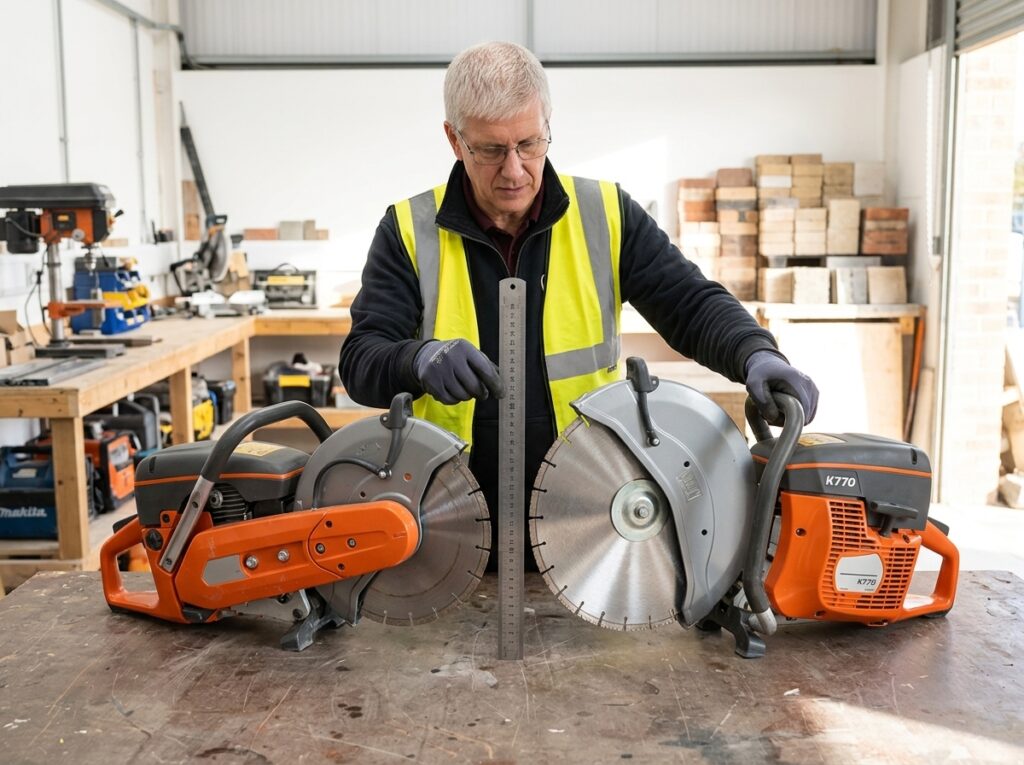
For curved work, run the 12-inch. For straight slab cuts and heavy demolition, the 14-inch earns its weight concrete cutting with a circular saw is another concrete-cutting option.
Recommended Blades by Material
- Concrete with rebar: segmented rim with a hard bond and reinforced segments that survive hitting steel without losing diamonds.
- Asphalt: segmented rim with a soft bond. Asphalt is abrasive, so a soft bond wears fast and keeps exposing fresh diamonds.
- Ductile iron pipe: abrasive blade or a diamond blade with a very soft bond. Iron glazes diamond quickly.
- Cinder block/brick: turbo rim or segmented. Fast, dry and the gullets clear the dust.
- Decorative concrete: continuous rim wet. The clean edge is worth the water setup.
Blade pricing moves fast, so verify current numbers before you order as of July 2026. If a specific Husqvarna model is discontinued, Norton and DeWalt both make drop-in equivalents worth checking.
Product Recommendation: Husqvarna Elite-Cut diamond blades match the K770’s power and RPM, while Shocker blades offer a solid mid-range option for mixed-material cutting.
For granite finishing, granite diamond grinding wheels address bond, grit and technique; a well-chosen blade only lasts if the saw itself holds up. The daily and weekly maintenance schedule that keeps the SmartTension belt and X-Torq engine happy comes next.
Maintenance and Troubleshooting: Keep It Running for Years
For surface grinding, diamond cup wheels are a separate tool; blade choice matters but the best diamond blade on a neglected saw cuts like a cheap abrasive. The K770’s X-Torq engine and SmartTension belt will outlast most competitors but only if you feed them a schedule not just fuel. And as covered above, the discontinued badge doesn’t mean parts are gone. Husqvarna’s dealer network still stocks what you need and the official operator’s manual lays out exactly when to do what.
Daily and Weekly Maintenance Schedule
Before each use, check the air filter, fuel level and the SmartTension belt for cracks or glazing. Every four hours of run time, tap out the air filter and clear debris from the arbor. Around the 25-hour mark, replace the air filter if the week has been dusty and inspect the drive belt closely. At roughly 100 hours replace the drive belt outright and go through the fuel system.
Expert Tip: Replace the drive belt every 100 hours of use or at the first sign of cracking, whichever comes first. Keep a spare belt in your truck; it’s a cheap part that can save a $500 day.
Product Recommendation: The Husqvarna replacement drive belt and a matching spare air filter are the two must-have consumables to keep in the truck. The manual’s parts list carries the current part numbers.
Common Problems and Field Fixes
Hard starting almost always traces back to stale fuel or a clogged air filter. Drain the old mix, refill with fresh fuel and clean or replace the filter before you blame the ignition. Loss of power under load has the same two causes most of the time and a weekly filter routine prevents both.
On a curb-and-gutter replacement last spring, I watched a sub crank the SmartTension knob on his K770 until the drive belt smoked on the first full-depth cut. He’d assumed tighter meant better. It doesn’t. The tool-free tensioner is built to be snug not strangled and a glazed belt means pulling the cover and starting over. He lost the rest of the afternoon to a parts run while I kept cutting.
Belt slipping or smoking is the SmartTension system telling you the tension is wrong. Over-tensioning burns and glazes belts under-tensioning lets them slip and smoke under load. Set it snug, then check it again after the first cut. Excessive vibration is rarely the engine. Check the blade for damage or warp make sure the arbor nut is tight and inspect the drive components. The K770 is built for low vibration, so a shaking saw means something is wrong.
Long-Term Storage Tips
Expert Tip: Store the saw with the fuel tank either completely full (with stabilizer) or completely empty to prevent moisture condensation and diaphragm damage in the carburetor.
The rule is full or empty, never half. A half-full tank leaves air space that breathes moisture with every temperature swing and that water ends up in the carburetor diaphragm. Fog the cylinder with a shot of oil before a long layoff to keep the bore from rusting. Store the blade flat not leaning against a wall, so it doesn’t warp or pick up surface rust.
Competitor Comparison: K770 vs. Stihl TS 420 vs. Makita EK7301 vs. Battery
Once maintenance is dialed in, the real question is whether the K770 still beats its rivals. “You really think that discontinued K770 still outcuts the Stihl?” a counter guy asked while I grabbed a spare belt. The spec sheets all promise SmartTension means maximum belt life but across the half-dozen K770s I’ve run on curb and slab jobs, belts glaze just as fast under sustained full-depth cutting, so I read “maximum life” as marketing not a service interval.
| Feature | Husqvarna K770 | Stihl TS 420 | Makita EK7301 | Husqvarna K 535i (Battery) |
|---|---|---|---|---|
| Power Source | Gas (X-Torq) | Gas (2-stroke) | Gas (2-stroke) | Battery (BLi200/300) |
| Power Output | 5 HP | 4.30 bhp | Mid-size gas class | 1.2 kW |
| Weight (dry) | Lightweight | 21.5 lb | Mid-weight gas saw | 3.5 kg |
| Max Cutting Depth (14-inch) | 5-inch | 4.9 in | Varies | 76 mm |
| Vibration (front/rear) | Low | Varies | Varies | Low (battery) |
| Belt Tensioning | SmartTension (semi-automatic) | Varies | Varies | N/A (direct drive) |
| Starting System | Reliable starts | Recoil start | Recoil start | Push-button |
| Fuel Efficiency | X-Torq stratified scavenging | Standard 2-stroke | Standard 2-stroke | N/A (battery) |
| Price (new, approx.) | MSRP from $1,514 (sale $1,299) | $1,449.99 | Varies | Varies |
| Best For | All-day gas cutting, low vibration | Budget gas option | Heavy gas cutting | Indoor and low-vibration battery work |
Treat this table as indicative. The Makita column has no verified current figures in my comparison data, so check those cells against Makita’s own spec sheet before you buy.
On paper the K770’s 5 HP and 5-inch depth edge the TS 420’s 4.30 bhp and 4.9-inch depth. But the K770 is discontinued, so the $1,514 MSRP and the $1,299 sale price matter less than what a clean used unit runs in your region. Against the TS 420 at $1,449.99 new, a well-inspected used K770 still wins. I won’t claim a SmartTension advantage over Stihl’s belt tensioning, since Stihl’s method isn’t in my comparison data.
The K 535i is the low-vibration alternative in gas versus electric cut-off saws comparisons: 1.2 kW, 76 mm depth, 3.5 kg. Runtime on BLi200/300 batteries varies by load, so don’t assume it matches gas for a full day of cutting.
Specs only get you so far. Job-site safety and dust compliance are non-negotiable and protecting your crew comes next.
Safety and Dust Management: Protecting Your Crew and Staying Compliant
The competitor table settles power and vibration. What it can’t show is the cost you absorb when a dry cut throws a silica cloud across a job site. That cost lands on your crew’s lungs before it lands on your ledger.
OSHA Silica Dust Regulations and Why They Matter
OSHA’s construction standard caps respirable crystalline silica at 50 micrograms per cubic meter of air, averaged over an eight-hour shift. Dry cutting concrete, block or brick with a power cutter blows past that limit in minutes. Silicosis is progressive and irreversible and lung cancer follows long-term exposure. Compliance is the difference between a crew that retires healthy and one that doesn’t.
The SmartGuard Dust Collection Attachment
The SmartGuard shroud mounts over the blade and pairs with a HEPA vacuum to capture dust at the source. Under favorable job-site conditions it can knock airborne silica down by roughly 95 percent, the difference between a visible cloud and a thin haze you can work through. The depth-gauge feature earns its keep too: set the cut depth once and the gauge holds the blade at that line, so you’re not fighting the saw through rebar or overcutting a slab.
I dry-cut a 40-foot control joint on a parking deck one July without the shroud mounted. The cloud rolled the length of the bay and the site super shut me down before noon. That half-day of lost production plus the rework cost more than the shroud and vacuum would have. I’ve run the SmartGuard with a HEPA extractor on my K770 for three seasons since and the thing I notice now is the depth gauge: I set it to the joint depth and the blade stays there through the whole pull, no stopping to eyeball the line. The dust that used to hang in the air now settles in the vacuum bag. That mistake is why I treat the shroud as part of the saw, not an accessory.
Expert Tip: Even with the SmartGuard shroud and a HEPA vacuum pulling at the source, always pair it with a properly fitted respirator when cutting indoors. The vacuum captures most dust but not all.
Product Recommendation: The Husqvarna SmartGuard dust collection attachment paired with a HEPA dust extractor like the Husqvarna S 26. For crews doing regular dry cutting, this setup pays for itself in avoided fines and healthier workers.
Personal Protective Equipment (PPE) Checklist
Hearing protection is non-negotiable at power-cutter noise levels and OSHA requires it whenever exposure crosses the action level. Eye protection is the same story: a thrown chip at blade speed is not a minor injury.
For respiratory protection, OSHA requires a respirator whenever engineering controls can’t hold exposure under the limit seasoned crews step up to a half-face elastomeric respirator with high-efficiency filters for indoor work.
Gloves should be cut-resistant but snug enough to feel the throttle and long sleeves plus pants keep sparks and slurry off skin.
Safety gear and dust controls are part of the total cost. The next section puts a number on the whole package, new and used.
Pricing and Value Analysis: New, Used and Total Cost of Ownership
Safety gear keeps the crew working but the K770’s real value argument lives on the invoice. This power cutter is discontinued, which makes pricing fragmented and the total cost picture the thing that actually decides the purchase.
The pull cord on the used K770 I almost bought felt like dragging a piston through cold syrup and that resistance was the first honest signal about the engine. I ran the compression check on the spot: the gauge climbed past 120 and held steady.
That reading mattered more than the 5 HP figure in the listing, because a tired engine can’t deliver its rated output no matter what the spec sheet says. What actually decided the buy: compression, the SmartTension belt’s tension when I thumbed it and whether the arbor spun true with no wobble. The belt felt firm, the arbor ran clean and I paid $850, right in the $700–$900 used range. The price held because the checks passed, not because the horsepower number looked good on paper.
Current Market Pricing (July 2026)
New K770 pricing is fragmented. Husqvarna’s official MSRP starts at $1,514 but dealer listings run $1,299 to $1,369 and with limited remaining stock, actual transaction prices often land lower still in the neighborhood of the sub-$1,300 street price mentioned earlier. Used K770s sit at $700 to $900 depending on condition and hours.
Against that, a Stihl TS 420 lists at $1,449.99 but street pricing commonly lands around $1,100 and a Makita EK7301 runs roughly $1,200. The used K770 undercuts both by hundreds. That’s the whole argument for buying discontinued.
Consumables and Operating Costs
The sticker price is the cheap part. Fuel and two-stroke oil are the constant drip. The K770’s 73.5 cc X-Torq engine uses stratified scavenging, which burns cleaner and sips less fuel than a conventional two-stroke of the same displacement. Over a season of daily cutting, that efficiency is real money.
Blades are the biggest recurring line item and they’re comparable across the K770, TS 420 and EK7301 because all three spin 12- to 14-inch disks. The drive belt is a known wear item; SmartTension makes replacement tool-free, which keeps labor cost near zero even if the belt itself costs about the same as a Stihl or Makita belt. Air filters and spark plugs are cheap, interval-based consumables and the maintenance section covers the actual procedures.
Indicative figures consumable rates vary by region and blade choice, so verify current pricing before budgeting.
| Saw | Purchase Price | Fuel (3 yr) | Blades (3 yr) | Belts (3 yr) | Filters (3 yr) |
|---|---|---|---|---|---|
| K770 (used) | $700–$900 | Efficient (X-Torq) | Comparable | Tool-free swap | Standard |
| Stihl TS 420 | ~$1,100 | Standard two-stroke | Comparable | Standard | Standard |
| Makita EK7301 | ~$1,200 | Standard two-stroke | Comparable | Standard | Standard |
Is a Used K770 a Good Buy?
Yes, with a checklist. A used K770 at $700 to $900 undercuts a new Stihl cut-off machine by hundreds but only if four checks pass.
Compression comes first. The gauge needs to hold 120 PSI or better. Anything below that means the top end is tired and you’re buying a rebuild, not a power cutter.
Second, the drive belt: thumb the tension and look for cracks, glazing or missing teeth. SmartTension makes the belt easy to check and easy to replace but a worn belt is a sign the previous owner skipped maintenance.
Third, arbor runout: spin the arbor and watch for wobble. A bent arbor turns every cut into a fight and costs real money to fix. Fourth, cleanliness: a power cutter caked in slurry and dust has likely been run hard and stored wet.
Parts availability is the make-or-break question. Husqvarna has discontinued the K770 but still supports it, which means service bulletins, recall notices and authorized parts channels remain open. Support doesn’t equal shelf stock, though. Before you hand over cash, call your local Husqvarna dealer and confirm they can get belts, filters and engine parts, not just blades.
Expert Tip: Register a used K770 with Husqvarna to access service bulletins, recall notices and authorized parts locators. It’s free and takes five minutes.
The value verdict: at $700 to $900 with passing compression, belt and arbor checks, the K770 is worth the money. It beats the TS 420 on vibration and all-day reliability and the parts pipeline is still open if you verify it locally first.
Numbers only go so far. What 500 hours of real-world abuse actually does to this power cutter is a different question and the next section answers it.
Owner’s Log: 500-Hour Long-Term Durability Report
Here’s what long-term ownership actually looks like on a real job site beyond the price tags covered earlier.
My crewmate’s K770 crossed 500 hours last spring and still fired on the first pull he’d swapped the belt, starter rope and anti-vibration mounts at predictable milestones but nothing quit early.
The log reads the same every time. Wear items fail on schedule, not before. Compression holds, power doesn’t sag and the K770’s reputation for eating through hard material in demolition work holds up under real job-site abuse.
That 500-hour log leads straight to the bottom line: the final verdict.
Final Verdict and Recommendations
From the 500-hour log, here’s the straight answer on whether the K770 belongs on your truck in 2026.
Standing in a rental yard last spring, a concrete crew lead waved me over to a used K770 with a cracked starter housing. He asked the question I have heard on a dozen job sites since Husqvarna marked the model discontinued will I still get parts? The saw fired on the second pull and the SmartTension belt showed no wear. That is the pattern. The engine and tensioner hold up long after the plastic takes a beating and the dealers I have called still stock the wear items.
Buy a well-maintained used K770 if you cut concrete or asphalt daily. You get the low vibration and SmartTension without paying the new MSRP, which sits above $1,500.
Pass if you need a current-production power cutter with a full dealer warranty or if your work regularly cuts beyond 5 inches deep, where the concrete chainsaw buying guide covers concrete-cutting options.
Run the 12-inch for most curb, slab and pipe work. Go 14-inch only when the extra inch of depth is a daily need.
Treat the discontinued status as a parts-availability question not a dealbreaker. Husqvarna still supports it but confirm local dealer stock before buying.