Chain wear and water failures eat profit faster than any saw price difference. The rental saw seized halfway through a 12-inch reinforced wall and the top-7 list I’d trusted never mentioned that its chain would glaze without enough water. That failure cost me a day of downtime and a new chain. It’s why I stopped trusting generic reviews.
Key Takeaways
- Chain life, not sticker price, drives your real cost: a cheap saw that burns chains can cost more per year than a premium one
- Match power source to the job: gas outdoors, hydraulic for indoor and underwater work, electric for occupied buildings
- Water flow is non-negotiable: insufficient flow glazes diamonds and kills chains fast
- A pre-tensioned spare chain and a 5-minute swap beat an hour of downtime every time
- Run the numbers before you buy; the calculator in this guide makes it quick
Generic reviews don’t tell you which saw survives a 12-inch reinforced wall. They list the top 7 saws but they skip the job-site reality: chain bond, water flow, kickback. This guide gives you scenario-tested picks, a TCO calculator and a day-in-the-life case study from a real job.
Before comparing saws understand the three things that decide whether a saw lives or dies on the job: the chain, the power source and the water.
How Concrete Chainsaws Work
You already know what a diamond chainsaw is. What decides whether it earns its keep comes down to three things: the chain, the power source and the water.
Diamond Chain Technology
A diamond chain doesn’t cut like a wood saw’s teeth. It grinds rather than shearing material; shearing versus grinding explains the difference between abrasive removal and shearing action. The chain carries segments or a continuous rim loaded with diamond grit held in a metal bond; diamond blade types compare similar formats for concrete cutting. As you cut, the bond wears away, exposing fresh, sharp diamonds underneath. That abrasive mechanism also explains how diamond blades work. That self-sharpening action keeps the chain biting as long as the bond wears at the right rate for the material you’re in.
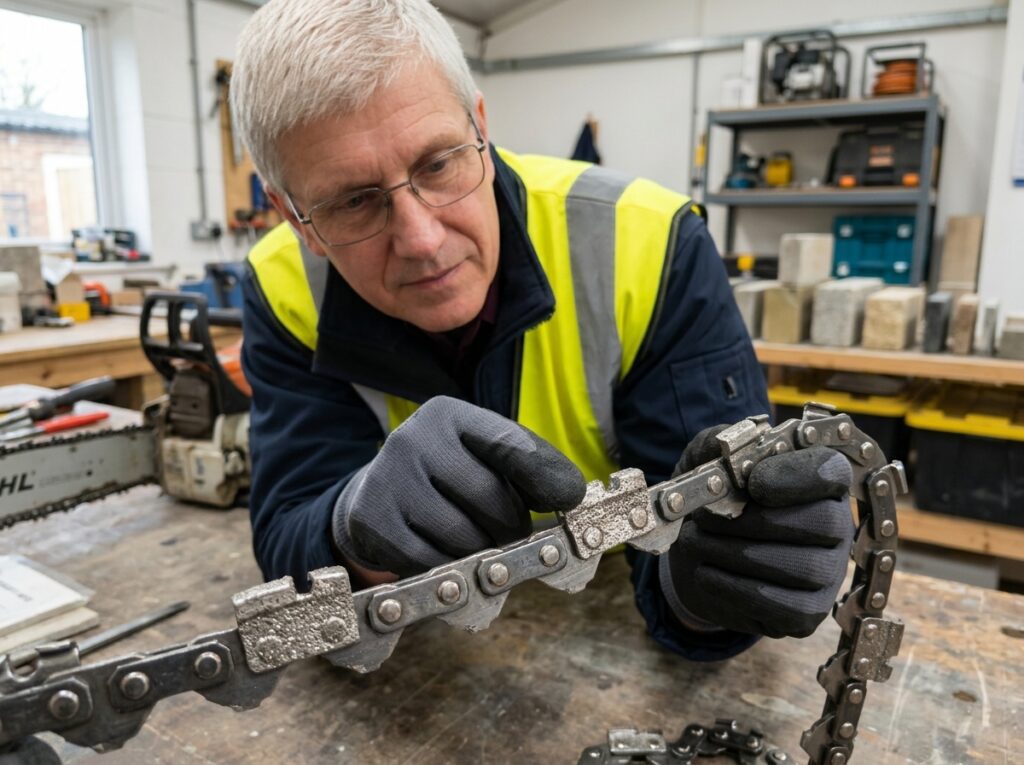
Expert Tip: Match the diamond chain bond to the material: harder bonds for reinforced concrete, softer for abrasive brick or block. The wrong bond can halve chain life.
Segmented chains have gaps between the diamond sections, whereas segmented versus continuous rim blades explains how those rim designs affect porcelain edges. Those gaps let slurry and debris flush out, so the chain runs cooler and keeps cutting in deep, dusty cuts. Continuous rim chains give a smoother finish and less vibration but they clog easier if water flow drops for porcelain tile edges, cutting porcelain without chipping depends on a suitable blade and cutting approach. For a 12-inch reinforced wall, I want segments. For a clean architectural opening, the continuous rim earns its place.
Power Sources: Gas, Hydraulic and Electric
Gas saws win on portability. No hoses, no power unit just fuel and go. The Husqvarna K 970, ICS 680GC and Stihl GS 461 all run on gas and handle outdoor demolition without a tether. Exhaust is the trade-off. You need ventilation and you’re breathing fumes all day.
Hydraulic changes the feel. The ICS 890F4 runs off a separate power unit, so you get continuous torque with no exhaust at the saw. That matters when you’re buried in a basement or cutting inside an occupied building. The downside is the hose whips and the power unit itself. You’re not walking far without dragging a line.
The spec sheet says 20.9 pounds but that’s before you bolt on the bar and chain. I watched a guy on a bridge demo fight a Husqvarna K 970 for six hours on a vertical cut. By noon he was bracing the saw against his thigh just to keep the nose from dropping. The extra weight of the bar and chain doesn’t sound like much until you’re holding it at shoulder height. A brochure number and a shift on the wall are two different things.
Electric and hydraulic-electric saws fill the indoor niche. No exhaust, low noise and they run all day on building power. You give up the free movement of gas but when the job is inside a hospital or a school that’s the only way the inspector lets you work.
The Critical Role of Water Cooling
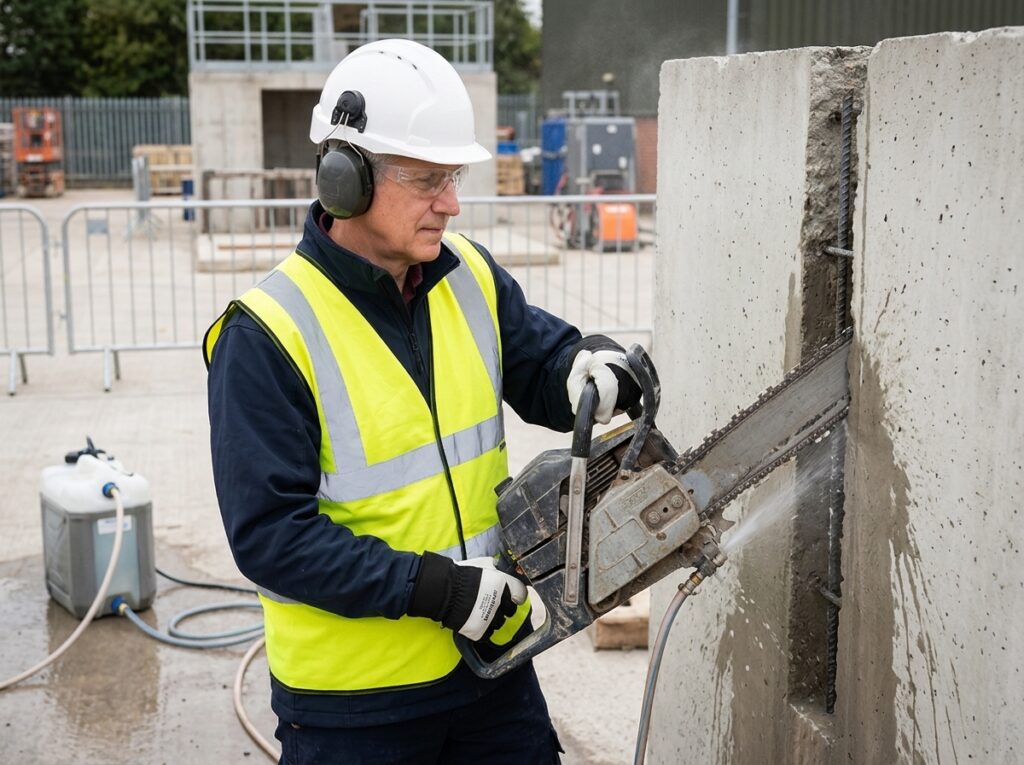
Water does two jobs and both are non-negotiable. First, it cools the chain. Without enough flow, the diamonds overheat, the bond glazes and the chain stops cutting; for a glazed diamond blade, diamond blade dressing methods cover ways to restore its cutting action. You can ruin a chain in seconds. Second, water knocks down respirable silica dust. OSHA’s silica standard exists because dry cutting concrete puts dust in your lungs that never comes out.
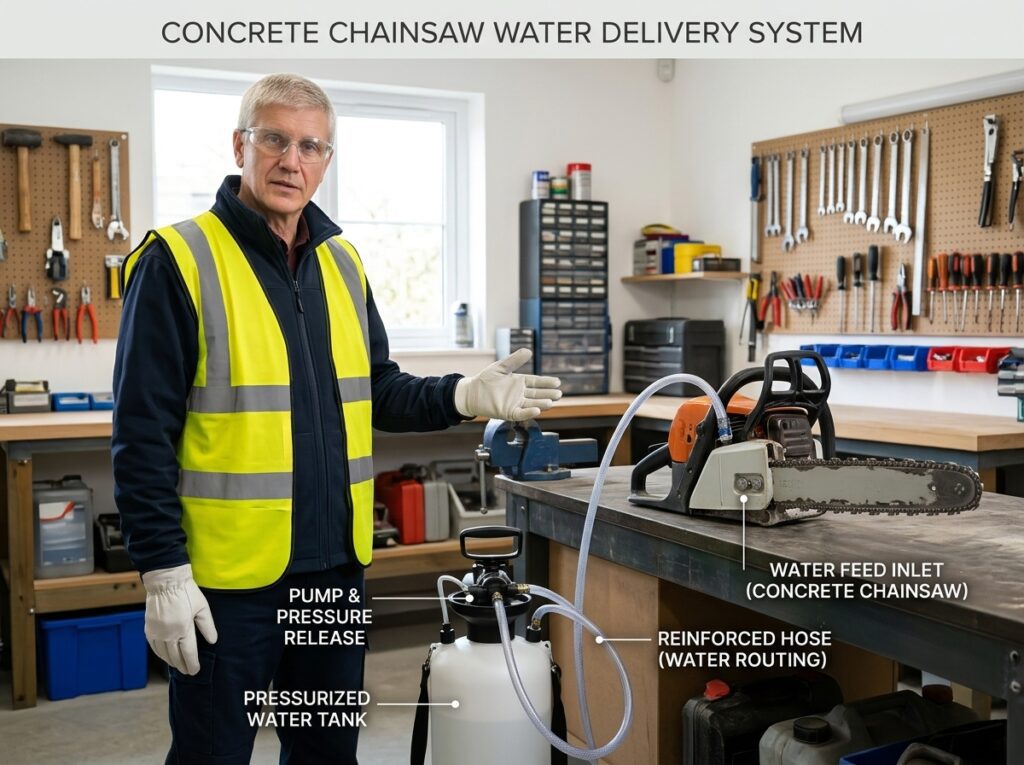
Minimum water flow is 1.5 gallons per minute. Hydraulic saws need 2 GPM. Fall below that and you’re trading chain life for nothing.
Expert Tip: Check water flow before every cut. A kinked hose or clogged nozzle can ruin a chain in seconds, so keep a spare nozzle and a pre-tensioned chain on site.
Dedicated water tanks and diaphragm pumps beat a garden hose every time. A pressure washer pump with a 50-gallon tank gives you consistent flow and pressure even when the job site’s water line is a hundred feet away. The hose routing matters too: keep it off the ground where you’ll step on it and tie it to the saw so it doesn’t kink at the swivel.
Get these three right and the saws below will do what the spec sheet promises when the chain hits rebar.
Top Product Reviews
Five saws dominate the concrete chainsaw market. Here’s how each one actually behaves when it’s buried in a wall.
Husqvarna K 970 Chain, Gas-Powered Workhorse
The K 970 Chain is the saw I reach for when the job is straight-up outdoor demolition and I need depth without dragging hoses. Gas-driven, 14-inch bar, 6.5 hp X-Torq engine and it’ll push a 15 to 16-inch cut from one side. It weighs around 20.9 pounds without the cutting equipment which puts it in the middle of the gas pack. Not the lightest not the heaviest.
Product Recommendation: The K 970 Chain is the go-to for deep cuts in heavy rebar, with a 14-inch bar and 6.5 hp gas engine that handles outdoor demolition and foundation work.
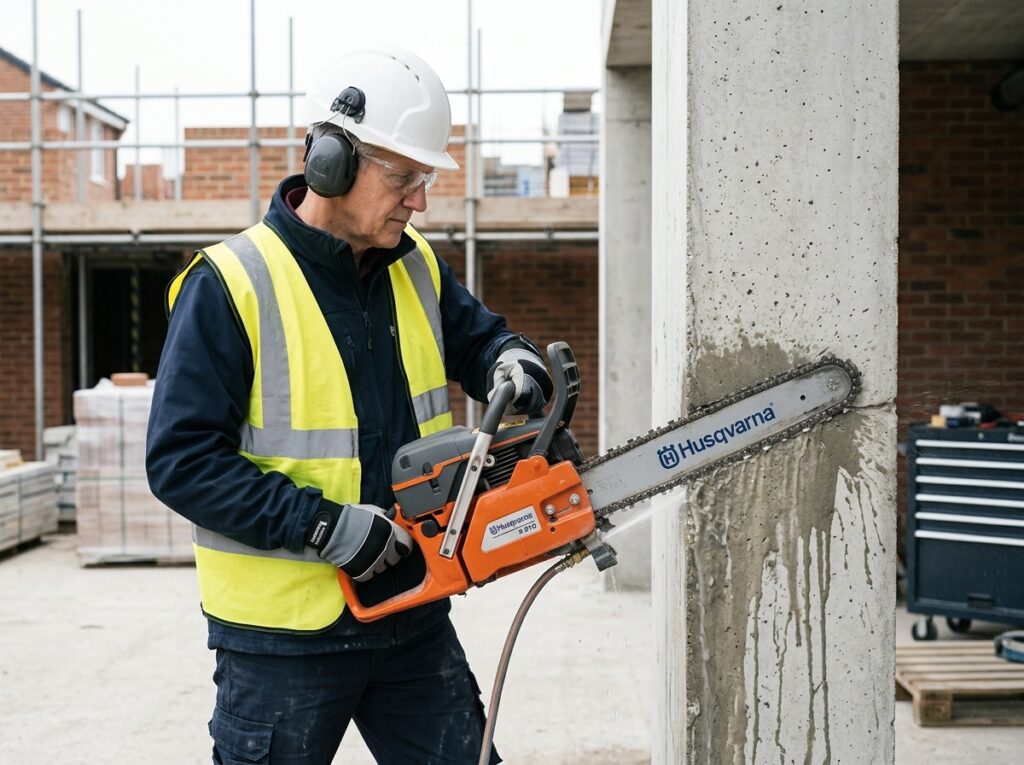
What the spec sheet won’t tell you is how the power-to-weight ratio plays out after four hours of vertical cuts on a foundation wall. The 6.5 hp keeps the chain moving through dense rebar without the bog-down you get from cheaper gas saws. The weight is manageable overhead for short stretches.
But the tensioner is finicky. It backs off under heavy vibration and a loose chain on a gas saw cutting 16 inches deep is a problem you notice when the chain derails and you’re staring at lost time on the clock.
Expert Tip: On the K 970, replace the drive sprocket and chain together every 20 hours, a worn sprocket chews up a new chain in minutes.
Pros: Deep cuts from one side strong torque through heavy rebar no hoses to manage. Cons: Tensioner needs constant attention, gas fumes rule it out for indoor work vibration fatigue on long cuts.
Best for: outdoor foundation cuts and demolition where you need 15-plus inches of depth and ventilation isn’t a concern.
ICS 890F4, Hydraulic Power for Demanding Cuts
The 890F4 is a different animal. Hydraulic powerhead, 23.5 pounds with hose whips, bar depths available at 10, 15, 20 and 25 inches. Minimum water flow is 2 GPM at 20 psi, operating speed 6,100 rpm. This is the saw you want when the job has no room for compromise on power or air quality.
Product Recommendation: The ICS 890F4 is the top choice for continuous, fume-free cutting in underwater, indoor, and heavy-rebar work, with bar depths from 10 to 25 inches.
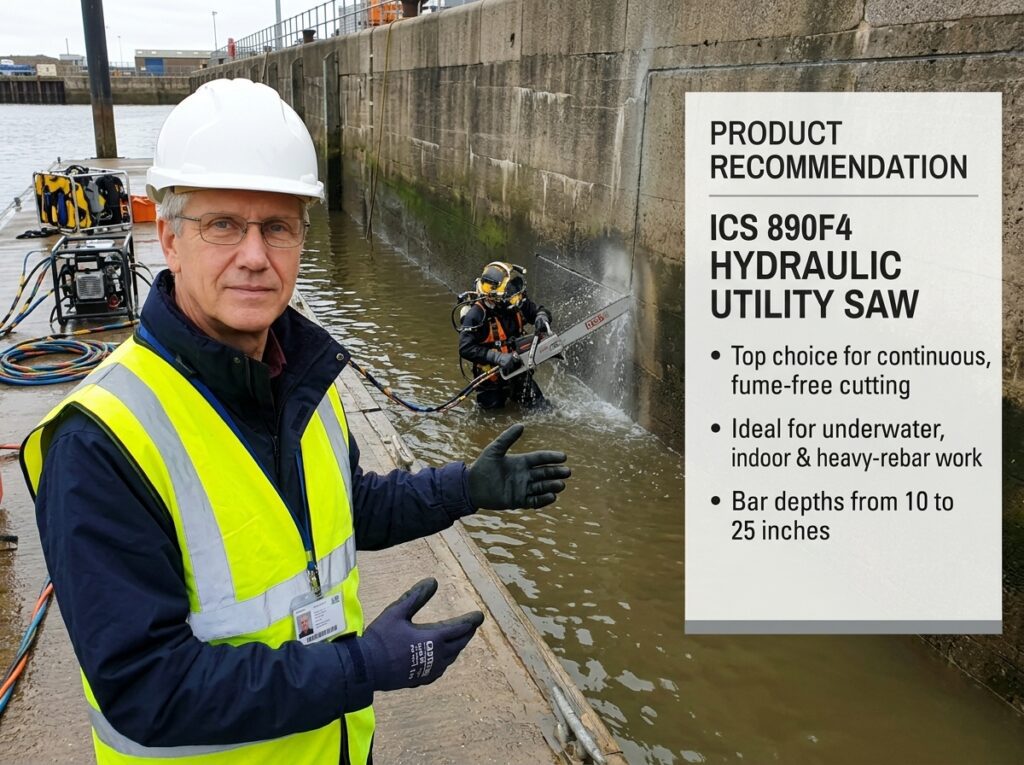
Continuous torque is the real story here. Gas saws surge and settle with throttle position. Hydraulic power delivers steady pull through the entire cut, so the chain doesn’t glaze from intermittent pressure. No fumes, either, which is why it works underwater and in sealed basements.
The tradeoff is the power unit. You need a hydraulic pump skid and that’s weight and cost most guys don’t factor in until they’re loading the truck. The saw itself is 23.5 pounds but the supporting equipment turns a one-man job into a two-man logistics problem.
Expert Tip: For overhead or awkward-angle cuts, pair the 890F4 with a lightweight power unit and shoulder harness to manage hoses and reduce fatigue.
Pros: Continuous torque, fume-free, cuts up to 25 inches deep, works underwater.
Cons: Requires hydraulic power unit (cost and weight), hose management adds complexity, higher total investment.
Best for: indoor, underwater and heavy-rebar cuts where gas fumes or torque drop-off will kill the job.
ICS 680GC, Balanced Gas Performer
The 680GC is the daily driver. Gas-powered, 21 pounds with bar and chain available with 12-inch and 14-inch guide bars. It sits at a lower price point than the K 970 or the 890F4 and for a lot of crews that’s the whole decision.
Product Recommendation: The ICS 680GC is the dependable, portable daily driver, with 12- and 14-inch bars and a gas engine that won’t break the bank.

What I like about the 680GC is that it doesn’t pretend to be something it isn’t. It starts, it cuts and it’s light enough to hand off to the new guy without a twenty-minute lecture. The 12-inch bar handles most residential slab and wall openings. Step up to the 14-inch bar for deeper cuts and you give up some maneuverability.
The air filter is the weak link. Concrete dust packs it fast and a clogged filter drops power before you notice the saw getting sluggish.
Expert Tip: On the 680GC, carry a spare air filter and clean it daily, concrete dust clogs it fast, cutting power and wasting fuel.
Pros: Affordable, portable, easy to hand off, two bar options cover most daily work.
Cons: Less power than the K 970, no indoor capability, air filter needs daily attention.
Best for: day-to-day residential and light commercial cuts where you need portability and cost control more than maximum depth.
Diamond Products CC1600, Electric/Hydraulic for Indoor Precision
The CC1600 gets mislabeled more than any saw in this category. It’s a hydraulic-powered wall saw with a 36-inch blade capacity, available with a 3.8 or 5.2 cubic inch motor and a max of 30 GPM at 3000 psi. This is not a handheld chainsaw. It’s a wall saw system and treating it like one gets you hurt or wastes the machine’s capability.
Product Recommendation: The CC1600 is a hydraulic-powered wall saw with 36-inch blade capacity, ideal for zero-emission indoor precision cuts where power access is available.
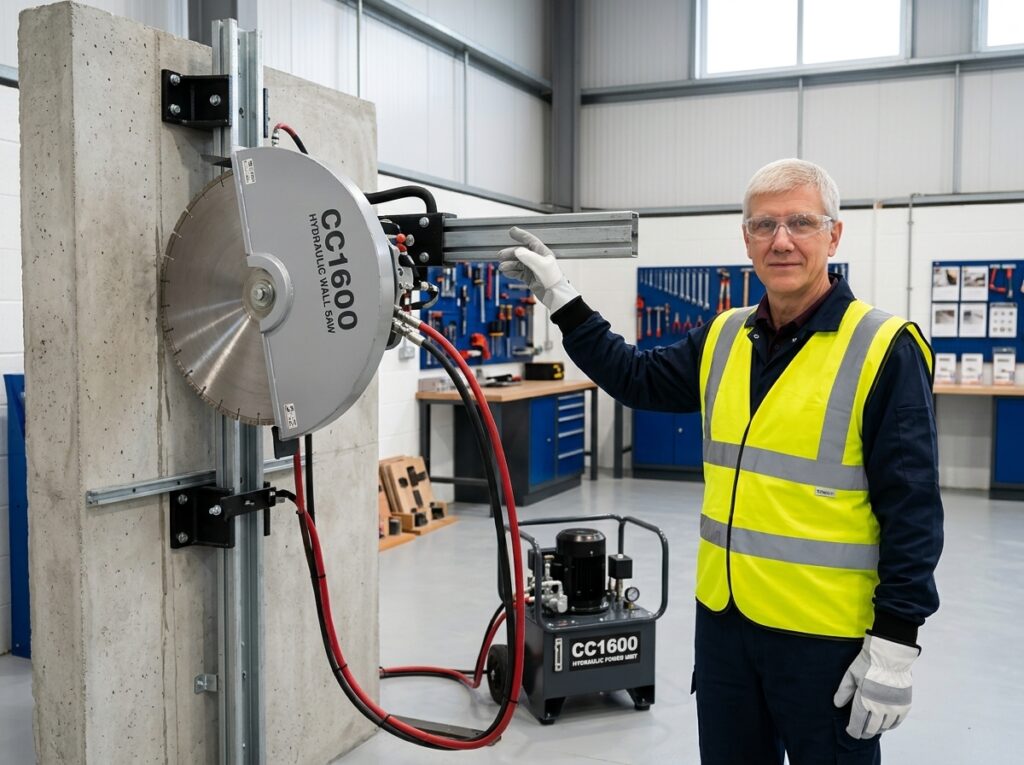
The CC1600 shines in indoor environments where fumes are a hard no and precision matters more than portability. Zero emissions at the cut site. The 36-inch blade capacity means deep, clean cuts through thick reinforced walls in a single pass.
But you need power access for the hydraulic unit and the setup time is real. This isn’t a grab-and-go saw. It’s a planned-operation saw for jobs where the cut has to be right the first time.
Expert Tip: For the CC1600, match the power unit’s hydraulic flow and pressure to the saw’s 30 GPM / 3000 psi max to avoid overheating.
Pros: Zero emissions at cut site, 36-inch capacity for deep precision cuts, hydraulic consistency.
Cons: Not portable in the handheld sense, requires power access and setup time, higher investment for specialized use.
Best for: planned indoor precision cuts on thick reinforced walls where ventilation is limited and accuracy is non-negotiable.
Stihl GS 461, Precision Gas Saw for Confined Cuts
The GS 461 is the tight-quarters specialist. 76.5 cc gas engine, 16-inch cutting length with a 15.7-inch cutting capacity. The feature that sets it apart is the guide bar with forward-pointing water nozzles. That sounds like a minor detail until you’re on your knees trying to make a flush cut along a floor edge and the water delivery from a rear-nozzle saw can’t reach the cut zone.
Product Recommendation: The Stihl GS 461 is the precision pick for flush cuts and tight corners, with a 16-inch cutting length and forward-pointing water nozzles.
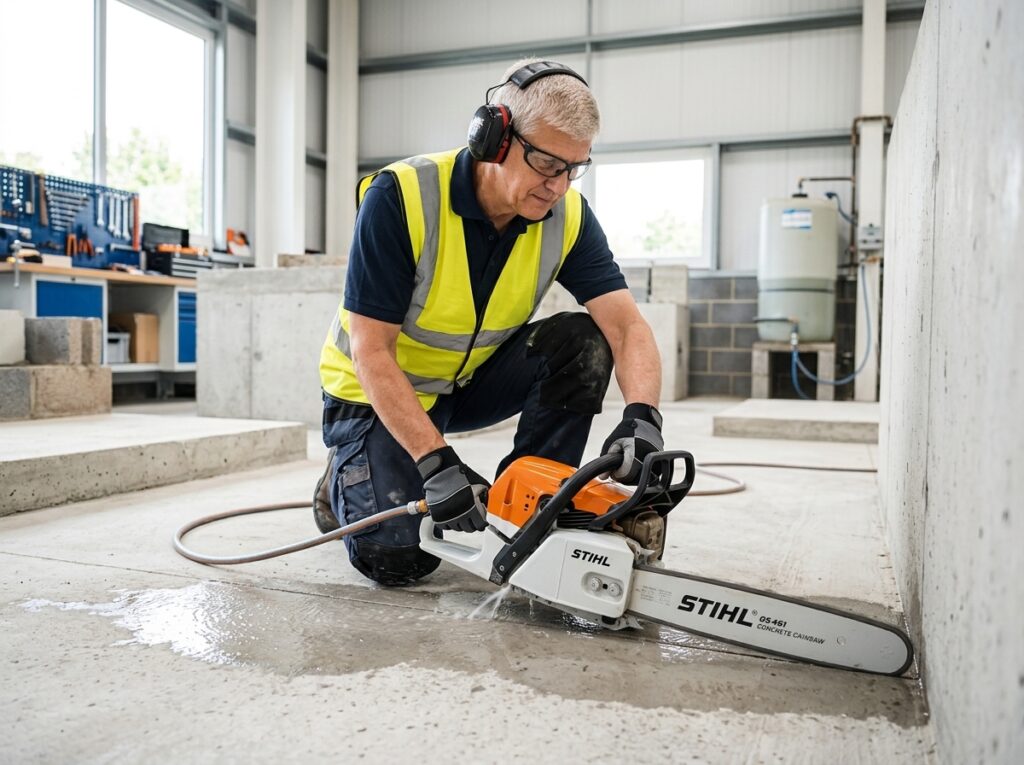
Ever notice how some saws starve the chain of water exactly when you need it most? The GS 461’s forward-pointing nozzles fix that. I’ve run flush cuts along floor edges where a rear-nozzle saw sends water to the back of the bar and the chain runs dry at the cut face. The forward nozzles put water where the diamonds are doing the work.
Chain stays cool, cut stays clean and you don’t glaze the bond halfway through. The tradeoff is chain life in heavy rebar. The 76.5 cc engine is tuned for control not brute force and pushing it through dense #5 rebar mats burns chains faster than the K 970 will. I save the GS 461 for finish work, corners and flush cuts where precision beats speed after cutting, diamond polishing paste is used to polish stone surfaces.
Expert Tip: On the GS 461, use a steady, controlled feed rate for flush cuts, forcing it binds the chain and shortens chain life.
Pros: Forward-pointing water nozzles deliver water to the cut face, maneuverable in tight spaces excellent for flush and corner cuts.
Cons: Shorter chain life in heavy rebar, less raw power than the K 970, gas fumes limit indoor use.
Best for: flush cuts, tight corners and precision trimming where water delivery and maneuverability matter more than maximum depth or rebar-busting torque.
Reviews tell you how each saw stands alone. The table shows how they stack up side by side.
Comparison Table
Here’s the whole field on one page. Five saws, two power sources and the numbers that decide which one goes on the truck.
23.5 pounds on paper. Add the hydraulic power unit and hoses and my back says closer to double that on a long wall run.
| Model | Power Source | Bar Length (inches) | Weight (lbs) | Max Cut Depth (inches) | Chain Life (linear ft) | Price Range | Best For |
|---|---|---|---|---|---|---|---|
| Husqvarna K 970 Chain | Gas | 14 | ~20.9 | 15–16 | Varies by rebar density | Premium tier | Deep one-sided cuts in reinforced walls |
| ICS 890F4 | Hydraulic | 10/15/20/25 | 23.5* | 25 | Varies by rebar density | Premium tier | Long runs with remote power unit |
| ICS 680GC | Gas | 12 or 14 | 21 | 12–14 | Varies by rebar density | Mid-range | General cutting, lighter option |
| Diamond Products CC1600 | Hydraulic | 36 (blade) | Varies | 36 | N/A (blade saw) | Premium tier | Wall saw work up to 36 inches |
| Stihl GS 461 | Gas | 16 | Varies | 15.7 | Varies by rebar density | Premium tier | Cleaner cuts with forward water nozzles |
*Weight excludes hydraulic power unit.
Chain life estimates assume reinforced concrete with proper water flow; adjust for rebar density. Prices vary by dealer and location, so confirm current figures before shortlisting. One spec catches contractors off guard more than any other: the 890F4’s 2 GPM minimum water flow, which will starve the saw on jobsites with a weak supply.
Here’s how to read those numbers for your specific jobs.
Buyer’s Guide: How to Choose the Right Concrete Chainsaw
The table narrows the field. These five decisions finish the job.
Power Source Selection
Match the power source to where you’ll actually cut. Gas saws breathe best in open air, where exhaust drifts away and noise spreads across the site. Hydraulic saws earn their keep on deep indoor cuts: hoses feed the powerhead from outside, so the engine stays out there and the operator breathes clean air. Electric saws fit confined spaces and emission-sensitive jobs, like occupied buildings or utility vaults where you can’t vent fumes; gas versus electric cut-off saws compare the power-source trade-offs for cutting work.
Expert Tip: Match the saw to the site: gas for open-air cuts, hydraulic for deep indoor work, and electric for confined or emission-sensitive spaces.
Total system weight matters more than the powerhead spec alone. A hydraulic saw means the powerhead, the hoses and the power pack. The ICS 890F4 powerhead weighs 23.5 lbs with hose whips and that number climbs fast once you factor in the hoses running back to the pack. Electric saws carry their own weight penalty in battery or cord management. Gas saws add fuel weight and vibration fatigue over a full shift.
The rental counter had the hydraulic powerhead spec sheet taped to the wall, 6,100 rpm in bold at the top. I stared at that number through the whole conversation. Wrong detail. The job was a 12-inch basement wall with rebar every 8 inches and what decided whether I finished before the inspector arrived was the 2 gpm water flow and a 15-inch bar that reached past the nose radius.
The rpm figure never entered a single decision on site. The weight did, 23.5 lbs with hose whips but only because I had to carry it down a flight of stairs, not because it cut any faster. I’d buy the saw again for the water spec and the bar depth options not for the speed rating that sold me at the counter.
The numbers that sell saws rarely match the numbers that finish cuts. Keep that in mind at the counter.
Bar Length and Cut Depth
Buy the shortest bar that reaches your deepest typical cut. Bar length is not the same as cut depth. The nose radius eats into the working length, so a 15-inch bar doesn’t give you 15 inches of cut. You need bar length minus nose radius to clear the far side of the wall.
Expert Tip: Buy the shortest bar that reaches your deepest typical cut; extra bar length adds weight and kickback risk without adding profit.
Longer bars add weight at the tip, which changes the saw’s balance and makes the nose harder to control. That extra length translates directly into kickback risk when the nose contacts rebar or the bar binds in a deep cut. I’ve watched contractors buy a 25-inch bar for a 12-inch wall because bigger sounded better, then fight the saw all day. A 15-inch bar would have cut the same wall with half the effort.
Diamond Chain Types and Compatibility
Chain compatibility is not negotiable. Pitch, gauge and drive-link count must match the bar and sprocket exactly. For blade rim, bond and application choices, a diamond blade selection guide offers a related selection framework. A chain that’s close but not right will throw, bind or chew up the bar in the first hour. Check all three numbers before you buy not after the chain arrives on site.
Bond hardness has to match the aggregate you’re cutting, and choosing a concrete diamond blade also means matching the blade to the material. A hard bond holds diamonds longer in soft aggregate but glazes over in hard aggregate, while granite diamond grinding wheels also depend on matching the bond to the stone. A soft bond wears faster in hard aggregate but keeps exposing fresh diamonds; for granite cutting, diamond blades for granite address material-specific blade choices. Get the bond wrong and the chain stops cutting halfway through the day.
Segmented chains handle rebar better than continuous rim chains because the segments flex independently when they hit steel. Continuous rim chains cut smoother in clean concrete but punish you when rebar shows up unannounced. For reinforced work, segmented is the default choice, while porcelain tile calls for selecting an appropriate rim; diamond blades for tile compare options for that application.
Expert Tip: Keep a pre-tensioned spare chain on the truck; a 5-minute swap beats losing half a shift to a dull or thrown chain.
Water Delivery Systems
Water flow is a spec not an afterthought. Minimum 1.5 GPM keeps the chain cool and controls silica dust. Hydraulic saws need 2 GPM at 20 psi. The ICS 890F4 runs at 6,100 rpm and that speed generates heat fast. Starve the chain of water and you’ll smoke the bond, warp the bar and breathe dust that puts you over the OSHA silica limit.
Product Recommendation: The Husqvarna WT 15 tank and pump kit supplies a consistent flow from its onboard tank, making it a dependable water source for gas or electric saws on remote cuts.
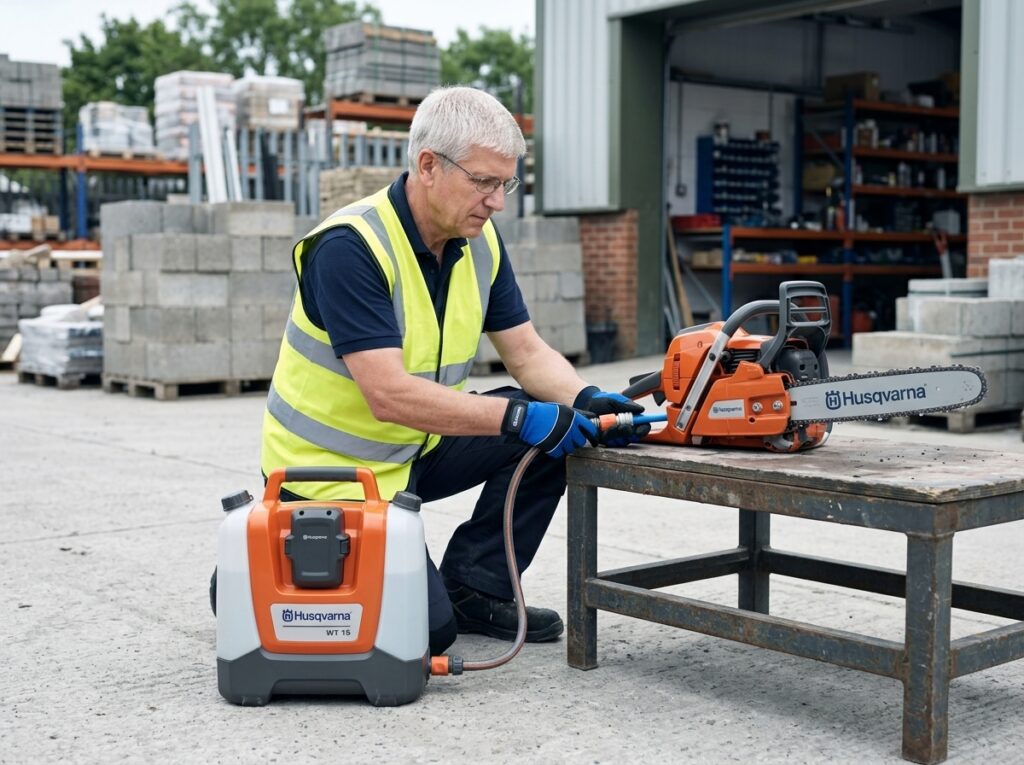
Water delivery options depend on the site. A hose works when you have a spigot and pressure within reach. A tank and pump kit like the WT 15 travels with you to remote cuts. Backpack systems work for short cuts where dragging a hose isn’t practical. Whatever you choose, verify the flow at the chain, not at the source. A kinked hose or clogged filter can drop you below the minimum without any warning.
Budget and Total Cost of Ownership
The sticker price is the smallest number in the real budget, a consideration that a diamond blade buying guide addresses through blade selection and cutting costs. Chain replacements and maintenance drive the true annual cost. A chain that lasts a few hundred linear feet in reinforced concrete means you’re buying several chains a year on any serious job. That cost alone often exceeds the saw’s sticker price within the first year.
Expert Tip: Estimate monthly chain use by dividing linear feet cut by chain life in your material, then multiply by chain cost to see the real annual expense before comparing saw prices.
Maintenance compounds the same way. Water pumps fail, hoses crack, bars wear and every hour of downtime costs more than any single part. A saw that saves a few hundred dollars upfront but eats chains twice as fast is the expensive saw. Run the numbers before you sign.
Interactive Total Cost of Ownership Calculator
The calculator turns the five decisions into one number. Enter your saw price, chain cost, expected chain life in your material and annual cutting volume. The spreadsheet divides linear feet by chain life to get chains per year, multiplies by chain cost, adds water and maintenance estimates and shows your true cost per foot. Two saws that look a few hundred dollars apart on the shelf can be thousands apart by year three.
The five decisions above set the saw. The next section walks the path from selection to your first clean cut.
First-Time Buyer’s Roadmap: From Selection to First Cut
New to diamond chainsaws? This roadmap removes the guesswork. Five steps, in order, take you from site assessment to a clean first cut without buying the wrong saw or burning a chain on day one.
Step 1: Assess Your Primary Job Site Conditions
Determine indoor, outdoor or underwater work, your max cut depth and rebar density. That sets power source, bar length and bond.
Skip this and you’ll buy a saw that can’t reach the cut or a chain that glazes over in hard aggregate. Last spring on the Riverside bridge retrofit, I watched a sub order a saw with a 15-inch bar for an 18-inch abutment. He had the ICS 890F4 in his truck but he’d spec’d the bar wrong.
The 890F4 takes bars up to 25 inches; he just never checked the cut depth before he bought. He spent the first morning borrowing mine. Measure the deepest cut you’ll make, add a few inches for plunge cuts and check rebar density with a scanner or the structural drawings; for round penetrations instead of linear cuts, diamond core drilling bits are used to drill masonry.
Step 2: Match Saw to Material and Environment
Use the comparison table to shortlist. For heavy rebar, prioritize chain life and water delivery over raw power. A hydraulic saw like the ICS 890F4 needs a minimum of 2 gpm at 20 psi to keep the chain cool. Anything less and you’ll smoke a chain in half a day. Indoor work pushes you toward electric or hydraulic for exhaust control. Underwater means hydraulic only. The job picks the saw.
Step 3: Budget for the Full System
The saw body is the cheap part all-purpose diamond blade selection also considers rim, bond and wet-or-dry use across varied jobs. Budget for initial chains, a water system with a pressure tank or pump, PPE (respirator, gloves, eye protection, hearing protection) and spares like bar nuts, chain tensioners and a spare bar. Run the TCO calculator before you sign the purchase order. A $3,000 saw that eats $800 in chains on the first job costs more than a $4,500 saw with a hard bond and proper water flow.
Step 4: Set Up and Test Before the Job
Assemble the saw, tension the chain and test water flow at the shop, not on the wall. Connect the water, run the saw for 30 seconds and confirm you’re getting full flow at the bar tip. Break in a new chain before production.
Expert Tip: Break in a new chain with a few shallow cuts in non-reinforced concrete to seat the diamonds and extend chain life.
That break-in run also lets you catch a bad tensioner or a kinked hose before you’re 40 feet up on a lift.
Step 5: Master the First Cut
Treat the first cut as a training cut, not a production cut. Start with a straight, shallow guide cut along your chalk line, maybe 1 inch deep. Use steady, moderate pressure and let the chain do the work.
Watch the water flow and the chain tension as you go. If the saw bogs or the slurry turns to dust, back off and check your water. Keep the bar nose out of the cut until you’re comfortable with the saw’s balance.
One clean shallow pass beats a deep crooked one you have to fix later.
Buying and starting are the easy half. Five problems show up mid-job and each one has a fix.
Problem/Solution Scenarios
Specs are theory. These are the five problems that actually cost you money.
Every job site throws one of these at you. Match the saw and chain to the problem and you cut clean. Miss the match and you burn chains and hours.
Cutting Through Heavy Rebar:
Problem: Rapid dulling and slow cuts.
Solution: High-torque saw + hard-bond chain + 1.5 GPM water; ease pressure on rebar.
Dense rebar turns a standard diamond chain into a butter knife. For reinforced concrete, matching diamond blade bond to material is another way to think about material-specific bond choice. The diamonds overheat, the bond glazes and the cut crawls. The fix is high torque and a hard bond. Hard bond holds the diamonds longer against steel instead of shedding them.
Water flow of at least 1.5 GPM keeps the chain cool and flushes the steel chips for separate steel cuts rather than rebar embedded in concrete, diamond blades versus steel saw blades explains the tool distinction. “That wall’s going to eat chains,” a foreman told me before a 12-inch reinforced basement cut and I’ve heard some version of that on every rebar-heavy job; the fix is always the same: a high-torque saw with a hard-bond chain and 2 gpm of water. Ease up when you hit rebar.
Let the diamonds grind; don’t force the saw.
Expert Tip: When you hit rebar, ease up on pressure and let the diamonds grind through the steel. Forcing the saw only generates heat and wears the chain faster.
Making Flush Cuts in Tight Corners:
Problem: Bar nose can’t reach the wall, leaving a lip.
Solution: Narrow-nose compact saw (GS 461) + plunge cut technique.
A standard bar nose leaves a lip because it can’t get into the corner. A narrow-nose compact saw like the GS 461 gets closer. Plunge cut technique: start the cut with the nose, then rotate the saw to follow the line. Remove the side cover if possible to gain an extra inch of clearance.
Expert Tip: For flush cuts, remove the side cover if possible to gain an extra inch of clearance, and always wear a full-face shield because chips fly in unexpected directions.
Working in Confined Spaces or Overhead:
Problem: Fumes, weight, awkward angles.
Solution: Hydraulic/electric saw + shoulder harness; body to the side of the cut line.
Gas saws pump exhaust into confined spaces. Hydraulic or electric saws eliminate that problem. Weight matters overhead. The ICS 890F4 hydraulic powerhead weighs 23.5 lbs with hose whips, light enough to run with a shoulder harness. Position your body to the side of the cut line not directly underneath.
Expert Tip: When cutting overhead, position your body to the side of the cut line, not directly underneath, because water and slurry will rain down and waterproof gear is a must.
Cutting Underwater or in Wet Conditions:
Problem: Gas can’t run submerged, electric shock risk.
Solution: Hydraulic only (890F4); flush after use.
Gas engines drown and electric saws carry shock risk. Hydraulic is the only safe power source underwater. The ICS 890F4 hydraulic powerhead works submerged. It needs a minimum of 2 gpm water flow at 20 psi for cooling and dust suppression though underwater the surrounding water helps carry heat away. After cutting, flush the chain and bar with fresh water immediately then disassemble and dry the bar nose sprocket.
Expert Tip: After underwater cutting, flush the chain and bar with fresh water immediately to prevent corrosion, then disassemble and dry the bar nose sprocket.
Managing Silica Dust and Slurry:
Problem: Hazardous dust and slurry.
Solution: Wet cutting, respirator for dry, slurry containment/disposal; cite OSHA standard.
Wet cutting is the default for silica control for tile-specific equipment trade-offs, wet versus dry tile saws compares those cutting setups. Dry cutting produces respirable crystalline silica, a hazard also addressed in guidance on cutting concrete with a circular saw. OSHA’s standard 29 CFR 1926.1153 sets a permissible exposure limit of 25 µg/m³ as an 8-hour time-weighted average and requires engineering controls and respiratory protection when cutting concrete. Slurry needs containment and proper disposal.

A Day in the Life:
Cutting a 12-Inch Reinforced Basement Wall, Narrative case study with timestamps showing the 890F4 + WT 15 + spare-chain strategy saving 2 hours on a real job.
7:00 AM. I mount the ICS 890F4 on the WT 15 wall track. The wall is 12 inches thick, heavily reinforced. I choose the 15-inch bar depth because the saw offers 10/15/20/25 inches and 15 clears the wall with room to work.
7:30 AM. First cut. The hard-bond chain bites into concrete and rebar. I keep water at 2 gpm, the minimum for the hydraulic saw. The chain grinds through the first rebar mat without glazing.
9:00 AM. Halfway through. The chain is still cutting but I feel it slowing. I swap to the spare chain. Two minutes of downtime instead of twenty fighting a dull one.
11:30 AM. Wall is cut. A crew without the right saw, the right bar depth and a spare chain would have burned two extra hours swapping chains, overheating and re-cutting lips.
The saw that solves those problems only keeps working if you maintain it. Here’s the care routine.
Maintenance and Chain Care
A concrete chainsaw is only as good as its maintenance. Five minutes of care beats an hour of downtime.
Daily Inspection and Chain Tensioning
Five minutes before the first cut saves the hour you’d lose mid-wall. Run your thumb along the chain and look for cracked segments, chipped diamonds or any segment sitting proud of the bond. Check the bar groove for wear that lets the chain wobble side to side. Then tension it.
The snap-back test is the only tension check I trust. Pull the chain away from the bar at the midpoint. It should snap back against the bar rail without sagging or binding. Too loose and the chain can jump the bar or bind in the cut. Too tight and you’re loading the sprocket bearing and stretching the chain before it ever touches concrete.
Expert Tip: Tension a new chain after the first few cuts because it stretches initially, then check tension every hour of use.
Cleaning and Flushing After Use
On a parking garage demo last August, I finished the last wall cut at 4:30, threw the saw in the truck and figured I’d flush it Monday. Monday the chain wouldn’t budge. Slurry had set in the bar groove like grout and the bar had started pitting. That cost me a chain and a bar, plus an hour of chipping dried slurry with a pick. Now I flush every saw before it goes back in the truck, no exceptions. Two minutes of water beats an hour of chipping.
Slurry hardens fast. Flush the bar and chain with water immediately after the last cut, before it sets. Run water through the bar groove and over the chain while the saw idles, then brush the groove with a stiff nylon brush. Dry the bar and chain with compressed air or a rag then oil them. A dry bar rusts overnight and rust chews up chain life faster than rebar does.
Expert Tip: In salty or marine environments, spray the bar and chain with a corrosion inhibitor after every cleaning.
Chain and Sprocket Replacement
Replace the chain when the diamond segments sit flush with the bond or when cutting speed drops noticeably on the same material. Don’t push a worn chain. It cuts slower, runs hotter and loads the saw harder.
Replace the sprocket with the chain, every time. A worn sprocket stretches a new chain unevenly and kills it in half its normal life. The set costs more up front but it’s cheaper than a chain that dies early and a sprocket that takes the next chain with it.
Expert Tip: Keep a log of chain changes and linear feet cut to predict replacement timing and avoid job-site delays.
Storage and Corrosion Prevention
Store the saw dry. For anything longer than a weekend, pull the chain and bar off, clean them, oil them and hang them. Drain the fuel tank or run the saw dry if it’s a gas model. Cap hydraulic hoses on hydraulic saws to keep dust and moisture out of the fittings. A saw that sits wet corrodes from the inside out.
Troubleshooting Common Issues
Wandering cuts usually mean a dull chain, uneven segment wear or a bar groove that’s opened up. Check the bar first, then the chain. Vibration that gets worse under load points to a loose chain, a worn sprocket or damaged segments. Overheating is almost always water flow or a dull chain. Gas start failures trace back to stale fuel, a clogged air filter or a fouled plug from running rich.
Maintenance keeps the saw running. Safety keeps you running.
Safety Best Practices
Every saw in this guide can hurt you. Here’s how to keep the job safe and compliant.
Personal Protective Equipment (PPE)
Think of PPE as your last line of defense. Before you pull the starter cord, you need a face shield, hearing protection, cut-resistant gloves, steel-toe boots and a waterproof jacket. Slurry sprays everywhere on a wet cut and a face shield keeps it out of your eyes. Hearing protection matters because a concrete chainsaw runs loud enough to damage hearing over a full shift. Gloves and boots protect against dropped chain sections and rebar ends.
For dry cutting, add respiratory protection. The OSHA silica standard sets a 25 µg/m³ PEL over an 8-hour TWA and dry cutting without a respirator will blow past that fast. A half-face respirator with P100 filters is the minimum when wet methods can’t keep exposure below the limit.
Kickback Prevention and Safe Operation
Kickback comes from two places: bar-nose contact and a pinched chain. The bar nose grabs when you let the top corner of the bar touch the cut and a pinched chain happens when the cut closes on the bar. Both throw the saw back at you fast.
The fix is simple. Keep the bar out of the cut’s top corner and never force a dull chain. A dull chain needs more pressure and more pressure means more bind. When the chain does bind, let off the throttle and back the saw out slowly. Don’t yank it.
Expert Tip: Before the first production cut, make a few shallow plunge cuts in scrap concrete to learn where the saw wants to climb or bind.
Dust Control and Silica Compliance
Wet cutting is the primary engineering control for silica. Water flowing through the cut captures dust at the source and turns it into slurry. The OSHA rule sets a 25 µg/m³ PEL over an 8-hour TWA and a properly wetted cut keeps you under that limit on most jobs.
Respirators come in only when wet methods can’t hold exposure down: dry cutting indoors, tight spaces with poor airflow or any cut where the water can’t reach the full bar length. For indoor work, run air monitoring. You can’t smell silica and by the time you feel it in your lungs, you’ve already exceeded the limit.
The dust monitor clipped to my belt was the first thing I checked after a wet cut through a 12-inch reinforced wall. The display sat well under the 25 µg/m³ PEL and the slurry running thick and gray down the wall smelled like wet concrete, not dry dust. That’s the difference between compliant and cited. When I shut the water off for thirty seconds to reposition, the reading climbed fast, past the limit before I got the flow back on. That spike is why I never dry-cut indoors without a respirator and a monitor running.
Water and Slurry Management
Slurry is a waste stream and it carries silica, concrete fines and whatever was in the concrete: rebar rust, sealers, old paint. Contain it with mats or a vacuum before it spreads. Never let it reach a storm drain. That’s a fast way to a state environmental citation and the fines aren’t small.
Check local disposal rules before the job starts. Some jurisdictions want slurry collected and disposed as solid waste, others allow it to dry and go in a dumpster. The rules vary by state and even by county.
Emergency Procedures
Before the first cut, know where the nearest ER is and how long it takes to get there. A kickback injury to the face or chest needs fast transport and you don’t want to be looking up directions while someone is bleeding.
Keep a stocked first-aid kit on the truck, not back at the shop. Add an eyewash station. Slurry in the eyes is a real risk even with a face shield. For kickback injuries, the response is pressure on the wound and immediate transport. Don’t try to finish the cut first.
Conclusion: Making the Right Investment
Every question in the FAQ comes back to the same answer: match the saw to the job and know your real cost before you buy.
The job closed out under budget but the real number was in the chain count. Three chains burned through one 12-inch reinforced wall because water flow kept sagging below 1.5 GPM and the bond was wrong for the aggregate. I’ve seen that pattern on every site I’ve walked. The saw price gets all the attention; for blade choices by application, tested diamond blade comparisons show how options differ. Chains, water and maintenance are where the margin lives or dies. One chain gone in a morning costs more than the demo you skipped.
Match the power source, bar length and chain bond to the job, not the spec sheet. Then run your own numbers on chains, water and maintenance before you spend a dollar.