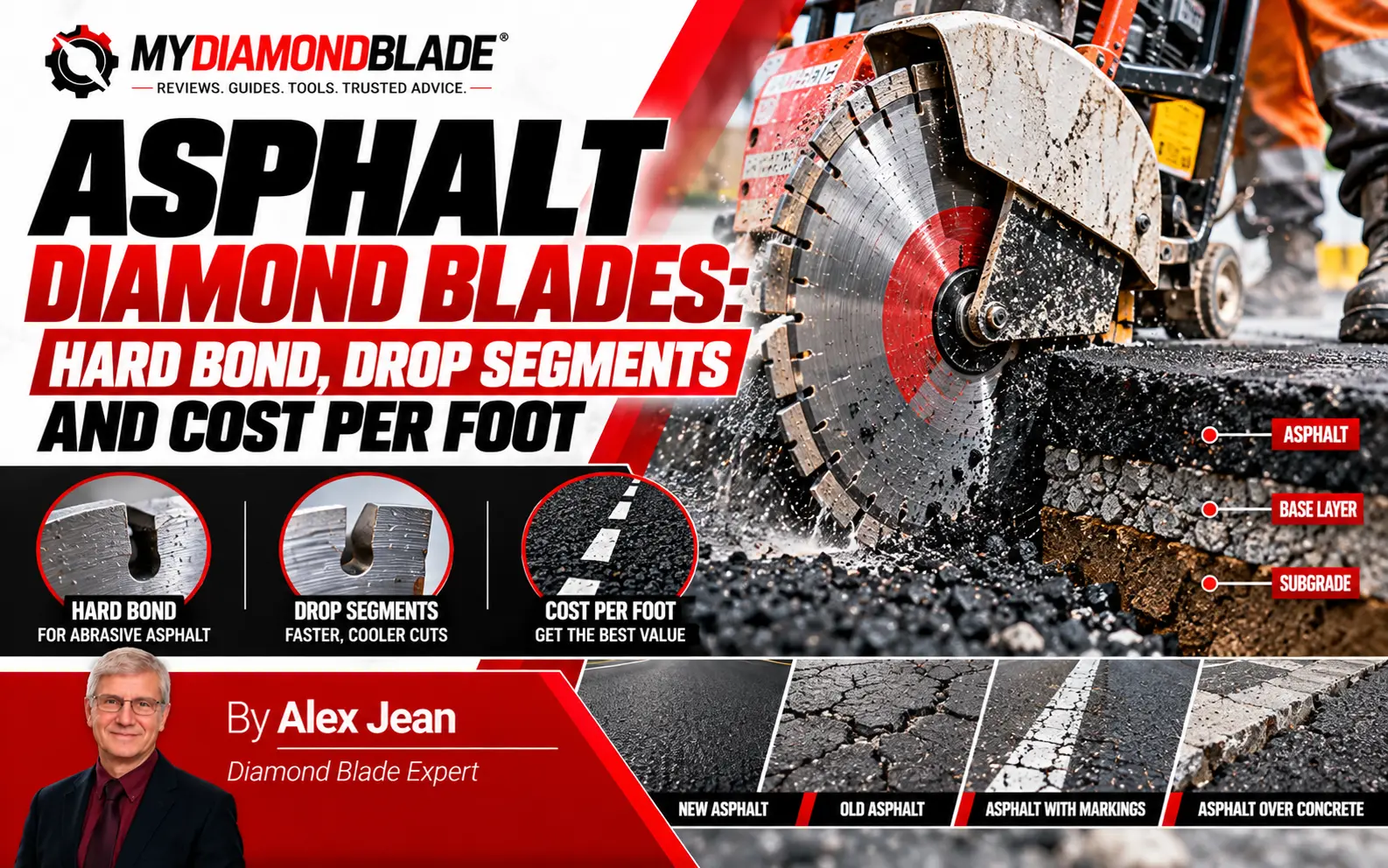
The saw bogged mid-cut on a trench patch, the concrete blade glazed and chipped by noon; I swapped to a hard bond blade and finished the same footage with half the effort.
Asphalt eats the wrong blade. Glazing, warping, chipping and early failure show up fast; on tile, porcelain tile chipping prevention addresses edge chipping. So do the hidden costs: slow cuts, blade swaps, downtime, rework.
Key Takeaways
- Hard bond blades with drop segments and wide gullets are essential for asphalt; concrete blades wear out fast.
- Wet cutting extends blade life 2–3x and controls silica dust; dry cutting only for short, shallow cuts.
- Match blade RPM and arbor to your saw; exceeding max RPM risks catastrophic failure.
- Dress glazed blades with a dressing stone to restore cutting speed.
- Total cost per foot, not sticker price, is the real decision metric.
This guide skips the marketing fluff and gets to the specs that actually matter: hard bond, drop segments, gullets. The real decision metric is total cost per foot not sticker price.
Now let’s get into the metallurgy that separates asphalt blades from concrete blades.
How Diamond Blades Cut Asphalt: Bond Hardness, Segment Design and Cooling
The intro covered why asphalt destroys blades. Here’s the mechanics behind it, because the wrong blade doesn’t just cut slowly; how diamond blades work depends on bond, segment design and cooling. It disappears.
The Abrasive Nature of Asphalt
Asphalt is aggregate (rock, sand, gravel) bound together by bituminous binder, and those material properties inform blade and wheel selection. The aggregate varies from soft limestone to hard granite depending on your local mix, but the binder is what makes asphalt uniquely punishing on a blade.The aggregate varies from soft limestone to hard granite depending on your local mix but the binder is what makes asphalt uniquely punishing on a blade; diamond blades for granite address the hard-stone case.
It heats up under friction, softens into a gummy slurry and loads the cut zone. A concrete blade runs a soft bond because cured concrete is hard and less abrasive. The matrix needs to shed diamonds fast to keep fresh crystals exposed.
On asphalt, that same soft bond erodes way too quickly. The segments shrink visibly with every pass.
Expert Tip: Cut asphalt with a concrete blade and the segments vanish fast. The soft bond sheds diamonds before they can cut.
Bond Hardness: The Key to Blade Life
Hard bond is the metal matrix that wears slowly. On soft, abrasive materials like asphalt, green concrete, limestone or block, you need that slow erosion so fresh diamonds expose at the right rate. Too soft a bond and the blade is spent by lunchtime.
Too hard and the blade glazes over: the diamonds polish flat, the cut slows, heat builds and you get warping or blade failure in stone finishing, diamond polishing paste is used to achieve a polished surface.
The right hard bond holds each diamond long enough to cut then releases it when the crystal is spent and exposes the next one underneath.
A guy on my crew grabbed a soft-bond concrete blade for a parking lot patch job last August. Figured a blade’s a blade. By lunch the segments had worn down to nubs and the core was starting to rub the asphalt. The hard-bond asphalt blade I handed him after lunch still had full segment height at quitting time. That’s bond hardness in practice: segment height you can measure with your thumbnail. Which is exactly why bond selection comes before anything else when you’re sizing up a blade for asphalt work.
Segment Design: Gullets, Drop Segments and Turbulence
Drop segments and wide gullets are what separate an asphalt blade from a general-purpose disc for broader mixed-material jobs all-purpose diamond blade selection involves weighing those design trade-offs. Gullets are those deep U-shaped spaces between segments. They channel the gummy asphalt slurry away from the cut zone so it doesn’t pack in and spike friction.
Drop segments also called turbo or segmented rims create turbulence that keeps debris moving outward instead of re-circulating. Laser-welded segments stay attached under the high heat asphalt generates.
A brazed joint can let go when the cut gets hot and a segment coming loose at speed is not something you want to be standing near.
Product Recommendation: The Husqvarna VARI-CUT S85 uses wider slots and a protection segment to clear debris and prevent undercutting in asphalt and green concrete.

The protection segment on that blade sits slightly proud of the core wall, so the abrasive slurry wears against the sacrificial segment instead of eating the steel core below the cut. That’s the specific failure mode it targets: undercutting, where the core thins faster than the segments and the blade binds or throws a segment.
Wet vs. Dry Cutting: Cooling and Dust Control
Wet cutting is the default for handheld saws; the concrete circular-saw cutting guide covers wet cutting for concrete with a handheld saw. Continuous water feed cools the blade, flushes slurry out of the gullets, suppresses silica dust and extends blade life by a wide margin.
OSHA’s Table 1 for handheld power saws calls for an integrated water delivery system that continuously feeds the blade. That’s the compliance path. Dry cutting works for short, shallow cuts on a dry-rated blade, but it’s a fallback.
The blade heats faster, the binder softens more aggressively and you’re breathing silica.
Expert Tip: Even on a dry-rated blade, hook up water when you can. Expect the 2–3x life extension covered earlier, plus far less silica dust.
RPM and Arbor Size: Matching Blade to Saw
Every blade has a maximum operating speed stamped on the core. Never exceed it. ANSI B7.1 sets the safety floor: the manufacturer rates the wheel for a maximum surface feet per minute and running over that speed is how cores crack and segments launch.
Match the arbor size to your saw’s spindle and use the correct flanges. A blade that’s loose on the arbor will wander in the cut and a wandering blade in asphalt is dangerous and ruins the kerf.
That’s the theory. The next section puts the top asphalt blades side by side and shows which ones hold up.
Top Asphalt Blade Reviews & Comparison Table
Seven models, one table and the honest trade-offs on each; the best diamond blades tested roundup broadens the comparison.
| Brand/Model | Diameter | Bond Type | Segment Design | Wet/Dry | Price Range | Key Features |
|---|---|---|---|---|---|---|
| Marcrist AS350 | 300/350/450mm | High-cobalt hard bond | 10mm laser-welded drop segments | Wet or dry | $$$ | Diamond core protection, EN 13236, up to 3.5x more cuts |
| Diamond King Tools Black Magic | Varies | Hard bond | Drop segments | Varies | $$ | Versatile for asphalt and occasional concrete/rebar |
| Quality Diamond Blades Asphalt Pro | Varies | Extra-hard bond | Turbo segmented | Varies | $$$ | Built for continuous cutting |
| Diatech Asphalt Diamond Blade | 300/350/450mm | Hard bond | Drop segments | Varies | $$$ | Premium high-production speed |
| Norton Clipper Asphalt Blade | 300mm (up to 500mm) | Hard bond | Segmented | Dry or wet | $$ / $$$ | Trusted brand, walk-behind and handheld options |
| Husqvarna Vari-Cut Asphalt Blade | Varies | Hard bond | Alternating turbo/segmented | Varies | $$$ | Wider slots, protection segment prevents undercutting |
| MK Diamond Asphalt Blade | Varies | Hard bond | Drop segments | Varies | $ | Budget-friendly mixed use |
Indicative only: where a spec isn’t published for a given model, I’ve marked it varies. Verify current specs and pricing before ordering.
How to read it: diameter first because it has to match your saw’s arbor and guard the diamond blade selection guide covers the rim, bond and cooling choices that follow. Bond type next: diamond blade types for concrete cutting show how blade design is matched to the job. Hard bond for asphalt, extra-hard only if you’re cutting all day. Segment design tells you how the blade clears slurry and resists binding. Wet/dry matters for your dust control setup. Price range is a tier not a number.
Note on price: $, $$ and $$$ are relative cost tiers not exact figures. A $$$ blade can still beat a $ blade on cost per foot if it outlasts it.
Detailed Blade Reviews
Why does a blade die with half its diamond segment still on the rim? I’ve pulled enough of them to know the answer is rarely the diamonds. It’s the steel core eroding just behind the segments, what the trade calls undercutting. The core thins, the segments wobble, the blade wanders and you toss it even though there’s plenty of cut left in the diamonds; diamond and steel saw blades are compared by their material-cutting roles.
The AS350’s diamond core protection and the Vari-Cut’s protection segment exist to stop exactly that. I’ve seen cores go paper-thin behind segments that still measured near full height. That hidden failure mode is why a blade’s true life is decided by the core not the segment and it’s the one thing a spec sheet never leads with.
Marcrist AS350: The Premium Performer for Hot Asphalt
The AS350 earns its $$$ tag. High-cobalt hard bond, 10mm laser-welded drop segments, diamond core protection. Wet or dry, in 300, 350 or 450mm. Marcrist rates it at up to 3.5x more cuts and it meets EN 13236. Ideal for hot asphalt and green concrete, where heat and abrasion kill lesser blades fast.

Expert Tip: This blade shines on high-RPM saws (5,000+ RPM); its low-vibration design reduces operator fatigue on long cuts.
The trade-off is price. You pay for the cobalt and the core protection.
Diamond King Tools Black Magic: The Versatile Workhorse
The Black Magic earns its name on mixed sites and diamond blade options for tile cover blade choices when a job includes tile. It handles asphalt day in and day out and it won’t flinch at the occasional concrete patch or a stray piece of rebar for rebar-rich concrete work, reinforced concrete diamond blades address the blade choice. That versatility is the point one blade on the saw instead of swapping between jobs.
Product Recommendation: For small contractors mixing asphalt patching and concrete sawing, this blade eliminates constant blade swaps.
The trade-off is focus. On pure asphalt production, a dedicated blade will out-cut it.
Quality Diamond Blades Asphalt Pro: Built for Continuous Cutting
Extra-hard bond, turbo segmented. This blade is built for crews that cut asphalt all day, every day. The turbo segments clear slurry fast and keep the cut cool on long runs.
The trade-off is feed rate. The extra-hard bond can glaze over on light, occasional work, so it needs aggressive feed to keep exposing fresh diamond.
Diatech Asphalt Diamond Blade: Speed and Longevity Combined
Available in 300, 350 and 450mm. Diatech positions this as a premium blade for high-production speed and the sizing covers everything from handheld saws to walk-behinds.
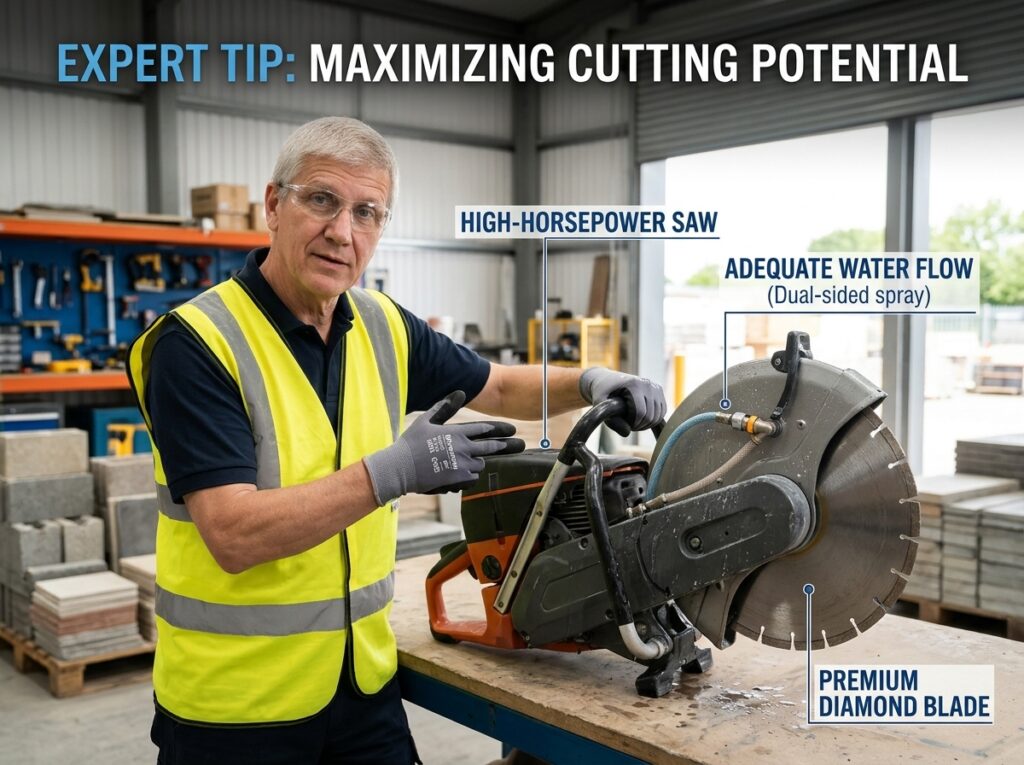
Expert Tip: Pair this blade with a high-horsepower saw and adequate water flow to maximize cutting potential.
The trade-off is cost. If you’re cutting a few joints a week, this is more blade than you need.
Norton Clipper Asphalt Blade: The Reliable Standard
Norton’s name has been on job sites for decades. The Pro 300 x 20mm dry/wet runs €204.50 before tax and the 500mm Extreme climbs to £477.00 before VAT. That range covers both handheld and walk-behind work.
The trade-off is speed. You’re paying for consistency.
Husqvarna Vari-Cut Asphalt Blade: Innovative Design for Sticky Conditions
The Vari-Cut’s alternating turbo and segmented sections are the standout. Wider slots move slurry out fast and a protection segment stops the core from undercutting. Husqvarna lists it as optimal for asphalt overlay, hard asphalt and soft asphalt and it fits the K 770, K 970, K 1270 and several other Husqvarna saws.
The trade-off is fit. It’s a Husqvarna blade for Husqvarna saws, so check arbor and guard before ordering.
MK Diamond Asphalt Blade: Budget-Friendly Versatility
The $ tier entry. MK Diamond gives you a workable asphalt blade for mixed use without the premium price. Good for patching, small trenching and the occasional demo cut.
Expert Tip: This blade is a good entry point for new asphalt cutters, but daily heavy use warrants a premium model.
The trade-off is longevity. The budget bond wears faster on hot, abrasive asphalt.
Shortlist from the table, then the buyer’s guide walks you through matching that shortlist to your saw, your water setup and your budget. Cost per foot is the filter that matters not the price on the shelf.
Buyer’s Guide: Matching Blade to Job and Saw
You’ve seen the blades; now match one to your job and saw. The wrong pick costs you in glazed diamonds or a blade that disappears in a day.
Step 1: Determine Your Primary Application
Asphalt is soft and abrasive, so it eats soft-bond blades alive. The default is a hard bond: the metal matrix wears slowly, exposing fresh diamonds at the right rate instead of shedding them into the slurry. Get this wrong and you get the two classic failures matching blade bond to material addresses the selection issue behind them. Glazing when the bond is too hard for the material, rapid wear when it’s too soft.
200 feet of asphalt trench: the cheap blade glazed solid before the halfway mark and the hard-bond blade finished with bite to spare. Which is exactly why hard bond is the default for asphalt.
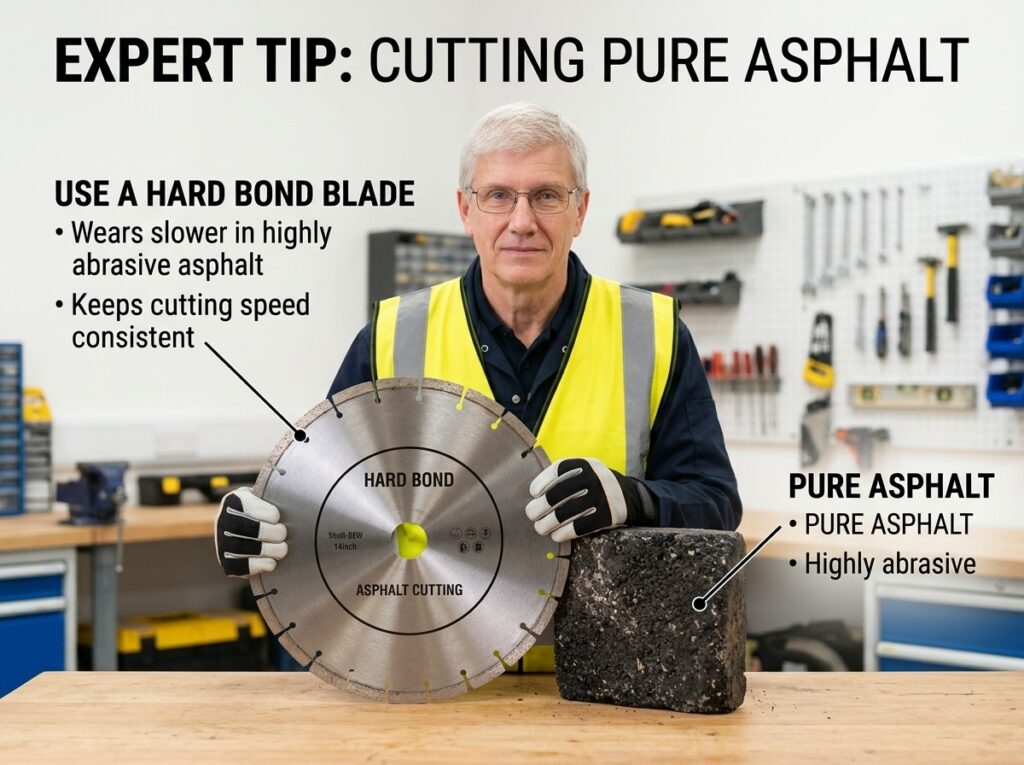
Expert Tip: For pure asphalt work, choose the hardest bond available. It wears slower in abrasive asphalt and keeps cutting speed consistent.
Step 2: Match Blade Diameter and Arbor Size to Your Saw
The blade has to fit the saw, period; for chain-based concrete cutting, the concrete chainsaw buying guide addresses saw selection. Diameter and arbor size are non-negotiable: a blade that’s too big or the wrong arbor won’t mount safely and a blade that’s too small wastes your depth of cut. Check the saw’s manual for its diameter limit and arbor spec before you buy.
Speed matters just as much gas and electric cut-off saws are another equipment choice for a cutting job. ANSI B7.1 sets maximum operating speeds for abrasive wheels and the rule is simple: never spin a blade faster than the manufacturer’s maximum surface feet per minute. Overspeeding is how blades come apart.
Step 3: Choose Wet or Dry Cutting Based on Job Site Conditions
Wet cutting is the OSHA-compliant default for handheld saws. The rule is clear: handheld power saws need an integrated water delivery system that continuously feeds water to the blade and any cut of four inches or less on any substrate needs that water running. It keeps dust down and the blade cool.
Dry cutting is for when water isn’t practical and it demands a different blade for tile jobs, wet and dry tile saw options compare the saw choices around water use. You need a segmented rim with wide gullets to move air through the cut and pull heat off the blade; continuous-rim and segmented blades for porcelain compares how those rim styles behave on tile. No water means no slurry flushing, so airflow does the work.
Expert Tip: For dry cutting, use a segmented rim with wide gullets to maximize airflow and cool the blade and mist the blade occasionally if the site allows.
Step 4: Consider Segment Design for Your Asphalt Type
Not all asphalt cuts the same. Sticky, aged or mixed material loads the blade differently and that’s where segment design earns its keep. Wider slots between segments clear slurry faster on abrasive cuts and a protection segment stops the steel core from undercutting when you’re cutting asphalt overlay or mixed material.
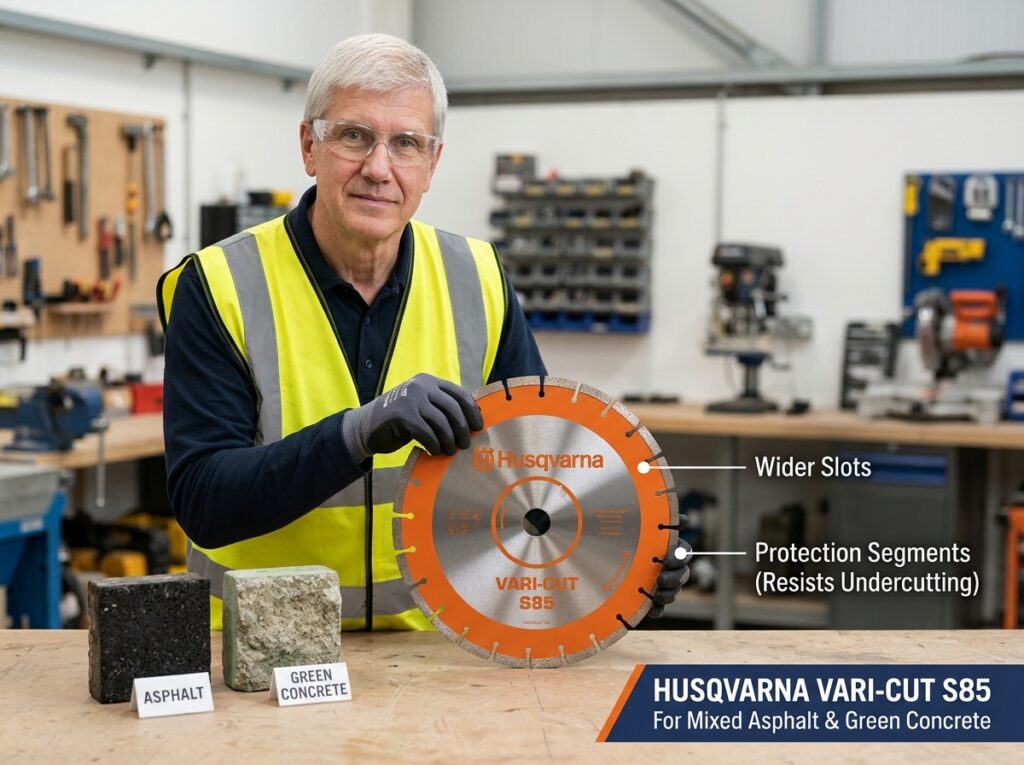
Product Recommendation: For mixed asphalt and green concrete, the Husqvarna VARI-CUT S85’s wider slots and protection segment resist undercutting on abrasive cuts.
Step 5: Budget vs. Total Cost of Ownership
Sticker price is the wrong metric. The right one is cost per foot: blade price divided by the linear feet it actually cuts before it’s done.
A cheap blade that dies halfway through a 200-foot trench means you buy two or three to finish one job, plus the downtime. A hard-bond blade costs more up front but finishes the trench and keeps cutting. Run that math before you buy.
Once you’ve picked the right blade, use these techniques to cut clean and fast.
Step-by-Step Asphalt Cutting Techniques
With the right blade in hand, technique is what keeps it cutting all day.
Preparation: Marking and Setup
Mark the cut line before the saw comes off the truck when the job also calls for drilling glass, tile or stone, diamond drill bits cover those materials. Check the blade for cracks or missing segments, set the depth to just clear the asphalt thickness and put on your PPE; when a project also needs holes through masonry, diamond core drilling bits address that drilling method. Call 811 before cutting near any utility.
Expert Tip: Call 811 or your local one-call service before cutting near any utility. Marked lines keep the saw out of buried trouble.
Cutting Technique: Shallow Passes and Steady Pressure
Start the saw and let it reach full speed before the blade touches asphalt. Then use a light touch: steady, even feed pressure, never forcing.
The blade stopped biting halfway through the first full-depth pass on a patch job last August. I’d set the depth to clear the asphalt in one go, figuring a hard bond blade could handle it. The saw bogged, the rim glazed and I spent twenty minutes dressing the blade on a scrap of block before it cut clean again.
That mistake is why I now run shallow passes on every asphalt cut. Multiple shallow passes beat one deep pass every time. Keep the saw straight; wander causes binding and uneven wear.
Wet Cutting: Water Flow and Positioning
Aim the water nozzle at the blade entry point and keep the flow continuous. Water controls silica dust and carries slurry away through the gullets. As noted above, it also stretches blade life considerably compared with running dry.
Dry Cutting: Managing Heat and Dust
Use a dry-rated blade and cut in short intervals. Lift the blade periodically to let it spin free and cool; this keeps the bond from glazing over. Wear a respirator. Never add water to a dry blade mid-cut.
Expert Tip: On hot asphalt, if the blade starts to drag from softened bitumen, lift it briefly and let it spin free to clear the rim.
Expert Tip: Blue or dark discoloration on the blade means overheating. Stop and let it cool before continuing.
Finishing the Cut
Run a light cleanup pass to square the edges. Inspect the cut for straightness and clean the blade before shutting down. A clean blade cuts better next time.
Even with good technique, problems happen. Here’s how to fix them.
Troubleshooting Common Asphalt Cutting Problems
When the cut goes wrong, these fixes get you back on track fast.
Blade Glazing (Diamonds Not Exposed)
A glazed blade looks polished and stops cutting for granite grinding, diamond grinding wheel selection for granite covers wheel bond, grit and technique. The bond is too hard for the material, so the diamonds stay buried. Dress the blade by cutting abrasive material to expose fresh diamonds or increase pressure briefly. If glazing keeps coming back, the bond is wrong for the job. Switch to a softer one.
On the Route 9 trenching job last August, I watched a utility crew burn through three blades in a morning, the same mistake I’ve corrected on a dozen jobs. Their operator kept forcing a hard bond through wet asphalt and the rim had polished to a mirror. I handed him a dressing stone and told him to cut a few passes through an old concrete curb. Thirty seconds later the blade was throwing chips again. A glazed blade is just starved of exposed diamonds, not worn out.
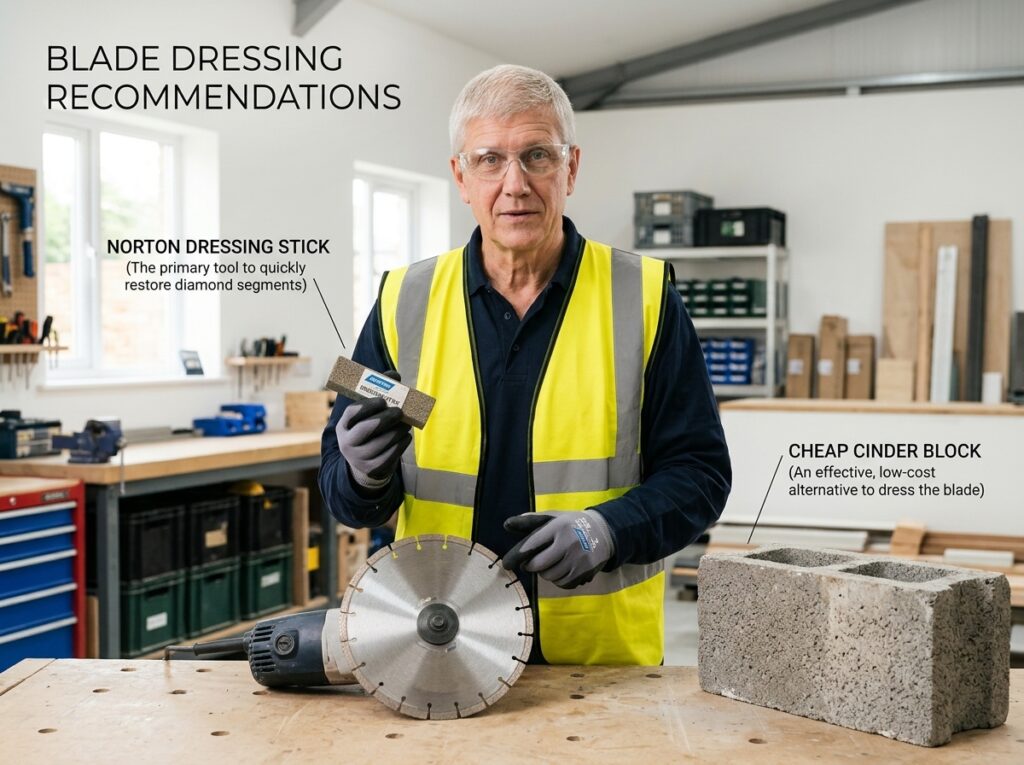
Expert Tip: Keep a dressing stone on the truck. Thirty seconds of dressing can revive a glazed blade and save a trip to the supplier.
Uneven Wear or Segment Loss
Uneven wear usually isn’t the blade’s fault. Check blade mounting and arbor runout first. A wobbling arbor wears one side and side pressure from twisting the saw breaks segments loose. Cracks around the segment welds mean the blade took a hit, often from rebar for metal-stock cuts, metal-cutting circular saw blades are the blade category to consider.
Overheating and Blade Warping
Heat is the enemy. A blade that runs dry on a long pass overheats and the steel core warps. Control heat with water or shallower passes and let the blade cool between cuts. Once a blade warps, it’s scrap.
Expert Tip: A warped blade can also wreck your saw’s bearings. Replace it before it costs you a saw.
Binding and Blade Wandering
Binding and wandering usually come from too much blade in the cut. Drop segments give the slurry somewhere to go and a straight, shallow pass keeps the blade from loading up and pulling sideways.
Product Recommendation: The Husqvarna VARI-CUT S85 uses wider slots and a protection segment to reduce binding and undercutting in sticky asphalt.
Excessive Dust (Dry Cutting)
Dry cutting throws silica dust and that’s a health problem not just a mess. For handheld saws, match dust control to OSHA Table 1: integrated water delivery that continuously feeds water to the blade. A shroud, vacuum and silica-rated respirator help but water is the standard.
Prevention beats cure. The next section covers how to stay safe and keep blades in top shape.
Safety and Maintenance Best Practices
Safety and maintenance separate pros from amateurs. A blade that cuts fast today is worthless if it shatters tomorrow or leaves your lungs full of silica.
Personal Protective Equipment (PPE): Eye, hearing, respiratory, hand/foot, hi-vis
OSHA 29 CFR 1926.1153 Table 1 sets the silica rule: handheld power saws need an integrated water delivery system that continuously feeds water to the blade and any cut four inches or less needs that same water delivery. ANSI B7.1 caps you at the manufacturer’s maximum surface feet per minute. Wear sealed safety glasses or a face shield, ear protection, an N95 or better respirator when water isn’t enough, cut-resistant gloves, steel-toe boots and hi-vis.
“OSHA says integrated water but my pump clogs every third cut,” a utility foreman told me and he’s right that a helper with a garden hose has kept silica down on more of my small patch jobs than any integrated system because the little pumps clog and the hose doesn’t.
Blade Inspection and Storage: Pre-use checks, cleaning, storage to prevent warping/corrosion
Before every cut, spin the blade and look for cracks. Check segment wear for uneven loss and confirm the arbor hole is clean and true. Store blades flat or hung, never leaning against a wall where they can warp.
Expert Tip: After wet cutting, dry the blade before storage to prevent corrosion on the steel core.
Blade Dressing and Maintenance: When/how to dress, rotate, arbor washers
A glazed blade stops cutting and starts burning. Dress it by running it through abrasive material to expose fresh diamonds. Rotate the blade periodically so wear stays even and replace arbor washers when they show grooving.
Product Recommendation: Keep a Norton dressing stick or a cheap cinder block on hand to dress the blade quickly.
Saw Maintenance: Water pump, belts, bearings, manufacturer schedule
Check the water pump before each wet job. Inspect belts for cracks, listen for bearing noise and follow the manufacturer’s schedule for everything else.
See how these principles played out on a real highway job.
Real-World Case Study: Asphalt Cutting on a Major Road Project
Theory only gets you so far. Here’s what happened on a real Texas highway job: a repair crew cutting trench lines for patching switched to the Diatech APF-20, a hard-bond drop-segment blade available in 300 x 20mm, 350 x 25mm and 450 x 25mm sizes.
I spec’d the wrong blade that first day. The cheap option glazed over by noon and wandered off the chalk line, which cost us a full afternoon of re-cuts. I track cuts per blade on every trench job now and the APF-20 with a quick dress in cured concrete every few cuts, outlasted the old stock by a wide margin.
Now, a quick interactive tool to find your blade.
Interactive Blade Selector Quiz
Answer a few questions and get a blade recommendation. The quiz asks about your saw type, blade diameter and job conditions. The burnt-rubber smell hit me before the saw stopped.
A soft-bond blade on asphalt glazes over fast and that smell is the diamond matrix burning.
I’ve made that mistake enough times to know the quiz’s first rule: hard bond for asphalt, every time. The mapping logic is straightforward: asphalt means hard bond and drop segments. The tool outputs a blade spec not a brand.
Let’s wrap up with the bottom line.
Conclusion
Here’s the bottom line. The right asphalt blade is a hard-bond, drop-segment blade matched to your saw and your job and you buy on total cost per foot not sticker price. A glazed-over blade told the whole story when a colleague kept forcing deep cuts with the wrong bond and the replacement cost him more than the right blade would have. Shallow passes, steady water flow and dressing the blade protect both cut quality and blade life.
Expert Tip: Set up your cuts correctly, use shallow passes and keep the water flowing. Technique protects the blade and your bottom line.