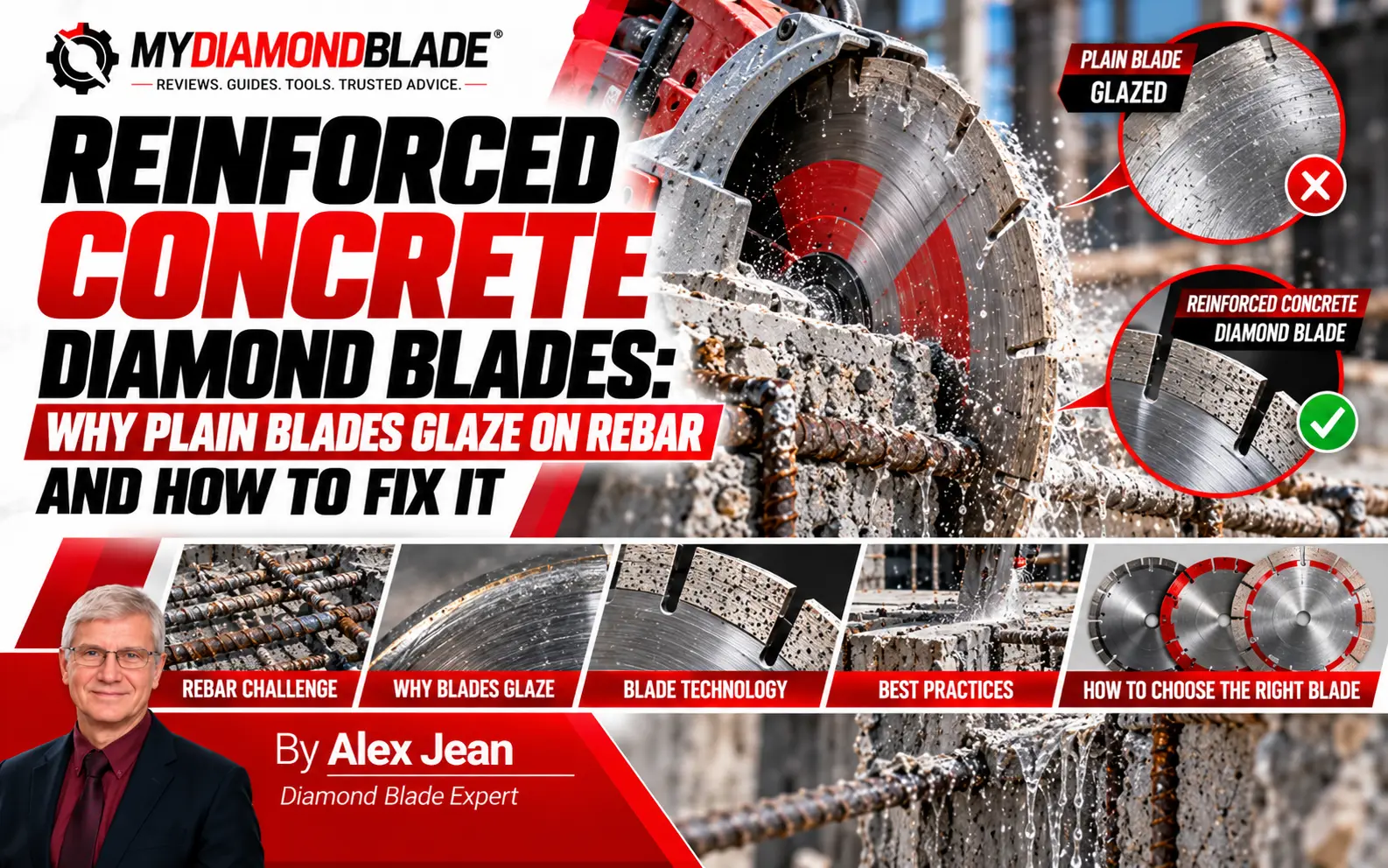
The saw bogs the instant the rim hits rebar. Sparks spray, the motor labors and every instinct says push harder. I burned through two plain rims on the same slab before I switched to a reinforced-concrete blade and the new rim cut the bar the old ones stalled on. That push is the mistake. Steel smears and polishes the diamond face, a key distinction when comparing diamond and steel saw blades. Concrete abrades and re-opens it. A plain blade loses that cycle the moment steel enters the cut.
Key Takeaways
- A plain concrete blade glazes on rebar because steel smears and polishes the diamond face
- Reinforced-concrete blades use a bond formulated to release worn diamonds and re-expose fresh ones after steel contact
- When the blade slows at rebar keep cutting into the concrete past the bar to re-open the diamond face
- Cut wet whenever possible to cool the rebar, prevent glazing and control silica dust
- Match rim type, bond, RPM rating and arbor size to your saw and depth before mounting
The fix is a blade engineered for that dual-wear cycle, plus a counterintuitive technique covered later: when the blade slows at rebar keep cutting into the concrete past the bar so the abrasive concrete re-opens the diamond face. The right blade and technique keep the cut moving through rebar instead of glazing to a stop. The comparison table and checklist in this guide walk you through both.
Before any of that makes sense, you need to know what a reinforced-concrete blade actually is and why it is not a plain concrete blade.
What a Reinforced Concrete Diamond Blade Is (and Why It Is Not a Plain Concrete Blade)
The glazing moment has a cause and the fix starts with the blade itself. A reinforced-concrete blade is a segmented diamond blade engineered for the steel-plus-concrete cut. It is not a plain concrete blade with a different label stamped on it. Steel smears and polishes the diamond face. Concrete abrades and re-opens it. A plain concrete blade never faces that cycle.
The core carries undercut protection so the steel center does not wear away faster than the diamond segments in abrasive concrete for drilled holes in masonry, diamond core drilling bits are the relevant tool. Without it, the core thins out and the segments eventually let go. That is a failure you do not want at speed.
The segments are laser-welded, not silver-brazed. Rebar heat can push past the silver braze’s roughly 1100°F failure point and a segment that comes off mid-cut is a hazard. Laser-welded segments hold past 3000°F, which buys real margin when you hit a bar.
A blade labeled “reinforced concrete” is a different tool not a marketing line. I watched a neighbour fight a slab with a plain concrete blade, convinced the label covered everything. The blade glazed on the first bar, he leaned on it harder and the silver-brazed segment peeled off. The blade was not defective. It was the wrong tool for a job the label never promised to handle.
Product Recommendation: For reinforced concrete, pick a segmented diamond blade rated for steel and concrete with an undercut-protected core and laser-welded segments seven tested diamond blades provide a range of products to compare.
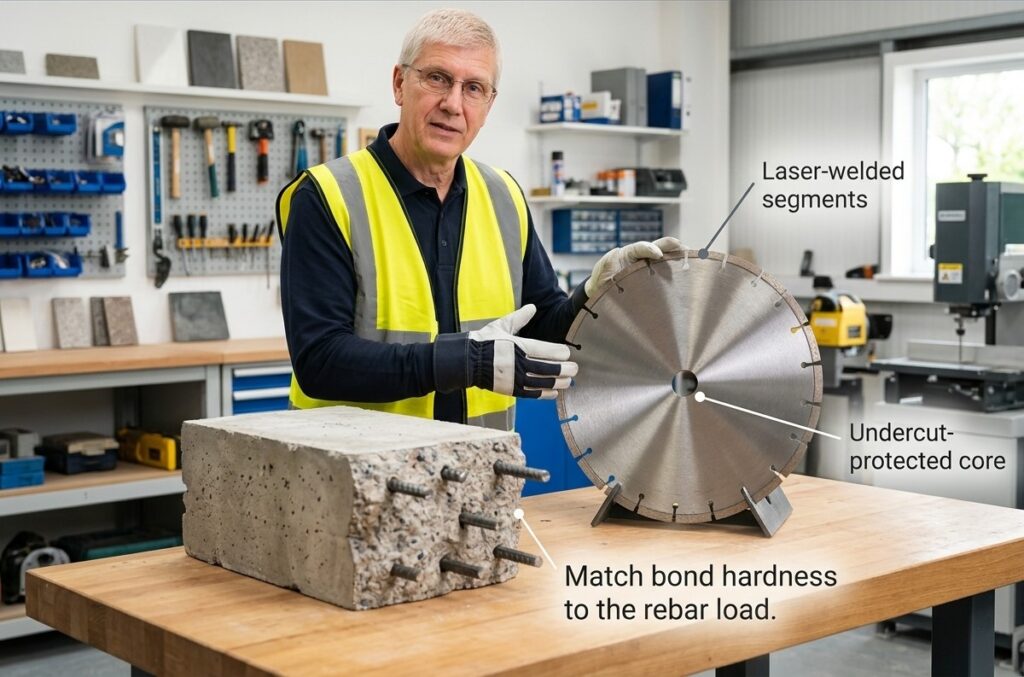
Expert Tip: For rebar-laden concrete choose a segmented blade with an undercut-protected core and laser-welded segments and match bond hardness to the rebar load.
To understand why those design features matter, look inside the blade at the bond matrix and diamond exposure cycle.
How a Diamond Blade Works: Bond, Matrix and Diamond Exposure
A reinforced-concrete blade is built differently and the mechanism starts with the bond matrix: the metal powder that holds the diamond grit. As the matrix wears, fresh diamond edges push to the surface. Concrete’s abrasiveness keeps eroding that matrix cycling new cutting edges forward. That cycle is diamond exposure and it’s why the blade keeps cutting instead of polishing, while diamond polishing paste is used to work toward mirror finishes on surfaces.
Why does a blade that looks sharp stop cutting? Across three driveway cuts last spring I saw the same pattern: the diamonds were still there but the metal around them had worn flush. The concrete never stopped abrading the matrix. The diamonds just stopped getting exposed. A quick pass through a scrap of abrasive block brings them back and the blade bites again for granite surface work, granite grinding wheel selection turns on matching the wheel to the stone. That is the exposure cycle not a dull blade.
Undercut protection matters here. In abrasive concrete, the steel core can wear faster than the segments. The protection keeps the core from eroding away while the segments do their work.
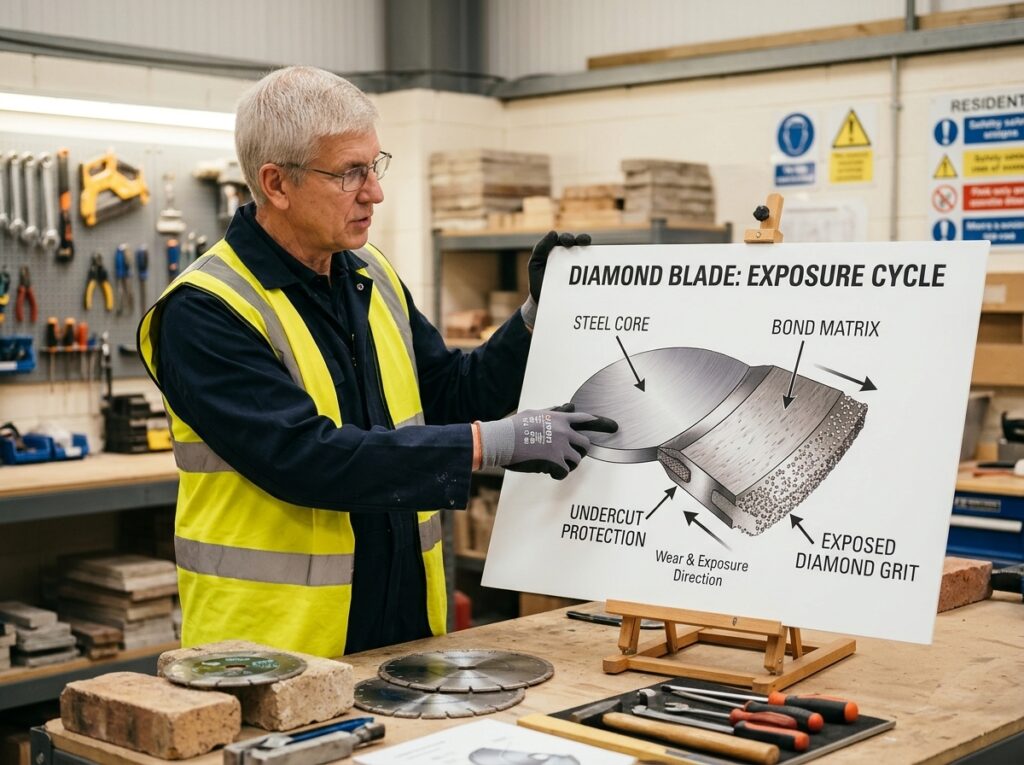
That mechanism is the foundation for understanding how diamond blades work. The three diamond blade rim designs put it to work differently and comparing them shows which one suits reinforced concrete.
Rim Types Compared: Segmented, Turbo and Continuous
The bond matrix explains how a diamond blade cuts. The rim design decides how fast, how clean and how hot.
Segmented Rim Blades
A segmented rim cuts fastest. Its gullets clear debris from the kerf and pull air across the rim to cool it and that airflow matters when you are buried in rebar. The trade-off is the roughest edge of the three rim types. For heavy reinforced concrete, that trade is worth making.
Expert Tip: For reinforced concrete, a segmented blade with a soft bond is the top choice. Its gullets clear debris and keep the rim cooler under heavy rebar.
Turbo Rim Blades
A turbo rim uses a serrated continuous edge instead of separate segments.
The serrations improve air flow and cooling while keeping more surface contact than a segmented blade. Fourteen cuts into a brick wall, the turbo rim’s serrations were still clearing dust from the kerf like a segmented blade’s gullets but the edge stayed smooth enough to lay tile against diamond blades for tile compare rim options for tile-edge work. That is the balance in practice: faster than a continuous rim, cleaner than a segmented rim.
It suits lightly reinforced concrete where finish matters more than raw speed.
Product Recommendation: If you need a smoother edge on lightly reinforced concrete, a turbo rim blade cuts faster than continuous and cleaner than segmented.
Continuous Rim Blades
A continuous rim has no gullets at all. That gives the cleanest possible edge on brittle materials like ceramic, marble and glass, cut wet for precision granite-specific diamond blades are matched to granite’s cutting demands. But no gullets means no air flow and heat builds fast. This rim is not for reinforced concrete.
Rim Type Comparison Table
| Rim Type | Best For | Cutting Speed | Finish Quality | Heat and Dust Control | Reinforced Concrete Suitability |
|---|---|---|---|---|---|
| Segmented | Fast cutting of hard concrete | Fastest | Roughest | Good, gullets clear debris and cool the rim | Best, especially with a soft bond |
| Turbo | Masonry and light concrete | Faster than continuous | Cleaner than segmented | Improved, serrated rim aids airflow | Good for light reinforcement |
| Continuous | Wet precision cutting of ceramic, marble, glass | Slowest | Cleanest | Poor, no gullets means heat builds | Not recommended |
Rim type is only half the story. Bond hardness decides whether the blade survives steel contact.
Bond Hardness and Why It Matters for Steel
Rim type sets the cutting behavior. Bond hardness sets the blade’s survival on steel. The rule runs inverse: soft bonds wear faster and expose fresh diamonds, which suits hard concrete, while hard bonds resist wear and suit soft materials. Get it backwards and you get glazing or excessive wear.
Reinforced concrete sits in the middle. You need a soft-to-medium bond, because concrete abrades the bond matrix while steel smears and glazes a too-hard bond.
The blade quit cutting halfway through the first bar. I had picked a hard bond for the rebar, reasoning it would resist wear. Wrong call. The steel smeared across the rim and polished the diamonds shut. A soft-to-medium bond would have let the concrete keep re-exposing the diamond edges between bars. I swapped to a laser-welded segmented blade and the difference was immediate. That mistake taught me what the technical sheets spell out: bond hardness is the blade’s survival mechanism on steel.
Heavy rebar demands laser-welded segments. They melt above 3000°F. Silver-brazed segments fail around 1100°F and forcing the saw into rebar only accelerates glazing.
Expert Tip: Match the blade’s RPM rating to your saw and verify arbor size before mounting; a mismatch can throw segments or glaze the rim.
The reason bond hardness matters so much comes down to the fundamental difference in how concrete and steel treat the diamond face. Concrete grinds the bond matrix away and keeps fresh diamond in the cut. Steel does the opposite: it smears, heats and seals the diamonds under a glazed layer. One bond choice decides which of those two forces wins.
Why Steel Is Different: Abrasion Versus Smearing and Glazing
Bond hardness matters because steel and concrete treat the diamond face in opposite ways, a contrast also addressed by shearing versus grinding in blade and wheel selection. Concrete is abrasive. It constantly grinds away the bond matrix and re-exposes sharp diamond edges. Steel is ductile, so it smears across the diamond face instead of wearing it away for solid steel stock circular saw blades for metal cover a different cutting application.
The Glazing Trap: What Happens at the Rebar Interface
When the blade hits rebar, the steel smears and polishes the diamond face smooth. The saw bogs down. Push harder and sparks fly; the blade glazes over completely. A glazed blade stops cutting, no matter how much feed pressure you apply.
The recovery is counterintuitive. Backing off at steel is the instinct but it leaves the face polished. Instead, keep cutting into the concrete past the bar. Within a few inches, the abrasive concrete re-opens the diamond face and the blade bites again.
On the St Albans retaining wall job that November, I watched a labourer hit rebar with a plain segmented blade and immediately lift off. The saw had been chewing cleanly through the concrete; the moment steel appeared, sparks flew, he backed away and within seconds the blade sat spinning with no bite. The rule I’d been taught was never force the saw into rebar and he followed it to the letter.
My finding that day went the other way: backing off entirely was the worse mistake. I had him drop back into the concrete just past the bar and keep feeding. Three or four inches of abrasive concrete later, the diamonds were cutting again. The concrete is what re-opens the face.
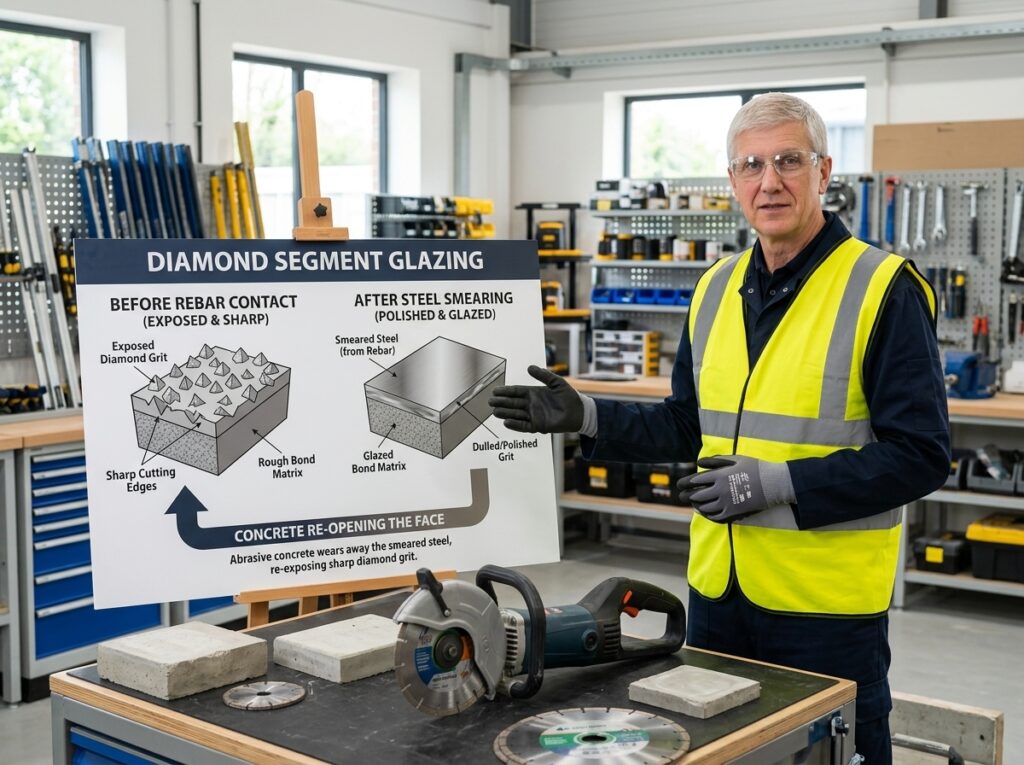
Expert Tip: When the blade slows at rebar, keep cutting into the concrete past the bar rather than backing off, so the abrasive concrete re-opens the diamond face within a few inches.
Debunking Reinforced Concrete Myths
Three myths keep costing people blades. First, a plain concrete blade is not enough for rebar. A blade rated for reinforced concrete has a bond and segment design that survives the steel smear. Second, backing off at steel is wrong; it leaves the face polished and the cut dead. Third, dry cutting accelerates glazing.
Knowing the mechanism, the next decision is whether to cut wet or dry.
Wet Versus Dry Cutting
The glazing mechanism points to the next decision: water or no water. “You’re not going to run that dry, are you?” a site supervisor asked me on a rebar-heavy slab. That one question said it all. What mattered was cooling and dust, not the blade’s marketing specs.
Wet cutting cools the blade and keeps steel from smearing diamonds into a glazed face. Water also controls silica dust, holding exposure below OSHA’s limit of 50 micrograms per cubic meter over an eight-hour shift. Dry cutting feels faster. It risks glazing, though and forces you to manage dust separately. For reinforced concrete, wet is the better call: it protects the bond matrix and extends blade life.
Expert Tip: Cut wet whenever possible. Water cools the rebar instantly, keeps diamonds from glazing and controls silica dust.
Product Recommendation: A wet cutting kit or water attachment delivers the cooling and dust control reinforced concrete demands.
With the blade and method chosen, the step-by-step technique comes next.
Step-by-Step Cutting Technique
Wet or dry decided, the technique is what keeps the blade alive.
Start with the scan. A rebar scanner or GPR detector maps the steel before you cut, so the blade meets rebar on your terms, not as a surprise.
Product Recommendation: Use a rebar scanner or GPR metal detector to map steel before you cut, so the blade meets rebar on your terms.
Then set depth. For full-depth cuts, size the blade to clear the slab in one pass so the sawn face stays clean and square.
Expert Tip: For full-depth cuts, size the blade to clear the slab in one pass so the sawn face stays clean and square.
Thick slabs get step-cut in 2-3 inch passes; a concrete chain-saw buying guide addresses chain-driven options for concrete cutting. Feed with steady, moderate pressure and reduce speed on harder concrete to avoid glazing.
Expert Tip: Feed with steady, moderate pressure. Too little glazes the diamonds, too much overloads the motor or deflects the blade.
On a car park slab in Leeds I pushed the saw hard into a rebar mat, thinking more pressure meant faster cutting. The blade slowed, glazed over and stopped biting. That mistake cost me a blade and an hour. The fix was counterintuitive: back off the pressure, let the blade find its pace and keep cutting into the concrete past the bar so the abrasive concrete re-opens the diamond face. Now I watch for that tell: a blade that slows at steel but recovers in concrete is working exactly as it should.
That tell is the whole game. When the blade slows at rebar, keep cutting into the concrete past the bar. The abrasive concrete re-opens the diamond face that the steel just smeared.
Expert Tip: Never force the blade sideways or push too hard. That causes segment loss and can warp the steel core.
DIY angle-grinder users work shallow, multi-pass cuts. Professional walk-behind saw operators take a full-depth single pass.
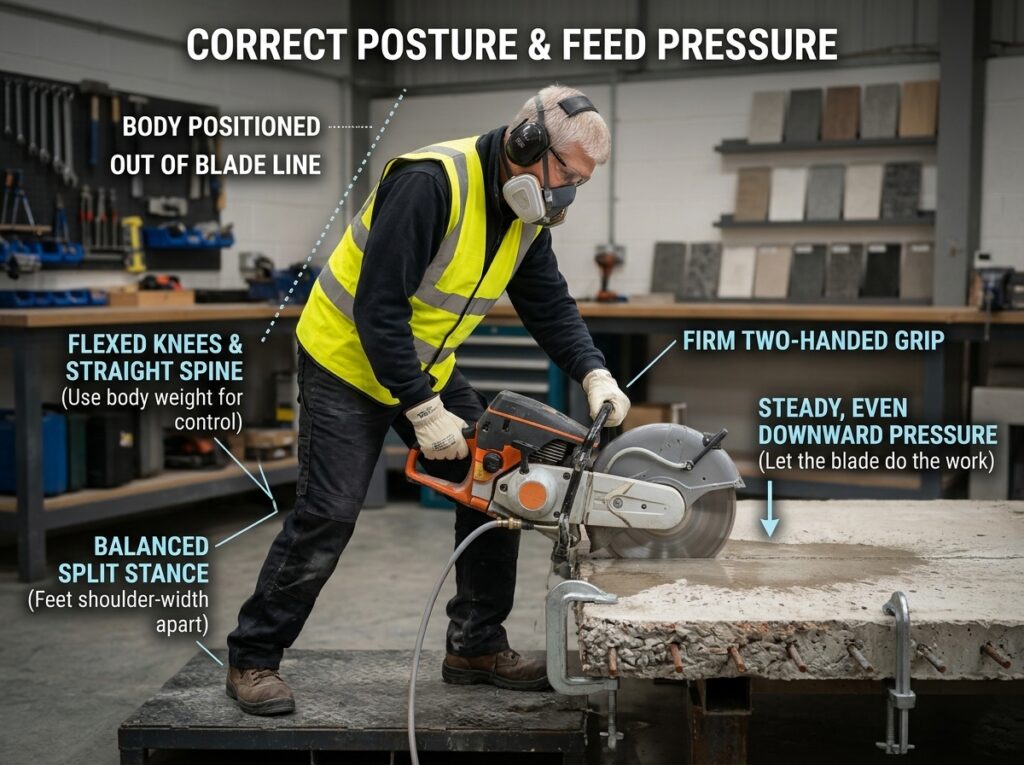
Product Recommendation: For reinforced concrete, a 9-inch angle grinder handles shallow cuts; switch to a petrol cut-off saw for deeper reinforced sections.
Before you cut, run through the diamond blade selection checklist to confirm the blade matches the job.
Blade Selection Checklist
Technique in hand, confirm the blade matches the job before you mount it. Four checks decide whether the cut goes clean or the blade glazes.
Match the rim to the material, a core choice covered in a diamond blade purchase guide. Reinforced concrete wants a segmented rim with a hard bond and an undercut-protected core. The abrasive concrete keeps re-opening the diamond face while the hard bond resists wearing away too fast. When rebar runs heavy, switch to a soft-to-medium bond with laser-welded segments; those welds survive heat that silver-brazed joints cannot.
Wet cutting earns its place on every reinforced pour. It pulls heat out of the bond matrix, extends blade life and knocks silica dust down before it reaches your lungs.
Check RPM compatibility against the tool’s rating including for gas and electric cut-off saws. Then inspect the blade before mounting.
Expert Tip: Inspect the blade before every use for cracks, missing segments or a warped core.
The slick patch on the segment told the story before I even spun the blade up. Running a thumb over the diamond face, I felt the mirror-smooth smear where steel had polished the diamond shut. That texture, on a car park slab job in Manchester meant the blade had hit more rebar than the bond could handle.
After enough reinforced pours, the check becomes automatic: segmented rim, hard bond for concrete that re-opens the diamond, soft-to-medium with laser-welded segments when the rebar runs heavy and wet cutting to keep the heat down. One thumb-swipe habit built over years of slab cuts has saved me more blades than any spec sheet.
Product Recommendation: Keep a dressing stone or abrasive block in the kit for quick blade touch-ups between jobs.
Interactive Blade-Selection Flow Chart
Start with the material. Plain concrete with no steel: segmented rim, hard bond, wet or dry depending on dust control. Reinforced concrete with light rebar: segmented rim, hard bond, wet cutting. Heavy rebar: soft-to-medium bond, laser-welded segments, wet cutting.
Depth steers the next call. Shallow cuts run fine on an angle grinder, while deep slabs step-cut in 2-3 inch passes on a cut-off saw. Tool type sets the blade diameter and RPM ceiling, so match the blade rating to the tool before you buy, including when using a circular saw for concrete.
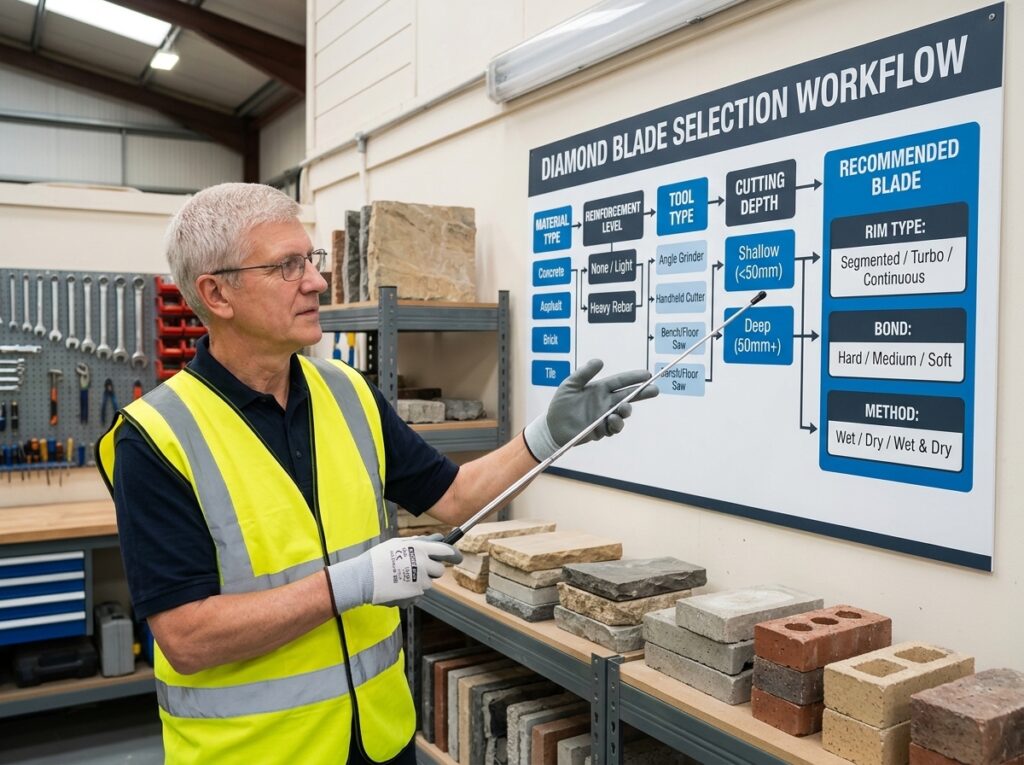
Blade selected, the last pre-cut step is safety and PPE.
Safety and PPE
Blade selected, the last pre-cut step is protecting yourself. Concrete dust is the hazard most people ignore until it’s too late. OSHA’s construction silica standard sets the limit at 50 micrograms per cubic meter over an 8-hour shift and dry-cutting reinforced concrete blows past that fast.
Product Recommendation: For reinforced concrete cutting, wear a P100 respirator, safety glasses, gloves and hearing protection.
He was coughing up grey phlegm the next morning, the fitter who ran dry cuts for a full 8-hour shift with nothing but a paper dust mask. That was the day I stopped treating silica as optional.
Kickback and flying debris are the physical hazards. Keep bystanders clear and hold a stable stance. Treat saw noise as a hearing hazard too; ear protection isn’t optional on a gas saw.
Expert Tip: Scan the slab with a rebar scanner or metal detector before cutting and get a structural engineer’s sign-off before cutting any structural reinforcement.
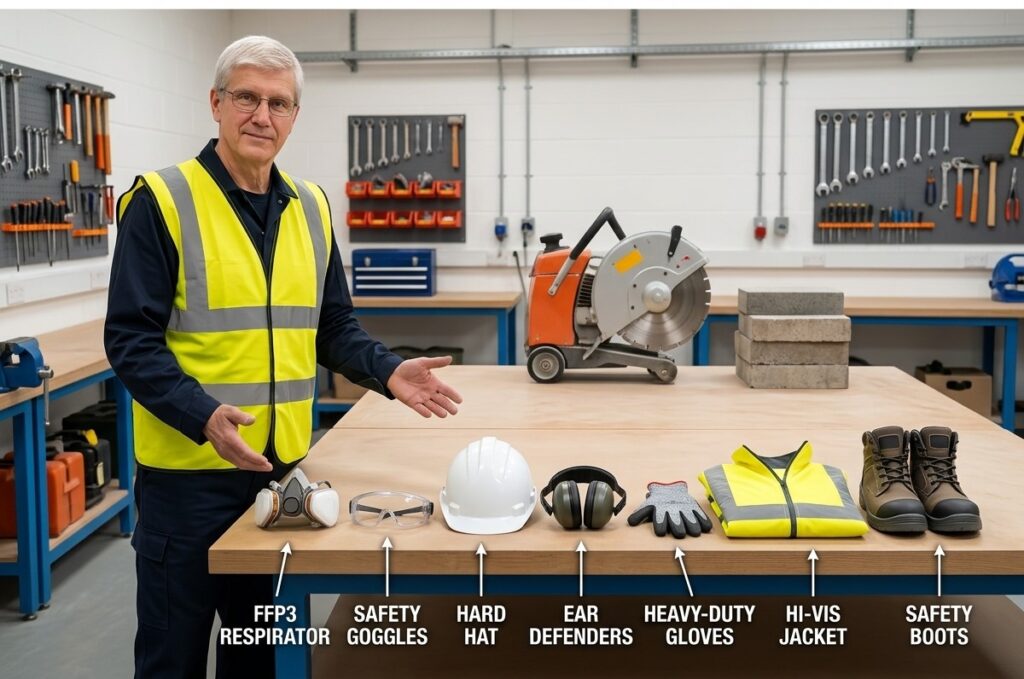
Even with the right blade and technique, problems happen. Here’s how to fix them.
Common Problems and Fixes
Even with the right blade and solid technique, problems happen. Here’s how to fix them.
Glazing is the most common failure I see on reinforced concrete. A polished diamond face stops cutting because the diamonds end up buried under smeared metal. Prevention is the fix: reduce speed on harder material and ease the feed pressure. When the blade stops biting, it’s glazed.
The blade stopped cutting halfway through a 6-inch reinforced slab on a basement extension job last autumn. The motor was spinning, the water flowing but the cut wasn’t advancing. I’d seen this exact failure on a retaining wall the previous spring and on a driveway patch before that.
Each time, the operator leaned into the feed, hit rebar and the diamond face polished over. The fix was backing off the pressure, dressing the face on an abrasive block and letting the concrete re-open the diamonds. That pattern repeats across enough jobs to tell me glazing is a technique failure, not a blade failure.
Expert Tip: Dress it on an abrasive block and ease feed pressure to restore bite diamond blade dressing methods cover ways to restore a glazed blade’s cutting face.
Product Recommendation: Keep a dressing stone or abrasive block on hand to de-glaze a polished blade and restore cutting speed.
Segment loss and core warping share a root cause: forcing the blade. Sideways pressure or driving it straight into rebar is the usual trigger. Keep the feed steady and moderate. Let the blade do the work.
Slow cutting is where most people reach for a new blade too fast. Check whether the bond matches the material and the rebar load before assuming one bond fits all; matching bond to material remains central to this choice. A blade that cuts slow in one concrete may be perfectly matched to another, which is why choosing a versatile diamond blade still starts with the material.
Overheating kills blades faster than wear does. Wet cutting and a steady feed keep the rim cool. Step-cut thick slabs in 2-3 inch passes so the blade never buries itself in hot, abrasive dust.
The technical claims in this guide rest on verifiable sources and hands-on expertise.
Sources, Credentials and Safety Compliance
The technical claims in this guide trace back to verifiable sources and hands-on jobsite work. OSHA 29 CFR 1926.1153 sets the silica permissible exposure limit at 50 micrograms per cubic meter as an 8-hour time-weighted average and that limit anchors the dust-control and PPE guidance throughout.